
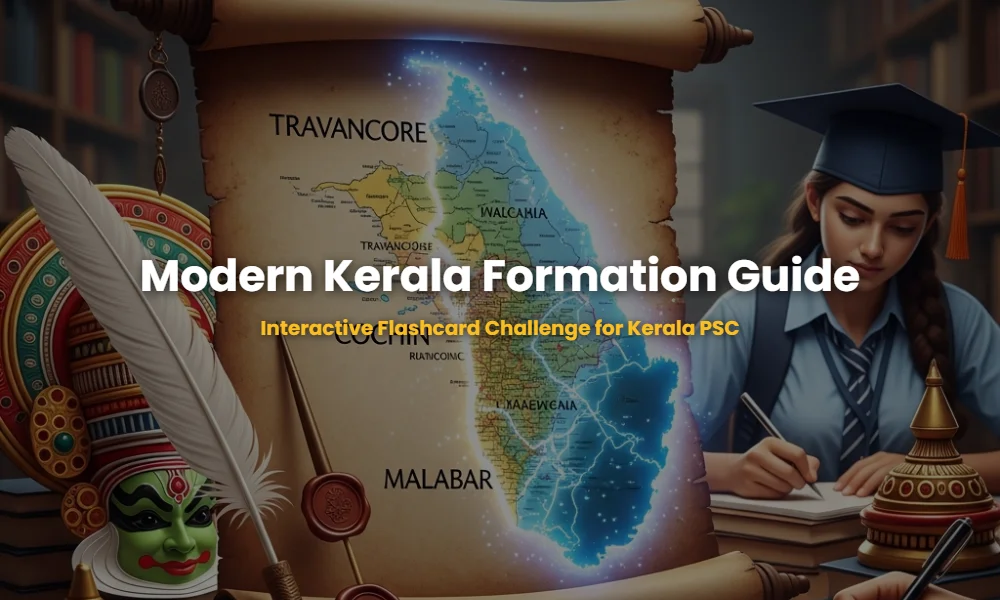
The Historical Journey to Modern Kerala
The evolution of Kerala from a fragmented collection of princely states and colonial territories into a unified linguistic state is a saga of diplomacy, resistance, and social reform. For aspirants of the Kerala PSC exam, understanding the historical events and treaties related to the formation of modern Kerala is paramount. This transformation wasn’t merely administrative; it was the culmination of centuries of socio-political movements and strategic colonial treaties that redefined the boundaries of the Malabar Coast.
🚀 Key Takeaways
- The Treaty of Seringapatam (1792) was the foundation of British Malabar.
- Velu Thampi Dalawa’s Kundara Proclamation marked the first major resistance against British hegemony.
- The Aikya Kerala Movement was driven by a linguistic identity that transcended princely borders.
- The State Reorganisation Act of 1956 finalized the modern borders of Kerala on November 1st.
What was the significance of the Treaty of Seringapatam in Kerala’s history?
The Treaty of Seringapatam (1792) was the decisive historical event that ceded the entire Malabar district from Tipu Sultan to the British East India Company. This treaty effectively ended the Mysorean dominance in the region and established British colonial sovereignty over Northern Kerala, which was subsequently governed as part of the Madras Presidency.
Following the defeat of Tipu Sultan in the Third Anglo-Mysore War, the British consolidated their power through various internal treaties with local rulers. In Central Kerala, the Treaty of Cochin (1791) made the Kingdom of Cochin a tributary of the British. Meanwhile, in the south, the Treaty of Perpetual Friendship (1795) signed by the King of Travancore further tightened the British grip. To succeed in the Kerala PSC History syllabus, students must differentiate between the direct rule in Malabar and the indirect rule (Subsidiary Alliance) in Travancore and Cochin.
| Treaty / Event | Year | Significance |
|---|---|---|
| Treaty of Seringapatam | 1792 | Ceding of Malabar to the British. |
| Treaty of 1805 | 1805 | Travancore became a subsidiary state. |
| Kundara Proclamation | 1809 | Revolt against British by Velu Thampi. |
Interactive Flashcard Challenge
Hover over the cards to reveal the historical facts! Perfect for quick revision.
How did the Kundara Proclamation influence the freedom struggle?
The Kundara Proclamation (1809) served as a seminal moment in the anti-colonial struggle in Kerala, being the first formal declaration of war against British dominance by a native administrative head. It articulated the fear that foreign rule would destroy the social fabric, religious traditions, and economic stability of the people, thereby galvanizing a massive popular uprising under Velu Thampi Dalawa.
Examining the Indian National Movement in Kerala reveals that these early sparks were not isolated. The Pazhassi Revolt in Malabar and the Kurichya Revolt (1812) were parallel streams of resistance. While Velu Thampi focused on political sovereignty, these tribal and local uprisings targeted the oppressive land revenue systems introduced by the British. For PSC aspirants, it is vital to note that while these revolts were suppressed, they laid the emotional foundation for the later organized nationalist movements.
💡 Expert Tip: Who was the British Resident during Kundara Proclamation?
Colonel Macaulay was the British Resident whose interference in the internal affairs of Travancore triggered Velu Thampi Dalawa’s resistance.
What led to the final unification of Kerala in 1956?
The final unification of Kerala was the result of the States Reorganisation Act of 1956, which was based on the recommendations of the Fazal Ali Commission. This act sought to reorganize Indian states along linguistic lines, leading to the merger of Malabar District (Madras Presidency), the state of Travancore-Cochin, and the Kasaragod taluk of South Canara into the modern state of Kerala.
Prior to this, the Integration of Travancore and Cochin occurred on July 1, 1949, with the Maharaja of Travancore serving as the Rajapramukh. The movement for Aikya Kerala (United Kerala) gained momentum through various conventions, starting from the one in Thrissur in 1947. Understanding the geographical landscape of Kerala today requires a deep understanding of these final border adjustments, including the transfer of four southern taluks (Kanyakumari area) to Madras State.
💡 Click to Reveal: First Governor & CM of Kerala
Governor: B. Ramakrishna Rao. Chief Minister: E.M.S. Namboodiripad (after the first assembly elections in 1957).
Conclusion: The Legacy of Treaties and Movements
The historical events and treaties related to the formation of modern Kerala highlight a complex transition from colonial subjugation to democratic statehood. For any PSC candidate, mastering the chronological order of these treaties—from Seringapatam in 1792 to the linguistic unification in 1956—is the key to scoring high in the Kerala History section.
Ready to Ace your Kerala PSC Prep?
Join our specialized mentorship program to get exclusive notes and mock tests on Kerala History!
💬 Chat with our Experts on WhatsApp (+91 9526806124)





Why were social reforms critical to the formation of modern Kerala?
Social reforms were the structural prerequisite for the formation of modern Kerala because they dismantled the rigid caste hierarchies that divided the Malayalam-speaking population. Movements like the Vaikom Satyagraha and the Temple Entry Proclamation created a sense of shared civic identity, which was essential for the eventual political unification of Malabar, Cochin, and Travancore.
The contributions of Travancore kings, particularly Chithira Thirunal Balarama Varma, cannot be overlooked. By issuing the Temple Entry Proclamation in 1936, Travancore became a model for the rest of India. This act, described by Mahatma Gandhi as a “miracle of modern times,” bridged the gap between different social strata and aligned the princely state with the broader goals of the Indian National Congress. This social cohesion made the Aikya Kerala demand more than just a linguistic claim; it became a demand for a progressive, egalitarian society.