
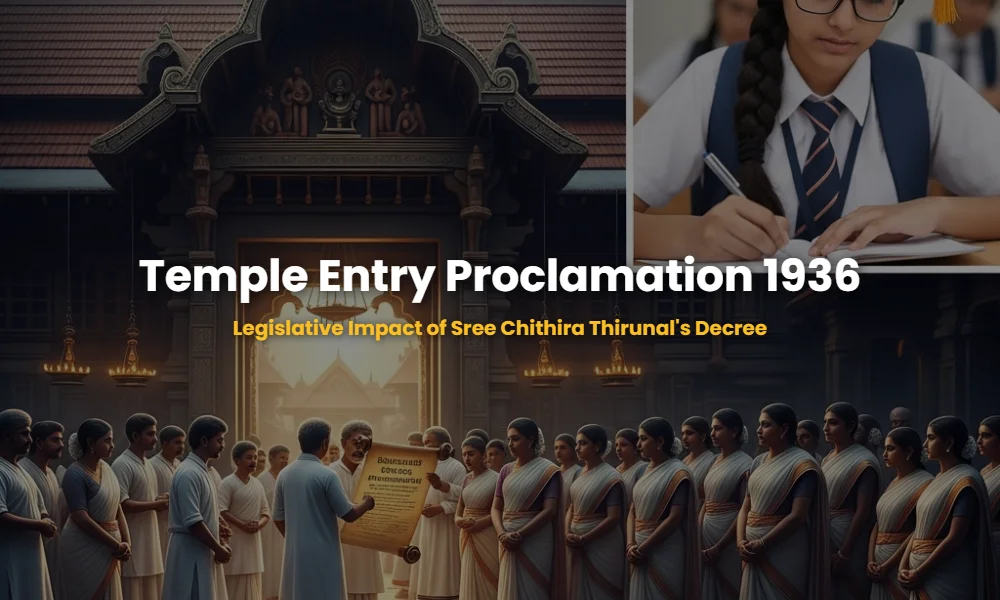
Introduction to the 1936 Proclamation
The Temple Entry Proclamation, issued on November 12, 1936, by Sree Chithira Thirunal Balarama Varma, the last ruling Maharaja of Travancore, remains the most significant landmark in the history of social reformation in Kerala. This legislative act abolished the centuries-old ban on ‘Avarnas’ or lower-caste Hindus from entering and worshipping in temples managed by the Travancore government.
🚀 Key Takeaways
- ✅ Date: November 12, 1936 (Malayalam Date: Thulam 27, 1112).
- ✅ Issued by: Sree Chithira Thirunal Balarama Varma.
- ✅ Key Advisor: Sir C.P. Ramaswami Iyer (Dewan of Travancore).
- ✅ Impact: Granted temple entry rights to all Hindus, regardless of caste.
- ✅ Historical Context: Followed the Vaikom and Guruvayur Satyagrahas.
What were the legislative achievements of the 1936 Proclamation?
The legislative achievements of the Temple Entry Proclamation involved the formal dismantling of caste-based discrimination in religious spaces through a royal decree. It fundamentally altered the Travancore Devaswom Board’s administrative bylaws, ensuring that no Hindu was denied entry to shrines based on their birth or lineage, thus setting a legal precedent for future civil rights.
From a Static GK perspective, candidates should understand the specific legal maneuvers taken by the Travancore state:
- The Royal Decree: It was not just a suggestion but a binding law that applied to all state-maintained temples.
- End of Customary Law: It effectively nullified ‘Theendari’ (pollution) customs that were legally recognized until then.
- Institutional Reform: The Devaswom Department underwent restructuring to accommodate the change in worshipper demographics.
💡 Examiner’s Pro-Tip: The ‘C.P.’ Connection
Sir C.P. Ramaswami Iyer is often credited with the drafting and strategic timing of the proclamation. He realized that the mass conversion movement (especially towards Christianity) among Ezhavas posed a threat to the Hindu monarchy, making this reform a political necessity as much as a social one.
How did the Proclamation impact the social fabric of Kerala?
The social impact of the Temple Entry Proclamation was revolutionary, acting as a catalyst for the total integration of marginalized communities into the mainstream Hindu fold. It boosted the self-respect of the ‘depressed classes,’ halted mass religious conversions, and triggered similar movements in Cochin and Malabar, ultimately unifying the Malayali identity across caste barriers.
Key social outcomes included:
- Spiritual Equality: For the first time, ‘Avarnas’ could walk the same paths and pray at the same altars as ‘Savarnas’.
- Educational and Political Momentum: Social equality in temples naturally transitioned into demands for better representation in the Travancore government.
- Gandhian Influence: Mahatma Gandhi hailed the proclamation as a ‘miracle of modern times’ and a ‘spiritual charter’.
| Feature | Pre-1936 Status | Post-1936 Status |
|---|---|---|
| Temple Access | Restricted to Savarnas only | Universal for all Hindus |
| Pollution Concept | Strict adherence to distance pollution | Legally abolished within temples |
| Conversion Rates | High (seeking social dignity) | Significant decline |
What were the historical precursors to this achievement?
The Temple Entry Proclamation was the culmination of decades of struggle led by social reformers and the masses. Key events like the Vaikom Satyagraha (1924-25) and the Guruvayur Satyagraha (1931-32) created the necessary public pressure and national awareness that forced the Travancore monarchy to act.
Key milestones leading to the proclamation:
- 1888: Aruvipuram Consecration by Sree Narayana Guru.
- 1924: Vaikom Satyagraha for the right to use temple roads.
- 1931: Guruvayur Satyagraha under K. Kelappan.
- 1932: Appointment of the Temple Entry Enquiry Committee.
💡 Static GK Fact: Who was the chair of the Temple Entry Committee?
The Temple Entry Enquiry Committee (1932) was chaired by V.S. Subramania Iyer. Its report was pivotal in convincing the Maharaja of the public’s readiness for change.
Interactive Static GK Quiz: Test Your Knowledge
Answer these questions to see how well you have mastered the Temple Entry Proclamation of 1936.
View Answer
Mahatma Gandhi
View Answer
November 12, 1936
View Answer
Sree Chithira Thirunal Balarama Varma
Expert Guidance for Kerala PSC Candidates
Focus on the specific dates and personalities for Prelims. For Mains, practice writing about the Socio-Political necessity of the reform. The role of Sree Narayana Guru‘s philosophy in setting the stage is frequently asked.
Need more Static GK notes or Mock Tests?
Get personalized guidance from top Kerala PSC experts today!
💬 Chat with our Experts on WhatsApp (+91 9526806124)




