
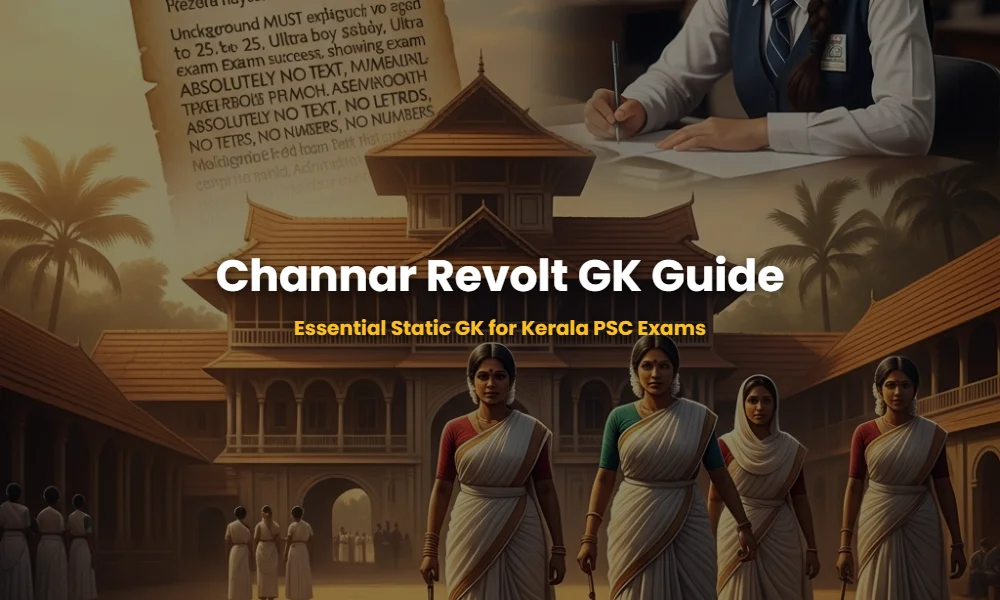
Why was the Channar Revolt significant in Kerala’s history?
The Channar Revolt, also known as the Upper Cloth Revolt or Melmundu Samaram, was the first organized social protest in Kerala’s history against caste-based discrimination. Occurring in the 19th century in the Princely State of Travancore, it challenged the oppressive dress codes that forbade lower-caste women from wearing clothes above the waist.
🚀 Key Takeaways
- Primary Objective: The right of Channar (Nadar) women to wear upper garments.
- Major Milestone: The Royal Proclamation of July 26, 1859, by Maharaja Uthram Thirunal.
- Key Influence: Vaikunda Swamikal and Christian missionaries (LMS).
- Phase 1: Started in 1822 following the arrival of Colonel Munro and missionary activity.
- LSI Relevance: Essential for Social Reformers of Kerala and PSC history modules.
Table of Contents
What was the core of the Channar Revolt?
The Channar Revolt was a series of protests between 1822 and 1859 in Travancore where the Nadar community fought for the legal right of their women to cover their upper bodies with a cloth, a privilege then reserved exclusively for higher-caste women like Brahmins and Nairs. It was a pivotal Kerala PSC history topic representing the fight for bodily autonomy.
In the rigid caste hierarchy of the 19th century, clothing was a marker of social status. Lower-caste women were prohibited by law and custom from wearing upper garments. However, with the arrival of the London Missionary Society (LMS) and the influence of Christian conversion, many Nadar women began wearing long jackets (Kuppayam), which sparked violent opposition from the upper castes.
💡 Examiner’s Pro-Tip: The ‘Kuppayam’
Initially, converted Channar women were allowed to wear the ‘Kuppayam’ (a long jacket). The conflict escalated when they began wearing the ‘Melmundu’ (upper cloth) over it, mimicking the attire of upper-caste women.
Timeline of the Upper Cloth Struggle
The Channar Revolt took place in three distinct phases, spanning nearly four decades, ultimately forcing the Travancore government to intervene under British pressure. Understanding these phases is crucial for mastering Static GK Kerala questions regarding social movements.
- 1813: Colonel John Munro, the British Resident, issued an order allowing converted Christian Channar women to wear jackets (Kuppayam).
- 1822-1823: The first phase of violence broke out in Kalkulam and Eraniel when Channar women began appearing in public with upper cloths.
- 1829: Maharaja Swathi Thirunal issued a proclamation reinforcing that Channar women should not wear upper cloths like the Nairs, but could wear the jacket.
- 1858-1859: The final and most violent phase. Riots erupted across South Travancore, leading to the burning of schools and churches.
How did Vaikunda Swamikal influence the movement?
Vaikunda Swamikal provided the spiritual and ideological backbone for the Channar Revolt by preaching the radical equality of all human beings and encouraging the Nadar community to defy caste-based dress restrictions. His teachings of ‘Ayya Vazhi’ and the slogan “One Caste, One Religion, One God” (pre-dating Sree Narayana Guru) empowered the marginalized.
Vaikunda Swamikal was the first to organize a Samatwa Samajam (Society for Equality) in 1836. He urged his followers to wear head-gear (Urumal) and upper cloths as a symbol of dignity, which directly fueled the Channar’s resolve during the mid-19th-century clashes.
The Royal Proclamation of 1859
The Royal Proclamation of July 26, 1859, was the historic decree issued by Maharaja Uthram Thirunal that officially granted Channar women the right to cover their upper bodies, though with a restriction that they should not imitate the exact style of the high-caste Nair women. This was the final legal victory for the Travancore history reform movement.
This proclamation was largely the result of intense pressure from the Madras Governor, Sir Charles Trevelyan, and the British Resident. The British threatened to intervene directly if the Travancore state did not protect the human rights of its subjects, marking a significant instance of British ‘Paramountcy’ aiding social reform.
| Year | Authority | Key Decision/Outcome |
|---|---|---|
| 1813 | Colonel Munro | Permission for converted women to wear jackets. |
| 1829 | Swathi Thirunal | Reaffirmed the ban on ‘Melmundu’ but allowed jackets. |
| 1859 | Uthram Thirunal | Granted right to wear upper cloth (with conditions). |
| 1865 | Ayilyam Thirunal | Extended rights to all lower-caste women. |
Detailed Facts for Kerala PSC (Static GK)
- Alternative Names: Channar Lahala, Melmundu Samaram, Upper Cloth Revolt.
- Location: Primarily South Travancore (Kanyakumari, Neyyattinkara).
- London Missionary Society (LMS): The missionary group that supported the Channars. Charles Mead was a prominent missionary leader.
- Lord Harris: The Madras Governor who initially pressured the Maharaja in 1858.
- Sir Charles Trevelyan: The Madras Governor during the 1859 Proclamation.
- Vaikunda Swamikal’s Birth Name: Mudichoodum Perumal (later changed to Muthukutty).
- Important Slogan: “Vaikunda Swamikal called the British rule ‘Neecha Rule’ and the Travancore rule ‘Ananthapuri Neecha Rule’.”
- July 26, 1859: The specific date of the Royal Proclamation.
Frequently Asked Questions
❓ Who was the Maharaja of Travancore during the 1859 Proclamation?
Maharaja Uthram Thirunal (1846–1860) was the ruler who issued the final Royal Proclamation on July 26, 1859.
❓ Which missionary was instrumental in the Channar Revolt?
Charles Mead of the London Missionary Society (LMS) played a vital role in advocating for the rights of the Nadar community and reporting grievances to the British Resident.
❓ What was the immediate cause of the 1858 phase of the revolt?
The immediate cause was the increasing physical attacks on Channar women in public markets for wearing the Melmundu, coupled with the state’s refusal to acknowledge their right to dress with dignity despite missionary interventions.
Need help with Kerala PSC Static GK?
Our expert mentors are here to guide you through the complex history of Kerala’s social reforms and other important PSC topics.
💬 Chat with our Experts on WhatsApp (+91 9526806124)




