
Introduction
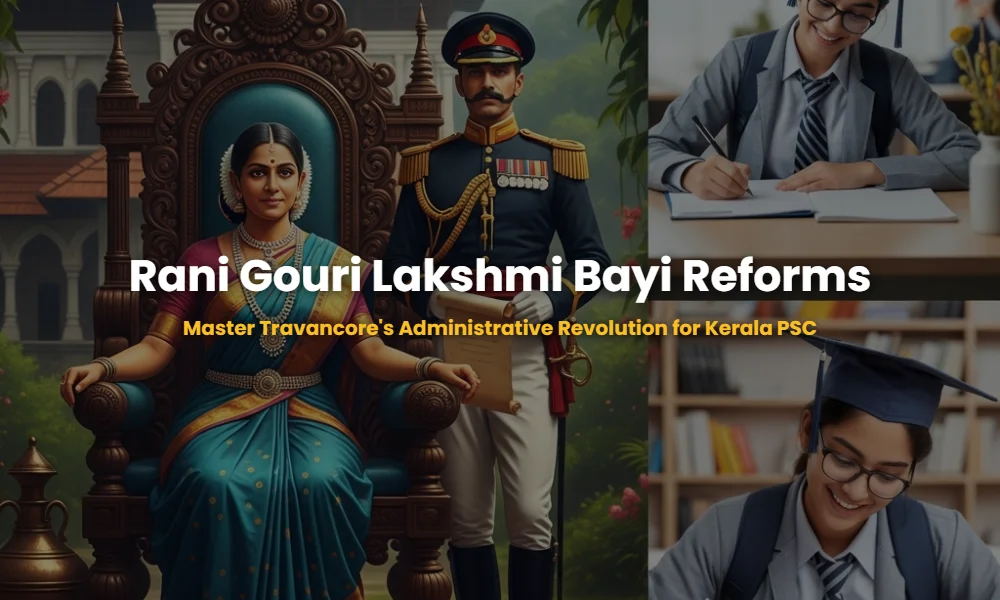
Rani Gouri Lakshmi Bayi (1810–1815) was a trailblazing regent of Travancore whose brief yet impactful reign laid the foundation for modern administration in the state. Stepping into power during a time of political instability and financial crisis, her collaboration with the British Resident, Colonel John Munro, who also served as the Diwan, resulted in a series of radical Static GK milestones. These reforms shifted the state from a medieval feudal structure to a rule-of-law-based modern bureaucracy.
🚀 Key Takeaways
- Judicial Reform: Separation of the judiciary from the executive for the first time.
- Revenue Modernisation: Introduction of the ‘Kandelzhuthu’ (land survey) and systematic tax collection.
- Social Milestone: The historic abolition of the slave trade in 1812.
- Administrative Restructuring: Organizing the state into Taluks and Proverthies.
- Temple Governance: Bringing major temples under government control (Deceased Department).
Table of Contents
How did Rani Gouri Lakshmi Bayi revolutionize the judicial system?
The judicial reforms of Rani Gouri Lakshmi Bayi, guided by Colonel Munro, ended the era of local chieftains acting as judges. She established a hierarchical system consisting of five Zilla (District) Courts and a Huzur Court (Appellate Court) at the capital, effectively separating judicial functions from the executive department to ensure impartial justice.
Before this period, judicial powers were vested in the hands of the Kariakkars (local administrators) who were often corrupt or lacked legal training. In 1811, five Zilla Courts were established at Padmanabhapuram, Thiruvananthapuram, Mavelikkara, Vaikom, and Aluva. The Huzur Court acted as the supreme judicial authority, presided over by the Diwan himself.
💡 Examiner Pro-Tip: Judicial Origins
Kerala PSC often asks about the ‘First organized judicial system in Travancore’. Remember: It was under Rani Gouri Lakshmi Bayi with the help of Col. Munro. The court system was modeled on the English pattern but adapted to local customs.
What were the key revenue reforms during the regency of Rani Gouri Lakshmi Bayi?
The revenue reforms focused on standardizing land taxes and eliminating arbitrary levies. The most significant measure was the Kandelzhuthu (land survey) which accurately recorded land holdings to prevent exploitation, alongside the abolition of several oppressive and minor taxes that burdened the common peasantry and traders.
The state’s finances were in disarray due to the tribute owed to the British East India Company. Modern Travancore history highlights how Munro and the Rani streamlined the treasury. They introduced a systematic method of accounting and audit. This period also saw the centralization of salt and tobacco monopolies, which became the primary sources of revenue for the state treasury.
Key Land & Revenue Milestones:
- Kandelzhuthu: A scientific survey of coconut trees and pepper vines to fix tax fairly.
- Tax Remission: Abolition of around 300 petty and vexatious taxes (known as ‘Chillara Kasu’).
- Salaries: Government officials were given fixed monthly salaries in cash instead of land grants, reducing corruption.
Why was the 1812 Proclamation regarding slavery so historic for Static GK?
In 1812, Rani Gouri Lakshmi Bayi issued a royal proclamation abolishing the slave trade in Travancore. This was a monumental social reform that preceded many similar movements in Europe and India, making it illegal to buy or sell human beings as commodities in the kingdom.
Though full-scale slavery (serfdom) was not totally abolished until 1853-55, the 1812 decree was the first official strike against the inhuman practice. This reform was deeply influenced by the humanitarian values of Christian missionaries and Colonel Munro’s personal convictions. It specifically targeted the trade of slaves who were often kidnapped or sold during famines.
How did the regency modernize the administrative structure of the state?
Administrative modernization involved the restructuring of the state into Taluks and Proverthies, overseen by Tahsildars and Proverthicars respectively. This replaced the inefficient local chieftain system and placed the entire administration under the direct control of the central secretariat, known as the Huzur Cutcherry.
One of the most controversial yet effective administrative moves was the Assumption of Devaswoms in 1811. Nearly 348 wealthy temples were brought under the control of the state government. The revenue from these temples was directed to the state treasury, while the government took responsibility for the conduct of rituals and the upkeep of the temples.
| Administrative Unit | Officer In-Charge | Key Reform |
|---|---|---|
| Taluk | Tahsildar | Revenue collection & law order |
| Proverthy | Proverthicar | Village level administration |
| Central Secretariat | Diwan | Shifted to Huzur Cutcherry |
Frequently Asked Questions (FAQs)
Who was the Diwan during Rani Gouri Lakshmi Bayi’s regency?
Colonel John Munro served as both the British Resident and the Diwan of Travancore during her reign (1810-1815).
What is ‘Kandelzhuthu’?
It was a detailed land and garden survey introduced by Rani Gouri Lakshmi Bayi to fix land revenue based on the actual number of trees (coconut, areca, etc.) and land productivity.
When was the slave trade abolished in Travancore?
The royal proclamation abolishing the slave trade was issued by Rani Gouri Lakshmi Bayi in 1812.
Expert Tip: For the Kerala PSC exam, focus on the specific years and the dual role of Colonel Munro. The ‘Assumption of Devaswoms’ is a recurring question in descriptive papers.
Need Personalized Guidance for Kerala PSC?
Our experts are here to help you navigate through the complex history of Travancore and other Static GK topics.
💬 Chat with our Experts on WhatsApp (+91 9526806124)




