
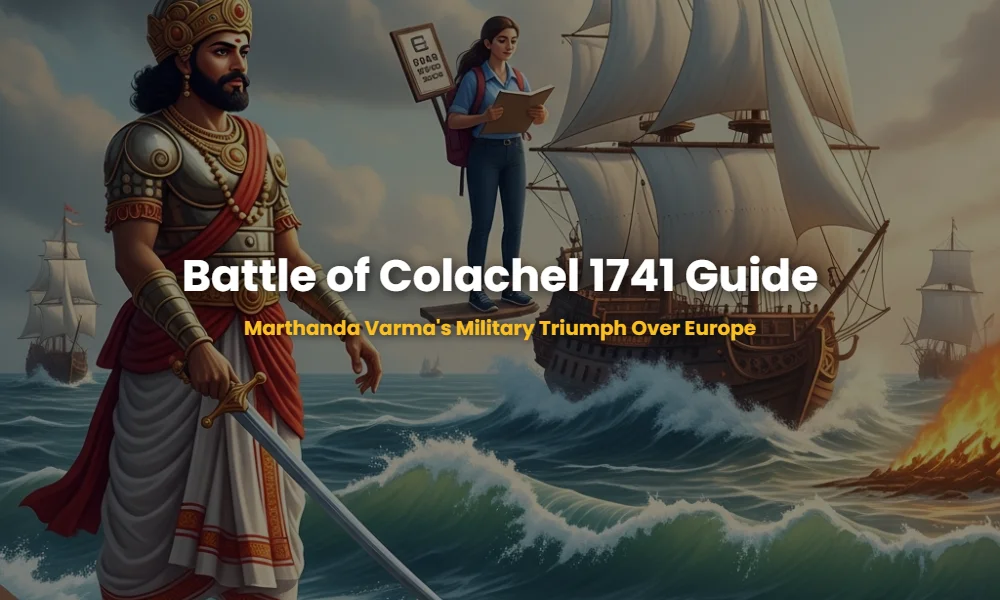
The Battle of Colachel 1741: A Landmark in Static GK
The Battle of Colachel (1741) remains one of the most significant military engagements in Indian history. It was the first time an Asian power decisively defeated a superior European naval force, specifically the Dutch East India Company (VOC). This victory by King Marthanda Varma of Travancore not only preserved the sovereignty of his kingdom but also altered the course of colonial history in the Indian subcontinent.
🚀 Key Takeaways for Kerala PSC
- Date of Battle: August 10, 1741 (Aadi 27, 916 ME).
- Key Protagonist: Anizham Thirunal Marthanda Varma, the architect of modern Travancore.
- Opponent: The Dutch East India Company (Vereenigde Oost-Indische Compagnie – VOC).
- Significance: First Asian victory over a European naval power.
- Aftermath: Capture of Eustachius De Lannoy and the eventual modernization of the Travancore army.
- Treaty: Treaty of Mavelikkara (1753) followed the long-term impact of this victory.
📑 Table of Contents
What led to the conflict between Travancore and the Dutch?
The conflict arose primarily due to the Dutch East India Company’s attempt to maintain a monopoly over the pepper trade in Malabar, which Marthanda Varma challenged by annexing neighboring spice-producing principalities like Desinganadu and Elayadathu Swaroopam. The Dutch feared that Marthanda Varma’s expansion would end their commercial dominance in the region.
Marthanda Varma, who ascended the throne in 1729, began a systematic consolidation of Kerala. He realized that economic independence was tied to the control of the spice trade. When the Dutch Governor of Ceylon, Gustaaf Willem van Imhoff, threatened to invade Travancore if the King didn’t stop his expansion, Marthanda Varma famously replied that he would invade Europe with his fishermen’s boats. This set the stage for the History of Travancore to enter a phase of open warfare with the Dutch.
What were the core military strategies used by Marthanda Varma?
Marthanda Varma utilized a combination of scorched earth policies, local intelligence, and superior positioning of his infantry to counter the Dutch naval superiority. By blocking land-based supply routes and utilizing the monsoon weather to trap Dutch ships, he neutralized the European advantage in heavy artillery and naval maneuvers.
1. The Scorched Earth Policy
Marthanda Varma ensured that the Dutch forces landing at Colachel found no local resources. Provisions were moved inland, and wells were often protected or diverted, forcing the Dutch to rely entirely on their ships for supplies, which were vulnerable to the rough Arabian Sea.
2. Integration of Kalaripayattu and Modern Drill
While the Dutch relied on flintlock muskets, the Travancore army used a mix of traditional Kalaripayattu trained shock troops and an infantry that was slowly being disciplined in modern formation. The agility of the Nair Pattalam (Nair Brigade) allowed for rapid guerrilla strikes in the marshy terrain of southern Kerala.
3. Intelligence and Espionage
The King’s prime minister, Ramayyan Dalawa, established an extensive network of spies. They monitored Dutch movements from the moment they sailed from Ceylon (Sri Lanka) and Tuticorin, allowing the Travancore forces to fortify Colachel before the main Dutch landing could be consolidated.
💡 Examiner Tip: Why is Ramayyan Dalawa important?
In Kerala PSC exams, Ramayyan Dalawa is often cited as the administrative and military genius behind Marthanda Varma. His coordination during the Battle of Colachel was pivotal to the victory.
How did the Battle of Colachel unfold in 1741?
The Battle of Colachel unfolded over several months, culminating in August 1741. The Dutch forces under Captain Eustachius De Lannoy landed at Colachel in February 1741 and began a blockade. However, the Travancore army successfully besieged the Dutch garrison, leading to their total surrender after a gunpowder explosion in the Dutch camp.
Timeline of Events:
- Nov 1740: Dutch ships arrive at Colachel and begin shelling the coast.
- Feb 1741: Dutch forces land and establish a fortified position at Colachel, capturing nearby villages.
- May 1741: Marthanda Varma reaches the south with his main army after dealing with local rebels.
- June-July 1741: The “Monsoon Siege.” Heavy rains prevent Dutch reinforcements from Ceylon. Travancore forces cut off Dutch supply lines from the land.
- August 5-10, 1741: Intensive fighting. A lucky strike (or planned sabotage) ignites the Dutch gunpowder store on August 7th.
- August 10, 1741: The Dutch surrender. 24 Europeans are taken as prisoners, including Eustachius De Lannoy.
Comparative Analysis: Travancore vs. The Dutch VOC
| Feature | Travancore Kingdom | Dutch East India Company |
|---|---|---|
| Leadership | Marthanda Varma & Ramayyan Dalawa | Eustachius De Lannoy & Van Imhoff |
| Primary Weaponry | Swords, Bows, Matchlock Muskets | Flintlock Muskets, Heavy Naval Cannons |
| Naval Strength | Minimal (Small Coastal Boats) | Superior (Galleons and Frigates) |
| Strategic Advantage | Knowledge of Terrain & Monsoon timing | Superior Firepower & Global experience |
| Outcome | Decisive Victory; Captured Prisoners | Total Defeat; Loss of Trade Monopoly |
How did Eustachius De Lannoy influence Travancore after his defeat?
Following his capture, Eustachius De Lannoy joined the service of Marthanda Varma and rose to become the ‘Valia Kappithan’ (Great Captain). He played a crucial role in modernizing the Travancore army by introducing European-style military drill, constructing the Udayagiri Fort, and establishing a modern gunpowder factory.
De Lannoy’s contribution was vital for the subsequent defense of Travancore against other invaders like Hyder Ali and Tipu Sultan. He helped build the Nedumkotta (Travancore Lines), a massive fortification wall that served as a northern barrier for the kingdom. To learn more about regional defenses, check out our guide on Forts of Kerala.
Static GK Quiz: Test Your Knowledge
❓ Which treaty ended Dutch influence in Kerala permanently?
The Treaty of Mavelikkara signed in 1753. Under this treaty, the Dutch agreed to stay out of the internal politics of Kerala and ceased to support local rulers against Travancore.
❓ What is the Colachel Victory Pillar?
It is a commemorative pillar erected at Colachel (now in Kanyakumari district, Tamil Nadu) to mark the victory of Marthanda Varma over the Dutch. It still stands today as a testament to Indian military prowess.
❓ Who was the Dutch Governor who threatened Marthanda Varma?
Gustaaf Willem van Imhoff. His arrogance and threats were a direct catalyst for the war.
Need help with Kerala PSC Preparation?
Our experts provide free guidance, mock tests, and detailed Static GK notes to help you crack the LDC, VEO, and KAS exams.
💬 Chat with our Experts on WhatsApp (+91 9526806124)




