
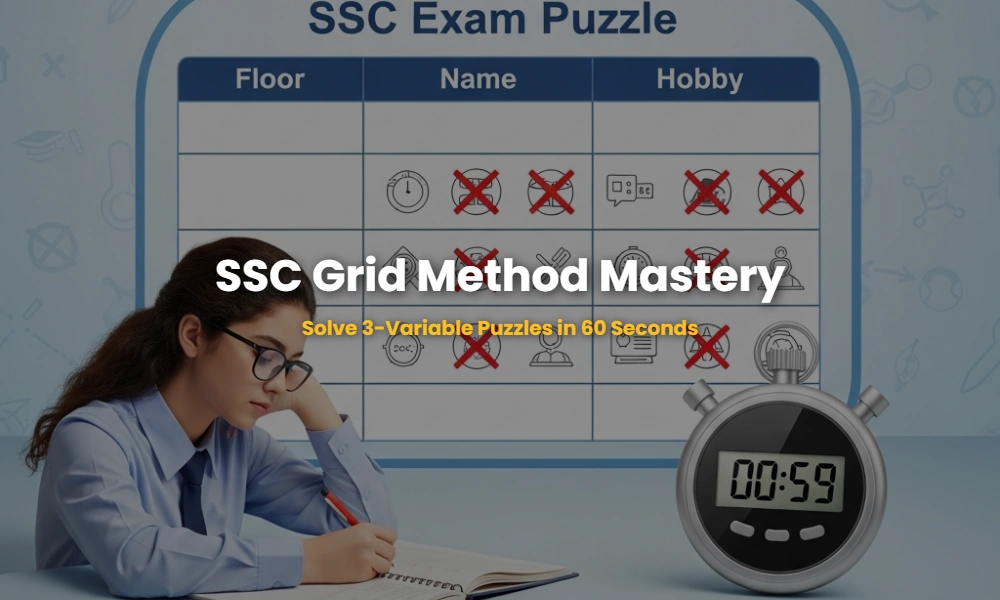
The reasoning section of the SSC CGL, CHSL, and CPO exams has evolved from simple linear arrangements to complex multi-dimensional puzzles. To stay ahead of the competition, candidates must transition from traditional hit-and-trial methods to the quick-reference grid method. This technique specifically targets 3-variable puzzles—such as floors, people, and their respective hobbies or professions—allowing for a visual synthesis of data that minimizes cognitive load and maximizes speed.
🚀 Key Takeaways
- Visualization Power: Grids allow you to see all possibilities simultaneously, preventing the need to re-read the question.
- Elimination Speed: Using ‘X’ marks for negative data instantly narrows down the search space.
- Variable Integration: Manage floor numbers, names, and a third variable (like colors or cities) in one unified structure.
- Time Management: Aim to complete the grid setup in 15 seconds and deduction in 45 seconds.
Table of Contents
What is the Quick-Reference Grid Method for SSC?
The quick-reference grid method is a logical mapping technique where variables are cross-referenced in a matrix to solve multi-layered puzzles. It involves creating a skeletal structure where fixed positions (like floor numbers) are rows, and dynamic variables (names and attributes) are columns, enabling rapid deduction through visual elimination.
In the context of SSC reasoning strategy, this method is superior because it handles conflicting data points with ease. When a puzzle states “A does not live on the 5th floor and does not like Red,” a grid allows you to mark those specific cells as invalid immediately, leaving the remaining cells as high-probability candidates for the correct answer.
How do you construct the Anatomy of a 3-Variable Puzzle Grid?
A 3-variable grid consists of a primary vertical axis representing the constant variable (e.g., floors 1-7) and multiple horizontal columns for the dependent variables (e.g., Name, Color, Profession). This tabular format ensures that every piece of information provided in the prompt has a dedicated slot for entry.
To master floor puzzles, you must identify which variable is “fixed.” For instance:
- Fixed Variable: Floor Number (1, 2, 3…).
- Variable 1: Person’s Name (A, B, C…).
- Variable 2: Additional Attribute (Apple, Banana, Orange…).
💡 Click to Reveal: The “Possibility Column” Trick
Always leave a small ‘Notes’ column on the right side of your grid. Use this to jot down relative statements like “B is two floors above A” which cannot be placed immediately in the main grid but are crucial for later deduction.
What is the Step-by-Step Execution Strategy for SSC Puzzles?
The execution strategy involves three phases: Scanning, Mapping, and Filling. First, scan for ‘Definite Information’ (e.g., “A lives on Floor 4”), then map ‘Negative Constraints’ (e.g., “B is not on Floor 2”), and finally use ‘Relative Clues’ to bridge the gaps between variables until the grid is complete.
Follow these steps to break the 60-second barrier:
- Identify the Constant: Always pick the most stable element (Floor number, Day of the week, or Rank) as your row headers.
- The Definite Fill: Look for words like “Exactly,” “Only,” or specific floor numbers. Place these in the grid first.
- The Negative Filter: Use a small ‘x’ to mark what is NOT possible. If the puzzle says “C does not like Blue,” put an ‘x’ in C’s row under the Blue column.
- The Linker Method: Look for common entities between clues. If Clue 1 mentions A and B, and Clue 4 mentions B and C, link them to place B precisely.
| Feature | Traditional Method | Quick-Reference Grid |
|---|---|---|
| Data Clarity | Scattered notes | Centralized visual map |
| Error Risk | High (missing clues) | Low (all clues in grid) |
| Speed | 2-3 Minutes | Under 60 Seconds |
| Complexity | Struggles with 3+ variables | Handles 3-5 variables easily |
What are the Common Pitfalls to Avoid in 3-Variable Puzzles?
Common pitfalls include misinterpreting “between” (not knowing if it implies immediate adjacency), ignoring negative constraints until the end, and failing to create parallel grids for multiple possibilities. Avoiding these errors requires rigorous practice with SSC mock tests that emphasize deductive logic.
Experts often highlight the “Either-Or” trap. If the puzzle says “Either A or B lives on the top floor,” do not guess. Instead, create two tiny sub-grids (Cases) and proceed until one contradicts itself. This is often faster than staring at a single grid trying to force a fit.
⚠️ Red Flag: “Only One Person Between…”
In SSC, if the puzzle says “There is only one person between A and B,” it means there is exactly one floor/seat separating them. It does NOT specify if A is above B or B is above A unless stated otherwise. Always account for both directions in your grid logic.
Expert Tips for Sub-60 Second Execution in SSC Exams
To achieve sub-60 second execution, candidates must develop ‘Muscle Memory’ by solving at least 50 grids during preparation. Focus on using shorthand (e.g., ‘R’ for Red, ‘Eng’ for Engineer) and maintain a clean, organized workspace on your rough sheet to avoid reading your own handwriting incorrectly.
In the high-pressure environment of the SSC computer-based test, your rough sheet is your best friend. Divide it into quadrants. Dedicate one quadrant solely to the 3-variable grid. By isolating the logic from other mathematical calculations, you reduce the risk of “visual noise” that slows down your brain’s processing speed.
Remember: The goal isn’t just to solve the puzzle, but to solve it fast enough to leave time for the Quantitative Aptitude section. The grid method is the only scalable way to ensure consistency across different difficulty levels of SSC exams.
Struggling with Complex SSC Reasoning?
Our expert mentors can help you master grid logic, syllogisms, and coding-decoding in record time. Don’t let 3-variable puzzles hold you back!
💬 Chat with our Experts on WhatsApp (+91 9526806124)




