
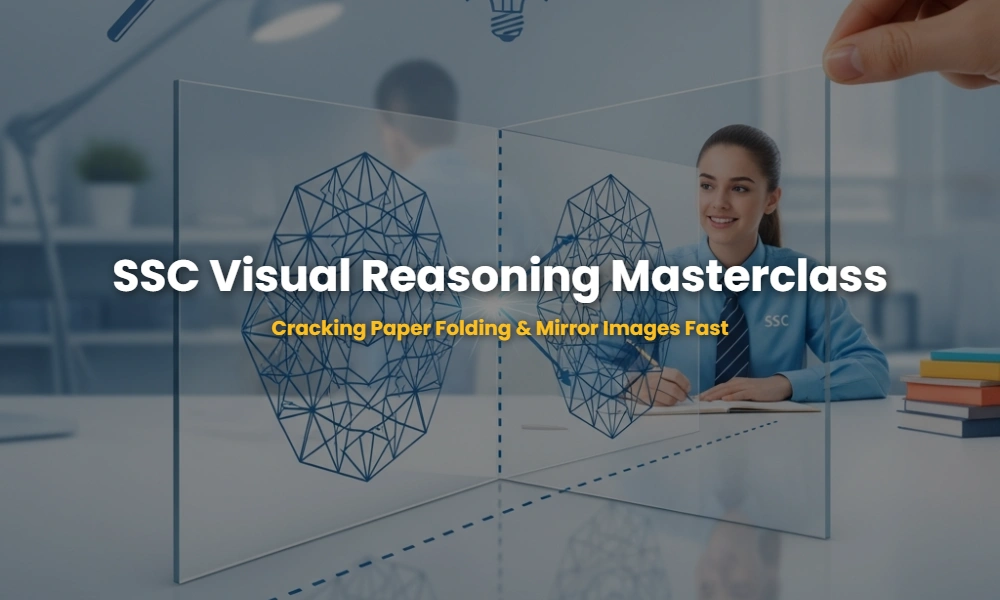
Mastering the Visual Elimination Method for SSC Reasoning
In the high-stakes environment of the SSC CGL, CHSL, and MTS exams, speed and accuracy are the twin pillars of success. Among the various sections, Non-Verbal Reasoning—specifically Paper Folding and Mirror Image questions—often determines the difference between a top ranker and an average candidate. While these questions look simple, they are designed to test your spatial visualization and logical symmetry. But what if you could solve them without even drawing a single line? That is where the Visual Elimination Method comes into play.
🚀 Key Takeaways
- ✅ Rule of Proximity: Elements closest to the fold/mirror line remain closest in the image.
- ✅ Mirror vs. Water Image: Vertical folds act as mirrors (left-right flip); horizontal folds act as water images (top-bottom flip).
- ✅ Layer Multiplication: Each fold doubles the number of patterns. 2 folds = 4 layers = 4 repetitions.
- ✅ Quadrant Analysis: Eliminate 75% of wrong options by focusing on just one corner of the original figure.
Table of Contents
What are Paper Folding and Mirror Image Reasoning?
Paper folding and mirror image reasoning involve identifying the symmetrical transformation of a figure across a specific axis. In SSC exams, this tests your spatial visualization, where you must mentally manipulate 2D shapes to predict their final form after reflection or overlapping.
Unlike arithmetic, these questions don’t require formulas; they require a keen eye for lateral inversion and symmetry. Understanding the SSC Reasoning Syllabus is the first step, but mastering the visual shortcuts is what secures the full 50 marks in Tier-1.
💡 Pro-Tip: The Transparency Rule
In paper folding questions with transparent sheets, the pattern does NOT flip; it simply overlaps. If the sheet is opaque (paper cutting), the pattern flips like a mirror image across the dotted line.
Mirror Image Logic: The Vertical and Horizontal Axis
Mirror image reasoning is the process of reflecting an object across a vertical plane (Mirror Image) or a horizontal plane (Water Image). In a vertical mirror, the left side of the object becomes the right side of the image, while the top and bottom remain unchanged.
For SSC aspirants, the biggest hurdle is identifying lateral inversion in complex alphabets or symbols. Here is the golden rule: The distance of a point from the mirror line in the object is equal to its distance from the mirror line in the image. If a dot is 2cm away from the mirror on the left, its image must be 2cm away on the right. This is the ultimate tool for the visual elimination method.
The Mechanics of Paper Folding & Cutting
Paper folding is a three-stage process involving folding, cutting/punching, and unfolding. The final unfolded sheet is essentially a series of mirror images generated by the previous folds, often referred to as the reverse unfolding technique.
When solving Non-Verbal Reasoning Tricks, think of each fold as a “hinge.” If a paper is folded from top to bottom, the fold line acts as a horizontal mirror. When you unfold it, every cut in the bottom half must be reflected in the top half as a water image. If it is folded from right to left, use mirror image logic across the vertical axis.
The Rule of N-Layers
If a paper is folded N times, the number of layers increases. A single hole punched through 2 folds (4 layers) will result in exactly 4 holes when opened. If an answer choice shows 3 or 5 holes, eliminate it immediately without checking the positions! This is the core of the Visual Elimination Method.
The Step-by-Step Visual Elimination Method
The visual elimination method is a strategy where you identify flaws in incorrect options rather than trying to construct the correct answer from scratch. This method reduces the cognitive load and saves roughly 10-15 seconds per question in the SSC exam.
- Identify the Last Fold: Look at the final figure in the sequence. This is your “base quadrant.”
- Check the Options for the Base: Ensure the base quadrant in the answer options matches the question figure exactly. If the cut is a triangle pointing left in the question, but pointing right in Option A, eliminate Option A.
- Unfold in Reverse: Mentally open the last fold first. Apply the mirror/water image logic across that specific fold line.
- Apply the Proximity Rule: Look at the elements closest to the center fold. They should appear mirrored right next to each other. If there is a large gap in an option where there should be proximity, eliminate it.
- Symmetry Check: The final image must have 100% horizontal or vertical symmetry (depending on the folds). If one side looks slightly different from the other, it is wrong.
💡 Practice Question: The Corner Cut
Question: A square paper is folded diagonally into a triangle, then folded again into a smaller triangle. A semi-circle is cut from the hypotenuse. How many holes? Answer: 4 holes. Since there are 4 layers, the semi-circle on the hypotenuse will form 2 full circles when unfolded. Look for options with exactly 2 circles.
Comparative Analysis: Mirror vs. Water vs. Paper Folding
To master these topics, you must understand how they differ in terms of axis and orientation. Use this table as a quick reference guide during your SSC Mock Test analysis.
| Topic | Axis of Reflection | Orientation Change | Best Shortcut |
|---|---|---|---|
| Mirror Image | Vertical (Y-axis) | Left ↔ Right | Check the first and last letters. |
| Water Image | Horizontal (X-axis) | Top ↔ Bottom | Left/Right remains constant. |
| Paper Folding | Dashed Line | Depends on Fold | Quadrant Analysis Method. |
Frequently Asked Questions (FAQ)
Get answers to the most common queries about SSC reasoning pattern questions.
1. How many questions appear from Paper Folding in SSC CGL?
Typically, 1 to 2 questions are asked in SSC CGL Tier-1, and 2 to 3 in Tier-2. Despite the low number, they are easy marks that shouldn’t be missed.
2. Can I use the elimination method for diagonal folds?
Yes. For diagonal folds, the pattern rotates by 90 or 180 degrees depending on the fold. Elimination is even more effective here because most wrong options fail the symmetry test.
3. What is the most common mistake in Mirror Images?
Confusing lateral inversion (mirror) with vertical inversion (water). Always check if the mirror is placed on the side (MN) or at the bottom.
Still Doubting Your Reasoning Speed?
Don’t let non-verbal reasoning pull your score down. Our experts are here to help you master every trick in the book for a perfect SSC score.
💬 Chat with our Experts on WhatsApp (+91 9526806124)




