
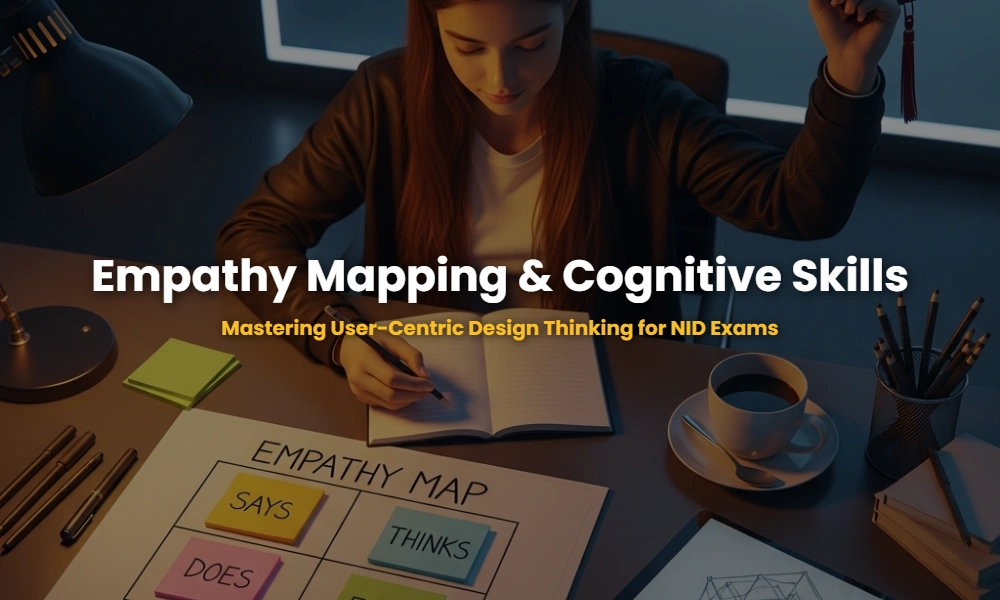
How can you master Cognitive Skills for integrating user-centric empathy mapping into creative response brainstorming?
In the high-stakes environment of the NID Entrance Exam, the ability to synthesize human emotions into design solutions is what separates a candidate from a professional. Cognitive Skills are the mental capabilities we use to learn, solve problems, and pay attention. When applied to empathy mapping, these skills allow designers to look beyond the surface of a brief and understand the psychological landscape of the end-user. This guide explores the advanced techniques required to integrate empathy-driven insights into your creative brainstorming sessions.
🚀 Key Takeaways
- Understand the four quadrants of empathy mapping: Says, Thinks, Does, and Feels.
- Develop Cognitive Skills to decode latent user needs during time-constrained exams.
- Utilize divergent thinking techniques to expand creative responses based on user pain points.
- Apply structured brainstorming frameworks like SCAMPER alongside empathy maps.
- Learn to bridge the gap between abstract empathy and concrete design features.
What is the significance of Cognitive Skills in empathy-driven design?
Cognitive skills are the foundational mental processes that allow designers to process information, recognize patterns, and empathize with users. In design, these skills facilitate the transition from logical observation to emotional resonance, enabling the creation of solutions that are not just functional but also deeply meaningful and user-centric.
When we talk about creative problem solving, we are essentially discussing the orchestration of cognitive functions like working memory and fluid intelligence. In the context of NID, the examiner isn’t just looking for a pretty sketch; they are looking for the ‘Why’ behind the ‘What’. Integrating user-centric empathy mapping requires high-level Cognitive Skills to simulate the user’s environment in your mind and predict their reactions to specific design interventions.
How do you build a user-centric empathy map during a time-constrained exam?
To build an effective empathy map quickly, one must use rapid cognitive categorization to divide user observations into four distinct quadrants: Says, Thinks, Does, and Feels. This structured approach forces the brain to move beyond superficial assumptions and investigate the deeper emotional drivers and frustrations of the target persona.
During an exam like the NID DAT, you don’t have hours for user research. You must rely on Cognitive Skills to build a ‘Synthetic Persona’.
The Four Quadrants:
- Says: Direct quotes or vocalized needs (even if imagined).
- Thinks: The internal monologue of the user. What are they afraid of?
- Does: Physical actions and behaviors observed in the scenario.
- Feels: The emotional state (anxiety, joy, confusion) resulting from the interaction.
💡 Pro-Tip: The ‘Fifth Quadrant’
Always add a ‘Pain & Gain’ section at the bottom. Identify the single biggest frustration (Pain) and the primary motivation (Gain). This focus helps in narrowing down your design thinking process significantly.
How does empathy mapping transform creative response brainstorming?
Empathy mapping transforms brainstorming by shifting the focus from ‘feature-first’ thinking to ‘human-first’ thinking. By centering the brainstorm around the user’s emotional landscape, designers can generate more relevant, innovative, and impactful solutions that address real-world psychological needs rather than just technical requirements or aesthetic trends.
When you integrate these Cognitive Skills, your brainstorming session becomes a search for solutions to the ‘Feels’ and ‘Thinks’ quadrants. For example, if a user ‘Feels’ unsafe while using public transport at night, your brainstorm shouldn’t just be about ‘better lights’ (Does), but about ‘psychological comfort’ (Feels). This leads to visual thinking exercises that explore transparency, community connectivity, and emergency haptics.
Comparison: Traditional vs. Empathy-Driven Brainstorming
The following table illustrates why sharpening your Cognitive Skills for empathy-centric mapping provides a competitive edge in design entrance examinations.
| Feature | Traditional Brainstorming | Empathy-Driven Brainstorming |
|---|---|---|
| Primary Goal | Quantity of ideas | Quality and relevance of impact |
| Starting Point | Product features | User emotions and pain points |
| Cognitive Load | Low (Surface level) | High (Deep psychological mapping) |
| NID Score Potential | Average | Superior / Top Percentile |
Which techniques ensure user-centricity in competitive design exams?
Techniques such as ‘Bodystorming’, ‘Point-of-View (POV) Framing’, and the ‘5 Whys’ ensure user-centricity by forcing the designer to inhabit the user’s physical and mental space. These cognitive exercises break down personal biases and allow for a more authentic exploration of the user’s journey and potential design solutions.
To truly master Cognitive Skills for NID, try these three advanced techniques:
- Cognitive Reframing: Look at the problem from the perspective of an extreme user (e.g., a child or an elderly person using a smartphone).
- Analogous Empathy: Find a different field that shares the same emotional core. If the user feels ‘rushed’ at a hospital, how do ‘rushed’ people feel at an airport?
- Metacognitive Auditing: Periodically ask yourself, “Am I designing this for me, or for the persona in my empathy map?”
💡 Quick Quiz: Test your Empathy IQ
Which quadrant does ‘The user is worried about the cost’ fall into?
Answer: It primarily falls into the ‘Thinks’ or ‘Feels’ quadrant, depending on whether it’s a logical calculation or an emotional anxiety.
Frequently Asked Questions
Can I use Empathy Mapping for every question in NID?
While useful, it is best applied to ‘Problem Solving’ or ‘User Interaction’ questions. For pure sketching or abstract visualization, keep it as a mental backdrop rather than a formal map.
How much time should I spend on mapping?
In a 30-minute question, spend no more than 3-5 minutes on the map. It should serve as a springboard, not the final destination.





