
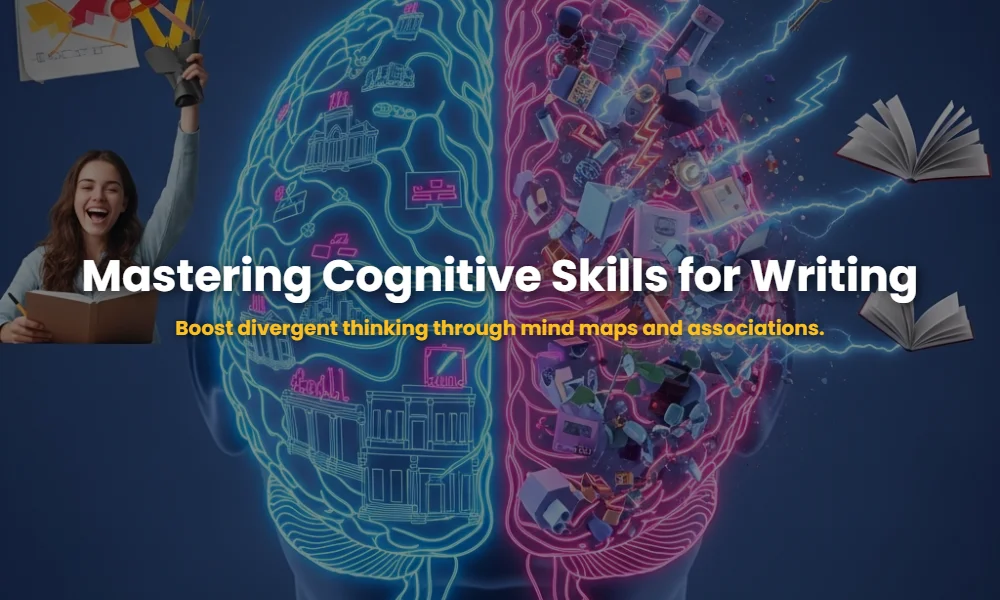
How can you master Cognitive Skills using mind mapping and forced associations to enhance divergent thinking for creative writing tasks?
In the competitive landscape of the National Institute of Design (NID) entrance exams, the ability to generate original, multifaceted ideas quickly is the hallmark of a top-tier candidate. Strengthening your Cognitive Skills is not just about intelligence; it is about training your brain to navigate complex creative writing tasks using structured techniques like mind mapping and forced associations.
🚀 Key Takeaways
- Divergent Thinking: Learn to move away from linear logic to find unique narrative paths.
- Mind Mapping: A visual strategy to map semantic networks and expand story worlds.
- Forced Associations: A radical technique to connect unrelated concepts for high-impact writing.
- NID Specificity: Tailoring these cognitive tools to solve design-oriented writing prompts.
- Practice Drills: Actionable exercises to improve mental flexibility.
Table of Contents
What is Divergent Thinking in Creative Writing?
Divergent thinking is a cognitive process used to generate creative ideas by exploring many possible solutions. In creative writing, it involves expanding a single prompt into a multitude of narrative possibilities, ensuring your creative ideation is both broad and original before narrowing it down to a single story.
For NID aspirants, divergent thinking is the antithesis of the ‘first-thought’ syndrome. When given a prompt like “The Silent Clock,” a linear thinker might write about a broken watch. A divergent thinker, using enhanced Cognitive Skills, might explore ideas ranging from a society where time is a physical currency to a clock that only ticks when someone tells the truth. This breadth is what examiners look for during the NID DAT preparation phase.
💡 Pro-Tip: The ‘Rule of Three’
Always discard your first three ideas. They are usually the most cliché and are likely what every other candidate is writing. Your fourth or fifth idea is where true divergent thinking begins.
How does Mind Mapping improve idea generation in writing?
Mind mapping improves idea generation by visually organizing information into a non-linear hierarchy, mimicking the brain’s natural associative architecture. This allows writers to see connections between disparate themes, characters, and settings, resulting in a more cohesive and deeply layered narrative structure for creative tasks.
When you start a mind map, you place your central theme in the middle. For a writing task, this could be an emotion, an object, or a phrase. As you branch out, you categorize your lateral thinking into sensory details, character motivations, and environmental obstacles. This visual representation ensures that your Cognitive Skills are firing across multiple domains simultaneously, preventing writer’s block.
Insider Tip: In the NID exam, use a mini mind-map in the margin of your answer sheet. It shows the examiner you have a structured thought process even before you begin the final draft.
What are Forced Associations and how do they benefit creative writing?
Forced associations are a creative problem-solving technique where you pair two seemingly unrelated concepts to generate a third, entirely new idea. This method shatters cognitive biases and forces the brain to find logical or narrative bridges between random elements, resulting in highly innovative and unexpected story arcs.
To apply this to Cognitive Skills development, take a random object (e.g., a paperclip) and a random abstract concept (e.g., betrayal). How can a paperclip symbolize betrayal? Perhaps it’s a tiny tool used to pick a lock, leading to a stolen secret. This ‘forcing’ of a connection compels you to move beyond literal interpretations, which is essential for the design thinking process in creative writing.
💡 Practice This: The Random Word Challenge
Pick two words from a dictionary at random. Write a 100-word micro-story connecting them. For example: ‘Elephant’ and ‘Symphony’. Result: An elephant that can only walk in time to a specific orchestra’s music.
Comparing Techniques: Mind Mapping vs. Forced Association
Choosing between mind mapping and forced associations depends on the nature of the creative writing task and the stage of your ideation process.
| Feature | Mind Mapping | Forced Association |
|---|---|---|
| Primary Goal | Expansion and Organization | Innovation and Disruption |
| Brain State | Analytical & Associative | Abstract & Lateral |
| Best Used For | World building & plot structure | Breaking writer’s block & metaphors |
| Complexity | Medium | High |
Applying These Cognitive Skills to NID Writing Prompts
NID writing prompts often require you to personify objects, complete a dialogue, or describe a scenario from an unusual perspective. Using these Cognitive Skills ensures you stand out by providing depth where others provide surface-level descriptions.
For instance, if asked to write a story from the perspective of a “Litter Bin,” use mind mapping to explore its sensory experiences (smells, sounds of the city) and forced associations to link it to a human emotion like “Longing.” The result is a poignant narrative about a bin that longs to hold a love letter instead of discarded wrappers. This level of conceptualization is exactly what differentiates an average score from a top rank.
💡 Quick Quiz: Test Your Divergent Thinking
Question: Name 5 unusual uses for a broken umbrella that aren’t related to rain.
Hidden Answer: 1. A trellis for climbing plants. 2. A skeleton for a kite. 3. A weapon for a theatrical play. 4. A drying rack for herbs. 5. A modular lampshade frame.
Frequently Asked Questions
Q1: Can Cognitive Skills be improved with short-term practice?
Yes, consistent daily practice of forced associations for even 15 minutes can significantly rewire your brain for faster ideation within weeks.
Q2: Is mind mapping allowed during the NID DAT exam?
While you shouldn’t submit a mind map as your final answer unless asked, using it as a rough planning tool in the designated space is highly recommended by experts.
Q3: How do I avoid getting stuck in one ‘branch’ of a mind map?
Use the ‘SCAMPER’ method (Substitute, Combine, Adapt, Modify, Put to another use, Eliminate, Reverse) to force your mind to jump to a new branch if you feel stuck.
Need Personalized Guidance for your NID Preparation?
Our expert mentors can help you master these cognitive techniques and more through live sessions and mock tests.
💬 Chat with our Experts on WhatsApp (+91 9526806124)




