
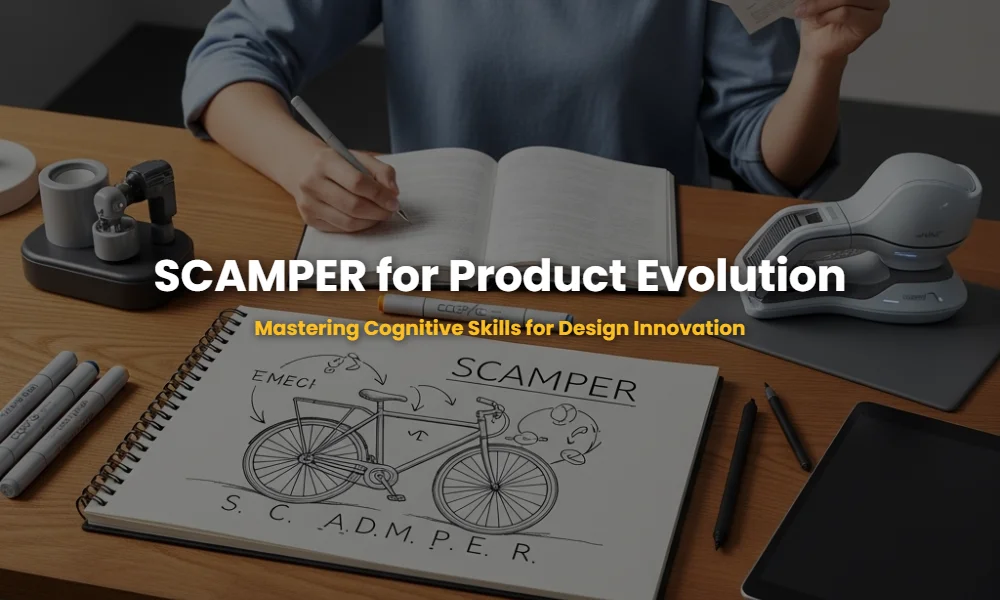
How can you boost Cognitive Skills with the SCAMPER technique for product evolution?
Mastering Cognitive Skills through the SCAMPER technique involves using a structured mnemonic to trigger lateral thinking, allowing designers to systematically evolve existing products into innovative solutions. By applying the seven lenses of SCAMPER, you can bypass creative blocks and generate high-utility concepts essential for competitive exams like NID.
🚀 Key Takeaways
- Understand the 7 core components of the SCAMPER framework.
- Learn how to apply divergent thinking to product redesign tasks.
- Enhance analytical Cognitive Skills for NID’s Studio Test and DAT.
- Master the art of ‘Product Evolution’ over ‘Incremental Improvement’.
Table of Contents
- Introduction to SCAMPER and Cognitive Skills
- S – Substitute: Changing Components
- C – Combine: Merging Functions
- A – Adapt: Contextual Shifts
- M – Modify/Magnify: Altering Perception
- P – Put to Another Use: Reimagining Utility
- E – Eliminate: Minimalist Efficiency
- R – Reverse/Rearrange: Structural Disruption
- SCAMPER Implementation Table
- Frequently Asked Questions
What is the connection between SCAMPER and Cognitive Skills?
The connection lies in the deliberate exercise of neural pathways associated with creative problem-solving and divergent thinking. By forcing the brain to look at a product through specific constraints, SCAMPER strengthens the user’s ability to identify opportunities for innovation where others see static objects, effectively building advanced design aptitude.
In the context of the National Institute of Design (NID), Cognitive Skills are not just about raw intelligence; they are about the speed and quality of your ideation process. SCAMPER (Substitute, Combine, Adapt, Modify, Put to another use, Eliminate, Reverse) provides a roadmap for this evolution. Using design thinking strategies alongside SCAMPER allows students to move from surface-level sketching to deep functional innovation.
How does ‘Substitute’ improve product evolution?
The Substitution technique improves product evolution by challenging the designer to replace existing materials, processes, or people involved in a product’s lifecycle. This cognitive shift often leads to breakthroughs in sustainability, cost reduction, or ergonomics by removing conventional barriers and introducing high-performance alternatives that redefine the product’s value proposition.
For example, if you are asked to redesign a traditional wooden chair, substitution might involve replacing wood with recycled carbon fiber for weight reduction or using inflatable air pockets instead of cushions. This requires you to utilize material exploration techniques to justify your design choices.
💡 NID Insider Tip: Substitution
Don’t just substitute the physical material. Think about substituting the *energy source* or the *emotional experience*. Can a lamp be powered by gravity instead of electricity? That is true substitution.
How can ‘Combining’ functions lead to innovative concepts?
Combining functions leads to innovation by synthesizing two disparate features into a single, cohesive unit, thereby creating a hybrid product with enhanced utility. This technique forces the brain to find commonalities between unrelated objects, resulting in ‘multitasking’ designs that solve complex user problems with a simplified form factor.
Consider the evolution of the smartphone. It combined a phone, a camera, and a computer. In NID entrance exams, you might be asked to combine a water bottle with a fitness tracker. To do this effectively, you must understand user-centric design to ensure the combination isn’t just a gimmick but a genuine improvement.
Why is ‘Adaptation’ critical for Cognitive Skills?
Adaptation is critical because it requires the cognitive ability to recognize successful patterns in one domain and apply them to another. It involves shifting the context of an existing solution to solve a new problem, demonstrating high-level analogical reasoning and the ability to leverage cross-disciplinary knowledge for product evolution.
Biomimicry is the ultimate form of adaptation. Adapting the structure of a bird’s beak to design a high-speed train is a classic example. When training your Cognitive Skills, look at how nature solves problems like insulation or transportation and adapt those mechanisms into your industrial design projects.
How does ‘Modifying’ or ‘Magnifying’ change design?
Modifying or magnifying changes design by altering the scale, shape, or sensory qualities of a product to emphasize specific features or cater to new demographics. This process allows designers to identify which aspects of a product are essential and which can be exaggerated to improve accessibility, durability, or user engagement.
Think of the oversized buttons on phones for the elderly (Magnify) or the ultra-thin profile of modern laptops (Modify). These changes are not just aesthetic; they are responses to ergonomic needs and technological advancements. In your sketches, experiment with exaggerated proportions to discover new functional possibilities.
What is ‘Put to Another Use’ in concept generation?
‘Put to Another Use’ involves identifying secondary or tertiary applications for an existing product or its components, often in entirely unrelated industries. This technique expands the designer’s mindset to see potential beyond the intended purpose, facilitating circular economy principles and unconventional problem-solving strategies.
Using shipping containers as modular housing units is a prime example of putting something to another use. In an NID scenario, you might be asked to take a waste product, like used tires, and turn them into playground equipment or furniture. This requires a strong grasp of sustainable innovation.
💡 Practice Exercise
List 5 different uses for a standard paperclip other than holding paper. This is a classic test for divergent thinking and cognitive flexibility.
Does ‘Eliminating’ components improve a product?
Eliminating components improves a product by removing redundant or non-essential parts to achieve simplicity, reduce maintenance, and lower manufacturing costs. This ‘less is more’ approach forces designers to focus on the core utility of the product, often leading to more elegant, user-friendly, and sustainable design solutions.
Consider the cordless vacuum or the buttonless interface of modern touchscreens. By eliminating wires or physical buttons, the user experience becomes more fluid. Elimination is often harder than addition because it requires the cognitive courage to decide what is truly necessary for the product to function.
How does ‘Reversing’ structure generate innovation?
Reversing or rearranging structure generates innovation by inverting the typical order of operations, physical layout, or user interaction of a product. This disruptive technique challenges established norms and can reveal hidden efficiencies or entirely new ways of experiencing a product that were previously obscured by tradition.
A classic example is the inverted ketchup bottle, which uses gravity to keep the product at the nozzle. Or consider a restaurant where the customers cook their own food. By reversing the traditional service model, a new dining experience is created. For your Cognitive Skills development, try sketching an object upside down or inside out to see if it functions better.
SCAMPER Technique Comparison for Product Evolution
The following table summarizes how each SCAMPER element influences the evolution of a standard product (e.g., a Bicycle).
| SCAMPER Step | Action Taken | Resulting Evolution |
|---|---|---|
| Substitute | Replace metal chain with rubber belt | Low maintenance, quiet ride |
| Combine | Add electric motor and battery | E-bike (Hybrid transportation) |
| Adapt | Apply gear system from clockwork | Multi-speed performance |
| Modify | Shrink wheels and frame | Portable folding bicycle |
| Put to Use | Stationary stand + generator | Energy-generating exercise bike |
| Eliminate | Remove pedals and chain | Balance bike for toddlers |
| Reverse | Sit down, pedals in front | Recumbent bicycle |
Frequently Asked Questions
How long does it take to master the SCAMPER technique?
Mastery is a continuous process, but with daily 15-minute practice sessions focused on random objects, you can significantly improve your Cognitive Skills and speed in as little as 4 weeks.
Is SCAMPER useful for NID’s GAT or DAT?
Absolutely. It is primarily used for the DAT (Design Aptitude Test) for product redesign questions, but the underlying cognitive flexibility also aids in solving logical reasoning and creative writing tasks in the GAT.





