
Table of Contents
How can you master Cognitive Skills through techniques for rapid brainstorming and thumbnail sketching to maximize output variety within GAT time limits?
Cognitive Skills represent the mental proficiency required to process information, identify patterns, and generate creative solutions under extreme temporal constraints. In the context of the NIFT GAT and CAT, these skills are the engine of innovation, allowing candidates to move from a blank page to a diverse array of conceptual designs in minutes. Mastering these skills involves a shift from linear thinking to divergent processing, ensuring that your output is both high-volume and high-quality.
🚀 Key Takeaways
- Divergent Thinking: Learn to generate multiple distinct ideas before narrowing down choices.
- SCAMPER Method: Use a structured checklist to modify existing concepts rapidly.
- Thumbnailing Efficiency: Master the art of the 30-second silhouette to capture form over detail.
- Time Partitioning: Strategically allocate your 180 minutes to ensure adequate ideation.
How do Cognitive Skills influence rapid brainstorming speed?
Cognitive Skills act as the neural engine for rapid brainstorming by streamlining information retrieval and associative thinking. In a high-pressure environment like the NIFT GAT, these skills allow a candidate to bypass mental blocks, facilitating the quick generation of diverse, innovative solutions through structured mental frameworks and pattern recognition. By training your brain to see connections between disparate concepts, you reduce the ‘latency’ between reading a prompt and sketching a solution.
To truly excel, students should utilize the Morphological Matrix. This involves breaking down a design problem into its core attributes (e.g., material, shape, function) and listing variations for each. By combining different elements from each column, you can generate hundreds of unique concepts within minutes. This systematic approach is far more effective than waiting for a ‘spark’ of inspiration. Integrating this with creative thinking strategies ensures that your cognitive load is focused on innovation rather than recall.
💡 Click to Reveal: The 6-3-5 Brainstorming Secret
Adapted for solo exams: Write 3 ideas in 5 minutes, then spend 2 minutes ‘evolving’ each. This creates 6 distinct paths in under 10 minutes. Examiners look for this evolution in your rough work!
What is the best technique for thumbnail sketching under pressure?
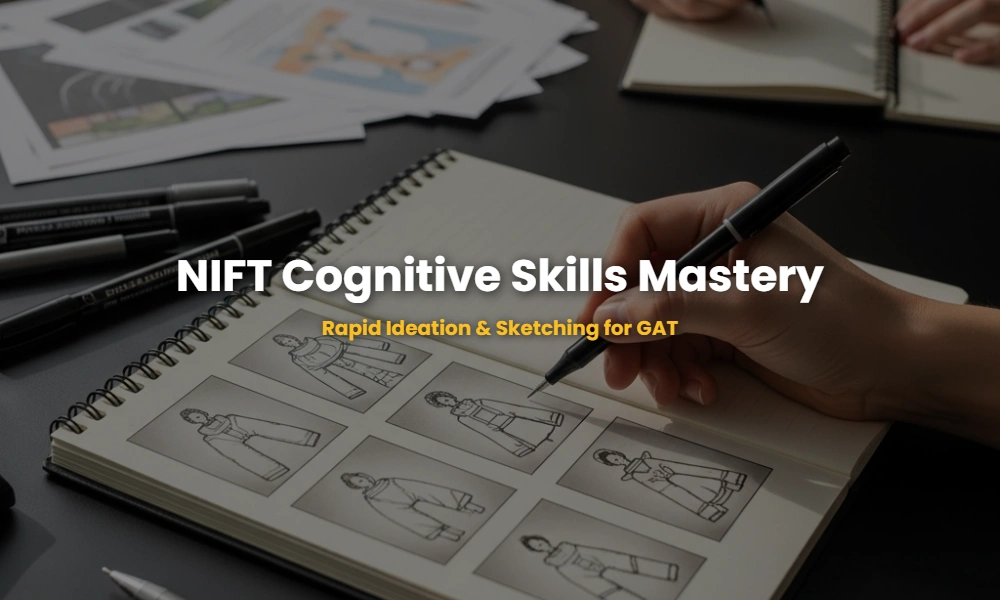
The best technique for thumbnail sketching under pressure is the Silhouette Method, which prioritizes the overall form and negative space over internal details. By focusing on the ‘readability’ of the shape in a small 2×2 inch box, you can quickly evaluate the visual impact of a design. This allows for rapid iteration, where you can produce 10-15 variations of a product or garment in under five minutes, ensuring a wide variety of options before committing to a final render.
Thumbnailing is a critical component of design drawing techniques. Use a soft lead pencil or a felt-tip pen to prevent over-erasing. The goal is fluency. During your GAT prep, practice the ‘8-6-4 Drill’: Draw 8 thumbnails in 8 minutes, then 6 improved versions in 6 minutes, and finally 4 refined concepts in 4 minutes. This progressive compression forces your brain to discard redundant ideas and focus on core innovation.
How can you maximize output variety within strict time limits?
Maximizing output variety is achieved by applying Categorical Shifts to your initial ideas, ensuring that each subsequent sketch explores a different stylistic or functional territory. Instead of making incremental changes (like changing a pocket size), a categorical shift involves changing the entire design philosophy—shifting from ‘Geometric’ to ‘Organic’ or ‘Minimalist’ to ‘Avant-garde.’ This demonstrates the high-level Cognitive Skills that NIFT evaluators prioritize, as it shows a broad design vocabulary and flexibility.
Consider the SCAMPER mnemonic to force these shifts: Substitute materials, Combine functions, Adapt a shape from nature, Modify the scale, Put to another use, Eliminate excess, and Reverse the orientation. When applied to NIFT exam preparation, SCAMPER acts as a cognitive shortcut, preventing the ‘repetitive sketch’ trap that many students fall into. By documenting these iterations in your rough work, you provide evidence of a sophisticated design process.
Ideation Method Comparison
Choosing the right method depends on the specific prompt provided in the GAT/CAT paper. The following table compares three primary cognitive frameworks for design speed.
| Method | Cognitive Focus | Ideal Timeframe | Best For |
|---|---|---|---|
| Mind Mapping | Associative Logic | 2-3 Minutes | Theme Expansion |
| Morphological Matrix | Combinatorial Logic | 5 Minutes | Complex Product Design |
| SCAMPER | Evolutionary Logic | 4-6 Minutes | Iterating a single concept |
Cognitive Skills FAQ
How many thumbnails should I draw for a NIFT question?
Aim for 4-6 distinct thumbnails. This shows the examiner you have ‘ideation depth’ without eating up all your time for the final rendering.
What if I get a mental block during the GAT?
Immediately switch to the ‘Opposite Thinking’ technique. Ask yourself: ‘What is the absolute worst/most boring solution?’ Often, reversing the traits of a bad idea leads to a brilliant one.
Is the quality of thumbnails more important than the quantity?
Variety is more important than quality in the thumbnail phase. The ‘quality’ should be saved for your final chosen concept.
Need personalized guidance on your NIFT prep?
Our experts are here to help you crack the GAT and CAT with specialized cognitive training.
💬 Chat with our Experts on WhatsApp (+91 9526806124)




