
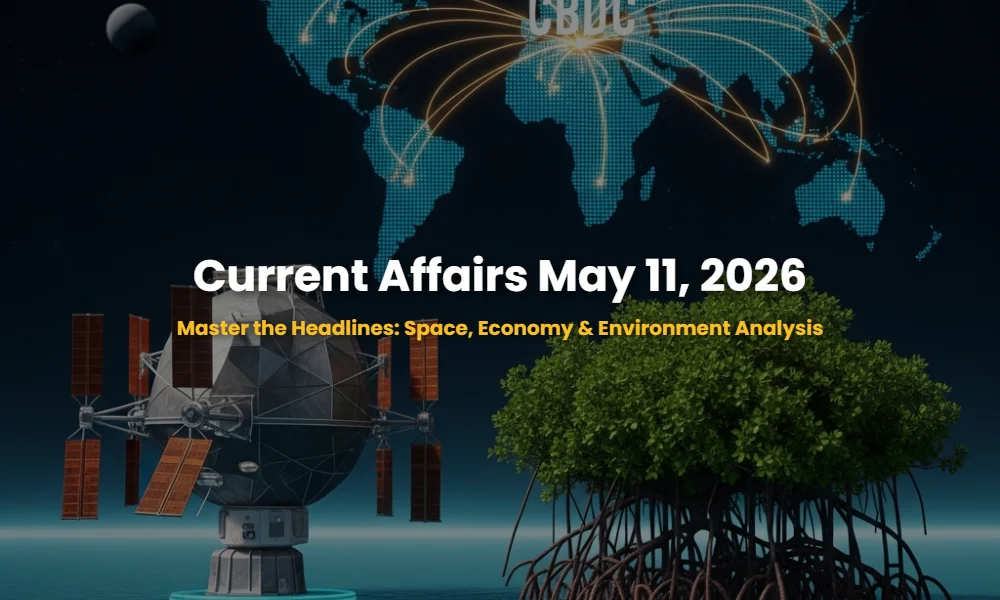
Daily Current Affairs: 11th May 2026
Welcome to today’s elite briefing. As the competitive exam landscape shifts towards higher analytical depth, our May 11 analysis focuses on the intersection of space governance, digital finance, and ecological sustainability. This module is designed to give you a strategic edge in UPSC, SSC, and Banking examinations.
🚀 Key Takeaways
- The 2026 Lunar Gateway Expansion and its legal implications for the Artemis Accords.
- Interoperability of CBDCs in G20 cross-border trade settlements.
- The Global Blue Carbon Initiative: New protocols for mangrove restoration.
- NIST’s finalization of Post-Quantum Cryptography standards (Module-Lattice-Based).
Table of Contents
What is the 2026 Lunar Gateway Expansion?
The 2026 Lunar Gateway Expansion refers to the docking of the I-HAB (International Habitation Module) to the gateway station in lunar orbit. This pivotal mission, part of the Artemis IV program, establishes the first permanent lunar-orbiting station, enabling long-term scientific research and a staging point for Mars missions.
The integration of the I-HAB, contributed by the European Space Agency (ESA) and Japan Aerospace Exploration Agency (JAXA), marks a significant milestone in international space policy. For students, it is crucial to understand the ‘Liability Convention’ and the ‘Outer Space Treaty’ in this context. Experts suggest that as we move toward lunar habitation, the legal definition of ‘celestial jurisdiction’ will be a recurring theme in mains examinations. Insider Tip: Focus on the HALO (Habitation and Logistics Outpost) and Power and Propulsion Element (PPE) as the structural foundation of the station.
💡 Click to Reveal Examiner Tip
Always link space missions to international law. If asked about the Lunar Gateway, mention its role as a ‘deep space logistics hub’ rather than just a space station to gain extra marks for technical accuracy.
How are G20 Nations Integrating CBDCs for Trade?
G20 nations are integrating Central Bank Digital Currencies (CBDCs) by establishing common interoperability standards to facilitate real-time, low-cost cross-border trade settlements. This shift aims to reduce reliance on legacy systems like SWIFT by utilizing decentralized ledger technology for instantaneous peer-to-peer central bank transactions.
As of May 2026, the ‘mBridge’ project has expanded to include 15 major economies. This represents a seismic shift in global digital finance. The primary challenge remains ‘atomic settlement’—the simultaneous exchange of assets and payments to eliminate counterparty risk.
| Feature | Traditional SWIFT Settlement | CBDC Interoperability |
|---|---|---|
| Settlement Time | T+2 to T+5 Days | Instantaneous (Atomic) |
| Intermediaries | Multiple Correspondent Banks | Direct Peer-to-Peer |
| Cost Efficiency | High (Fees + FX Spreads) | Low (Minimal Transaction Fees) |
What are the New Blue Carbon Restoration Protocols?
The new Blue Carbon restoration protocols finalized in May 2026 focus on standardized methodologies for measuring carbon sequestration in coastal ecosystems like mangroves, seagrasses, and salt marshes. These protocols enable countries to issue ‘High-Integrity Blue Carbon Credits’ under Article 6.4 of the Paris Agreement.
Blue carbon refers to the carbon captured by the world’s ocean and coastal ecosystems. Seagrasses and mangroves can sequester up to 10 times more carbon per hectare than terrestrial forests. For aspirants, understanding climate change mitigation strategies is essential. The 2026 update specifically addresses ‘Additionality’ and ‘Permanence’ in coastal restoration projects.
Interactive Mock Quiz: 11 May 2026
Q1. Which module is specifically being docked to the Lunar Gateway in May 2026 to provide habitation for international astronauts?
- A) Nauka Module
- B) I-HAB (International Habitation Module)
- C) Zarya Module
- D) Harmony Module
✅ Click to Reveal Answer & Deep Explanation
Correct Answer: B) I-HAB
The I-HAB is the European and Japanese contribution to the Lunar Gateway. Unlike the ISS modules (A, C, D), I-HAB is specifically designed for the high-radiation environment of cislunar space.
Q2. The term ‘Atomic Settlement’ in the context of G20 CBDC integration refers to:
- A) Settlement of nuclear energy trade contracts
- B) Simultaneous exchange of payment and assets
- C) A settlement involving individual retail customers only
- D) Decommissioning of old digital currencies
✅ Click to Reveal Answer & Deep Explanation
Correct Answer: B) Simultaneous exchange of payment and assets
In financial technology, atomic settlement ensures that a transaction is complete only if both the payment and the asset delivery happen simultaneously, preventing one party from defaulting.
Q3. Which ecosystem is NOT considered a primary source of ‘Blue Carbon’?
- A) Mangrove Forests
- B) Salt Marshes
- C) Boreal Forests
- D) Seagrass Meadows
✅ Click to Reveal Answer & Deep Explanation
Correct Answer: C) Boreal Forests
Boreal forests are terrestrial carbon sinks. Blue carbon refers specifically to carbon captured by coastal and marine ecosystems.
Q4. NIST has recently finalized standards for Post-Quantum Cryptography. Which mathematical structure is primarily used in these standards?
- A) Prime Factorization
- B) Elliptic Curves
- C) Lattice-based Cryptography
- D) Symmetric Key algorithms
✅ Click to Reveal Answer & Deep Explanation
Correct Answer: C) Lattice-based Cryptography
Quantum computers can easily solve Prime Factorization (Shor’s Algorithm) and Elliptic Curve problems, but Lattice-based problems are currently considered resistant to quantum attacks.
Q5. Article 6.4 of the Paris Agreement, mentioned in the context of Blue Carbon, deals with:
- A) Climate finance for developing nations
- B) International carbon market mechanism
- C) Technology transfer protocols
- D) Biodiversity conservation in high seas
✅ Click to Reveal Answer & Deep Explanation
Correct Answer: B) International carbon market mechanism
Article 6.4 establishes a mechanism to contribute to the mitigation of greenhouse gas emissions and support sustainable development through an international carbon market.
Q6. The ‘mBridge’ project is primarily associated with:
- A) Building physical bridges in Southeast Asia
- B) Multi-country CBDC platform for cross-border payments
- C) Bridging the digital divide in rural areas
- D) Space debris removal technology
✅ Click to Reveal Answer & Deep Explanation
Correct Answer: B) Multi-country CBDC platform for cross-border payments
Project mBridge is a collaborative effort involving several central banks and the BIS Innovation Hub to explore how CBDCs can improve cross-border settlements.
Q7. Which international space agreement prohibits the ‘national appropriation’ of the Moon by claim of sovereignty?
- A) Artemis Accords
- B) Outer Space Treaty of 1967
- C) Space Liability Convention
- D) Moon Agreement of 1979
✅ Click to Reveal Answer & Deep Explanation
Correct Answer: B) Outer Space Treaty of 1967
The Outer Space Treaty is the bedrock of space law, stating that space, including the Moon, is not subject to national appropriation by any means.
Q8. What is ‘Additionality’ in the context of Blue Carbon credits?
- A) Adding more carbon to the atmosphere
- B) The project results in carbon sequestration that would not have occurred without the credit incentive
- C) Adding more species to a mangrove forest
- D) The extra cost of measuring carbon levels
✅ Click to Reveal Answer & Deep Explanation
Correct Answer: B) The project results in carbon sequestration that would not have occurred without the credit incentive
Additionality is a core principle in carbon markets ensuring that the emission reductions or removals are truly additional to what would have happened anyway.
Q9. The Artemis IV mission is primarily focused on:
- A) First uncrewed flight of Orion
- B) First crewed flyby of the Moon
- C) Establishment of the first permanent lunar base on the surface
- D) Docking of I-HAB and assembly of the Lunar Gateway
✅ Click to Reveal Answer & Deep Explanation
Correct Answer: D) Docking of I-HAB and assembly of the Lunar Gateway
Artemis IV aims to deliver the I-HAB to the Gateway, marking the first time international partners contribute major habitation hardware to the platform.
Q10. Which organization finalized the Post-Quantum Cryptography (PQC) standards in early 2026?
- A) ITU (International Telecommunication Union)
- B) NIST (National Institute of Standards and Technology)
- C) WHO (World Health Organization)
- D) WTO (World Trade Organization)
✅ Click to Reveal Answer & Deep Explanation
Correct Answer: B) NIST
NIST is the global leader in establishing cryptographic standards, and its PQC project is the most watched development in cybersecurity.
Conclusion & Future Outlook
The events of 11 May 2026 highlight a world transitioning toward decentralized digital economies and multi-planetary presence. For competitive exam aspirants, the ability to synthesize these topics—understanding how CBDCs influence trade or how blue carbon affects international climate negotiations—is what separates a successful candidate from the rest. Stay updated, stay curious.
Need Personalized Guidance?
Our mentors are available to help you decode complex current affairs and prepare for your interview.
💬 Chat with our Experts on WhatsApp (+91 9526806124)




