
The Psychology of Memory: Why Mnemonics Save the Day
Welcome to the ultimate guide for Kerala PSC aspirants on myentrance.in. When the exam clock is ticking and your brain feels like an overstuffed suitcase, you don’t need more data; you need better organization. Memory hacks are the filing system of your brain. In the final hours before a Kerala PSC exam, your goal isn’t just to ‘read’—it’s to ‘retrieve’.
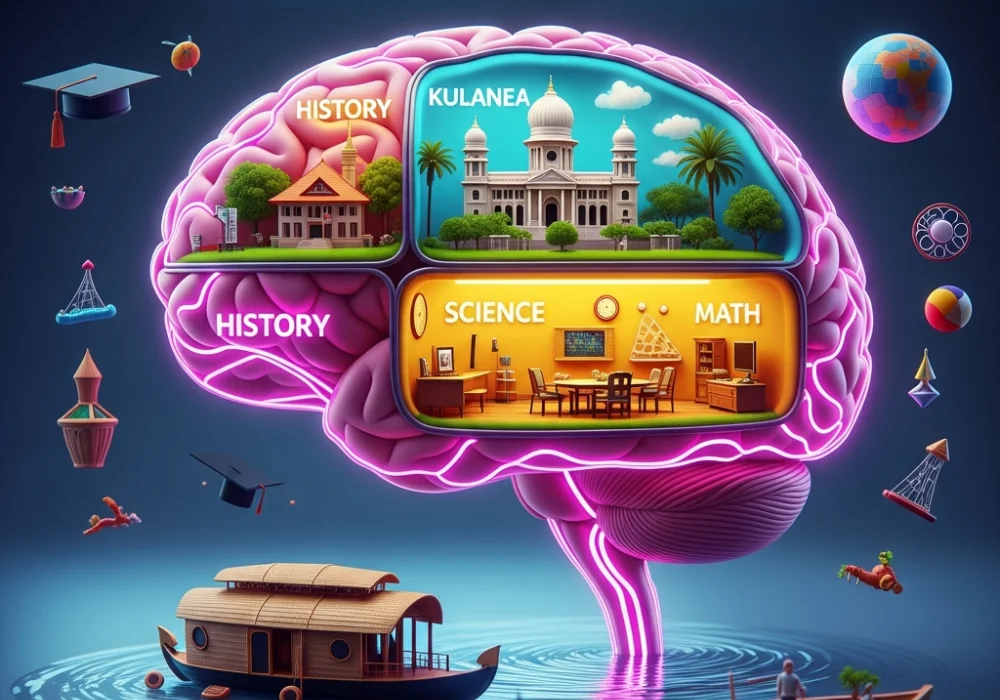
We use mnemonics (memory aids) and the ‘Memory Palace’ technique to anchor complex facts to simple, absurd stories. Research shows that our brains remember the weird, the colorful, and the funny far better than dry facts. Let’s dive into 10 high-impact memory hacks that will ensure you walk into the exam hall with total confidence.
💡 Why does absurdity help memory?
The Hippocampus, your brain’s memory center, is highly sensitive to novelty. A ‘boring’ fact is often ignored, but a ‘strange’ story creates a strong neural pathway. If you imagine an elephant wearing a crown while solving a PSC math problem, you are 10x more likely to remember the formula!
1. The S.M.A.R.T. Revision Strategy
Before you even pick up a book, use this acronym to filter your focus. Most students fail because they try to re-read everything. Use S.M.A.R.T. to survive the final 48 hours:
- S – Scan: Scan previous year papers specifically for repeated topics like the Renaissance in Kerala or National Parks.
- M – Map: Use mind maps to connect related facts (e.g., connect Sree Narayana Guru to his famous works and major social movements).
- A – Automate: Practice OMR marking. Don’t let your hand shake during the real deal.
- R – Rapid: Rapidly read bullet points instead of long paragraphs.
- T – Trust: Trust your subconscious mind. You have studied; the information is there!
Decoding Tip: Whenever you feel overwhelmed, chant ‘S-M-A-R-T’ to bring yourself back to a logical flow. Visualize a glowing smartphone screen with these letters to remind yourself to stay high-tech and efficient.
2. The ‘Memory Palace’ of Your Exam Hall
The ‘Method of Loci’ or Memory Palace is the world’s most powerful recall tool. Let’s build one for the essential items you MUST NOT forget. Imagine you are walking into your exam center gate. Attach these items to specific locations:
- The Gate: Imagine a giant, glowing Admit Card acting as the gate itself. You have to walk through the paper.
- The Security Desk: A security guard is juggling three Blue/Black Ballpoint Pens. The ink is leaking and turning his uniform blue. (Vivid images stick!).
- The Flagpole: Instead of a flag, your Identity Proof (Aadhar/Voter ID) is flying high in the wind.
- The Water Cooler: A Transparent Water Bottle is sitting there, but it’s filled with liquid gold.
How to use it: On the morning of the exam, simply ‘walk’ through this imaginary hall in your mind. If you see the blue security guard, you’ll remember the pens. If you see the paper gate, you’ll remember the hall ticket.
💡 Pro-Tip for OMR Anxiety
Imagine the OMR bubbles are tiny planets. You are an astronaut landing your pen safely in the center of the planet. This ‘gamification’ reduces the stress of marking errors.
3. The ‘C.A.L.M.’ Emotional Hack
Anxiety is the #1 reason for ‘blanking out’ during Kerala PSC exams. Use the C.A.L.M. technique when you feel the panic rising:
- C – Center: Take three deep breaths. Focus only on the air entering your nose.
- A – Analyze: Look at the question calmly. Is it really hard, or just worded strangely?
- L – Listen: Listen to your inner voice saying, “I am prepared.”
- M – Move on: If a question is a ‘Time-Eater’, skip it. Move on and come back later.
The Story: Imagine a calm lake in the middle of a busy Kochi street. You are sitting by that lake. The noise of the exam is the traffic; your focus is the still water.
4. The ‘T.R.A.P.’ Method to Avoid Negative Marks
Kerala PSC has a 1/3 negative marking policy. You must avoid the T.R.A.P.:
- T – Total Guesswork: If you have no idea about any of the four options, it’s a trap. Step away!
- R – Rush Reading: Reading ‘Which of the following is NOT true’ as ‘Which of the following is true’ is a classic trap.
- A – All of the Above: Don’t blindly pick this. Check at least two options before committing.
- P – Pattern Seeking: If you’ve marked ‘B’ for five questions in a row, don’t panic and change the sixth one just to ‘break the pattern’. Follow logic, not patterns.
💡 Click to reveal the ‘Golden Rule’
If you can eliminate TWO options with 100% certainty, the probability of getting it right is 50%. In this case, it is statistically beneficial to take the risk. If you can’t eliminate at least two, LEAVE IT.
5. The ‘P.A.C.K.’ Ritual for the Morning
Do not wake up and start reading a new textbook. Instead, follow the P.A.C.K. ritual:
- P – Protein: Eat a light, protein-rich breakfast (like eggs or sprouts). Avoid heavy ‘Sadya’ style meals that make you sleepy.
- A – Affirmation: Say out loud, “I have the memory of an elephant and the focus of a hawk.”
- C – Check: One final check of your bag for the hall ticket and ID.
- K – Keep Quiet: Avoid talking to ‘negative’ friends who ask, “Did you study that 500-page report on current affairs?” Silence preserves mental energy.
6. Subject-Specific Mnemonics (Bonus!)
Here are a few quick mnemonics for common Kerala PSC topics:
- Fundamental Rights (Articles 14-32): “Eat Five Eggs, Roast Chicken Rolls.”
(Equality, Freedom, Exploitation (Against), Religion, Cultural/Educational, Remedies). - Rivers Flowing West in Kerala: Think of the word ‘B.P.C.’ like the oil company.
(Bharathapuzha, Periyar, Chalakudy – specifically for the major long ones). - The First 5 Presidents of India: “Rajendra Rad the Zakir Giri Fak.”
(Rajendra Prasad, Radhakrishnan, Zakir Hussain, V.V. Giri, Fakhruddin Ali Ahmed).
7. The ‘B.O.D.M.A.S.’ of Time Management
In the exam, apply this version of BODMAS for time management:
- B – Brackets: Group questions into ‘Easy’, ‘Medium’, and ‘Hard’.
- O – Orders: Solve in order of your strength (e.g., GK first, then English, then Maths).
- D – Division: Divide your 75 or 90 minutes into blocks. Reserve the last 10 minutes for final OMR checks.
- M – Multi-tasking: Never do it! Focus on ONE question at a time.
- A – Accuracy: Accuracy beats speed every single time in PSC.
- S – Speed: Only increase speed in the final 20 minutes if you have many easy questions left.
8. Summary Table of Mnemonics
| Mnemonic | Topic | Core Meaning |
|---|---|---|
| S.M.A.R.T. | Revision | Scan, Map, Automate, Rapid, Trust |
| C.A.L.M. | Stress Control | Center, Analyze, Listen, Move on |
| T.R.A.P. | Negative Marks | Total Guess, Rush, All of above, Pattern |
| P.A.C.K. | Morning Routine | Protein, Affirmation, Check, Keep Quiet |
| Memory Palace | Exam Essentials | Visualizing items at a location |
Conclusion: You Are Ready!
Preparation is science, but performance is an art. By using these mnemonics and memory hacks, you are giving your brain the best possible tools to succeed in the Kerala PSC exam. Remember, everyone feels nervous, but those who have a ‘system’ (like the ones we discussed today on myentrance.in) are the ones who make it to the rank list.
Go forth with confidence. Your hard work is about to pay off!





