
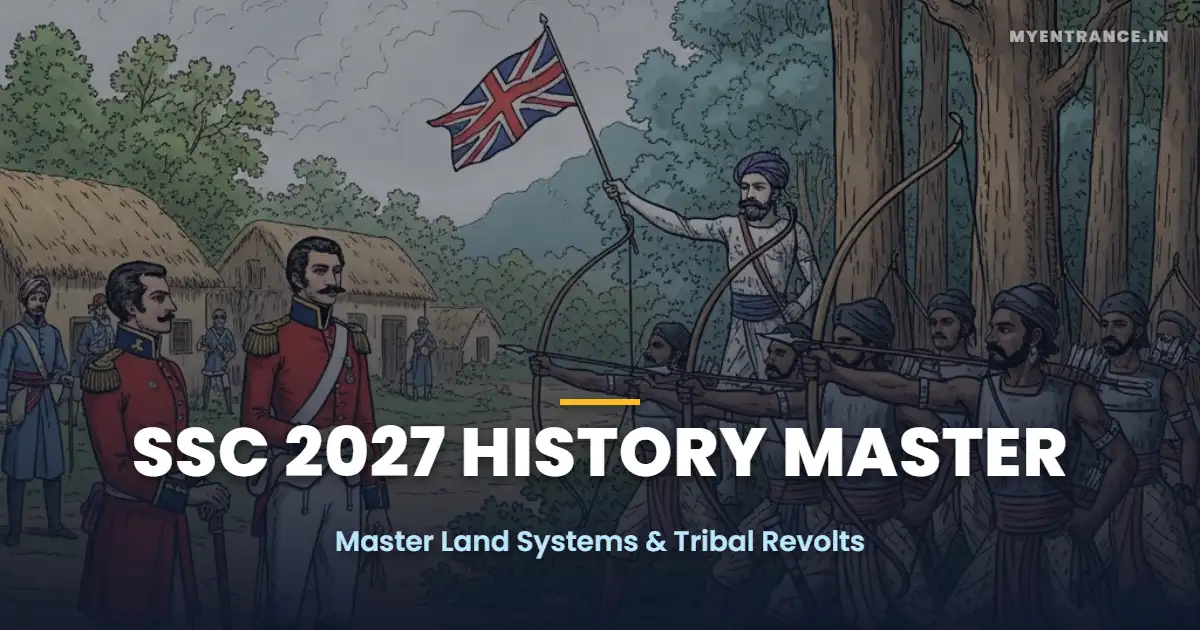
Mastering the Foundations of British Rule for SSC 2027
For students preparing for the 2027 Staff Selection Commission (SSC) exams, understanding the economic and social history of British India is non-negotiable. Between 1765 (the Treaty of Allahabad) and 1857 (the Great Revolt), the British East India Company fundamentally restructured Indian rural society. This guide dives deep into the three major land revenue systems and the resulting tribal resistance that shaped modern India.
Part 1: The Three Pillars of Colonial Revenue
The primary motive of the British was the maximization of land revenue to fund their military expeditions and commercial interests. This led to the introduction of three distinct systems across different regions of India:
1. The Permanent Settlement (Zamindari System)
Introduced by Lord Cornwallis in 1793 in Bengal, Bihar, and Odisha. Under this system, the Zamindars were recognized as the legal owners of the land. The state’s demand was fixed ‘permanently’. If the Zamindar failed to pay by the fixed date (the Sunset Law), his land was auctioned. The impact was devastating for the peasantry, who became mere tenants-at-will on their own land.
2. The Ryotwari System
Introduced by Thomas Munro and Alexander Read in 1820, primarily in the Madras and Bombay Presidencies. The settlement was made directly with the ‘Ryots’ (cultivators). While it aimed to eliminate middlemen, the revenue rates were excessively high, often leading to peasant indebtedness and land loss to moneylenders.
3. The Mahalwari System
Introduced by Holt Mackenzie in 1822 in the North-Western Provinces and parts of Central India/Punjab. The revenue unit was the ‘Mahal’ (village/estate). The village headman (Lambardar) was responsible for collecting and paying revenue. Unlike the Permanent Settlement, the revenue demand was revised periodically.
Part 2: The Fire of Rebellion – Tribal Uprisings
The aggressive expansion of land revenue systems, the introduction of ‘Dikus’ (outsiders), and the interference with traditional forest rights led to violent tribal outbreaks. For SSC 2027, you must memorize the leaders and dates of these movements.
Key Causes of Tribal Discontent:
- Loss of Land: Introduction of private property led to tribal land being seized by moneylenders.
- Forest Laws: Restrictions on shifting cultivation and forest produce use.
- Exploitation by Dikus: Traders and contractors from the plains exploited the simple tribal population.
- Missionary Activities: Interference with traditional tribal religious practices.
Interactive Flashcard Challenge
Hover over each card below to test your knowledge for the SSC 2027 exam!
Part 3: Detailed Timeline of Uprisings (1765-1857)
To score high in SSC 2027, you must understand the chronological flow of these events:
- Sanyasi Rebellion (1763-1800): Fought against the British restrictions on pilgrims and economic distress in Bengal. Famous in Bankim Chandra’s ‘Anandamath’.
- Chuar Uprising (1766-1809): Tribesmen of Midnapore against the hike in land revenue.
- Ho Uprising (1820-1837): Chhotanagpur region against British entry and revenue policies.
- Bhil Revolt (1818-1831): In the Western Ghats against Company rule.
- Kandh Uprising (1837-1856): Led by Chakra Bisoi, against the British attempt to stop ‘Meriah’ (human sacrifice) and new taxes.
Impact of Land Systems on Peasantry
The transition from traditional community ownership to colonial private property had three main results: 1. The Commercialization of Agriculture: Peasant were forced to grow cash crops (Indigo, Opium) to pay revenue in cash. 2. Rural Indebtedness: High taxes led peasants to moneylenders, leading to a cycle of debt. 3. Stagnation: Neither the Zamindars nor the British invested in land improvement, leading to frequent famines.
Preparation Strategy for SSC 2027
History can be overwhelming, but for the 2027 cycle, focus on mapping. Associate each tribal movement with its specific geography (e.g., Santhal – Rajmahal Hills, Khasi – Meghalaya). Practice these flashcards daily to ensure the dates and names are etched in your memory.
Need Help with SSC 2027 Preparation?
If you’re finding it difficult to memorize dates or understand complex historical patterns, our experts are here to help you bridge the gap!
💬 Chat with our Experts on WhatsApp (+91 9526806124)




