
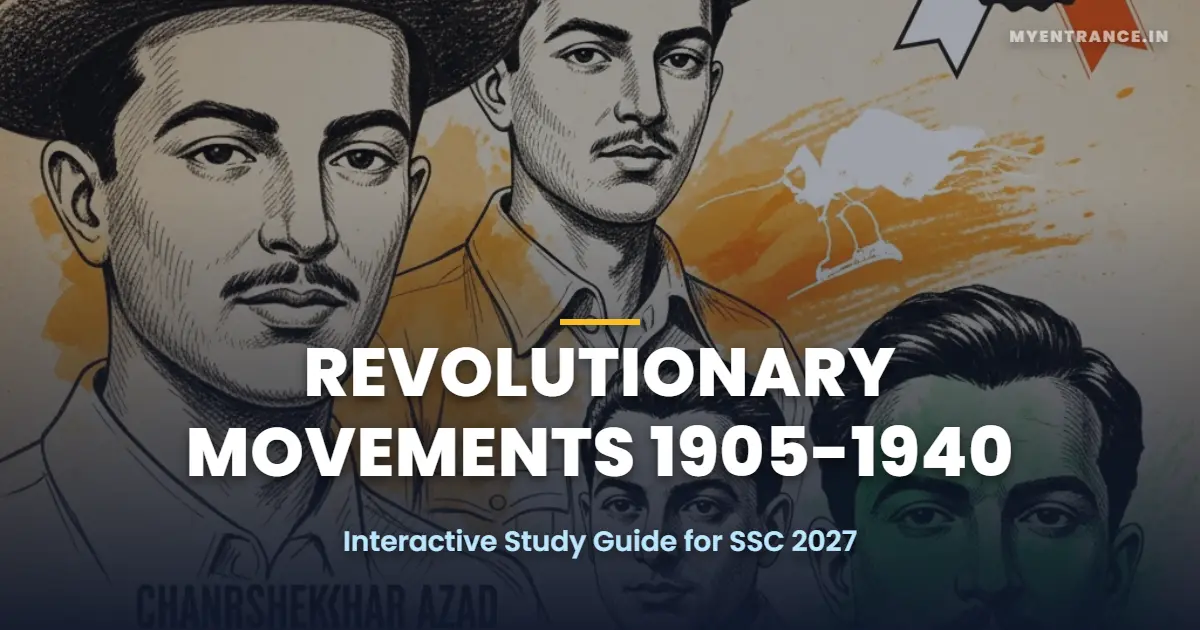
The Valiant Struggle: Revolutionary Movements in India (1905–1940)
For candidates preparing for the SSC CGL, CHSL, and MTS 2027 exams, the ‘Revolutionary Movements’ segment within Modern Indian History is a goldmine for marks. Unlike the mainstream moderate or extremist movements, the revolutionary phase was characterized by individual heroism, secret societies, and high-profile trials that shook the foundations of the British Raj.
Phase I: The Dawn of Militant Nationalism (1905–1915)
The 1905 Partition of Bengal acted as a catalyst. Disillusioned with the ‘prayer and petition’ methods of the Moderates, young nationalists turned toward the ‘cult of the bomb’.
Key Organizations and Leaders
- Anushilan Samiti: Founded by Pramatha Nath Mitra in 1902, it became a powerhouse of revolutionary activity in Bengal. Leaders like Barindra Kumar Ghosh and Bhupendranath Datta (brother of Swami Vivekananda) promoted physical and moral training.
- Jugantar Group: An inner circle of the Anushilan Samiti, they published the weekly ‘Jugantar’, which openly advocated for armed revolt.
- Ghadar Party: Operating from San Francisco, this international movement led by Lala Hardayal, Sohan Singh Bhakna, and Kartar Singh Sarabha aimed to incite a pan-Indian mutiny during World War I.
Phase II: The Resurgence and Socialist Influence (1920s)
The withdrawal of the Non-Cooperation Movement in 1922 left a void. Young leaders like Bhagat Singh and Chandrashekhar Azad sought a more radical path, heavily influenced by Marxism and the Russian Revolution.
The Rise of HRA and HSRA
The Hindustan Republican Association (HRA) was formed in 1924 in Kanpur. Its goal was to establish a Federal Republic of the United States of India. In 1928, under the leadership of Chandrashekhar Azad, it was renamed the Hindustan Socialist Republican Association (HSRA) at Feroz Shah Kotla, Delhi, reflecting its shift toward socialist ideals.
Phase III: The Chittagong Uprising (1930s)
While the HSRA was active in Northern India, Bengal saw a resurgence under the leadership of ‘Masterda’ Surya Sen. The Chittagong Armoury Raid of 1930 was one of the most organized revolutionary strikes in history.
Critical Trials and Events
The British used rigorous trials to suppress these movements, but they often backfired by turning revolutionaries into national icons.
- Lahore Conspiracy Case (1929-31): Bhagat Singh, Sukhdev, and Rajguru were tried for the murder of Saunders (revenge for Lala Lajpat Rai’s death). They were executed on March 23, 1931.
- Assembly Bombing (1929): Bhagat Singh and Batukeshwar Dutt threw smoke bombs into the Central Legislative Assembly to ‘make the deaf hear’ regarding the Public Safety Bill and Trade Dispute Bill.
- Meerut Conspiracy Case (1929): Targeted several communist and trade union leaders, showing the government’s fear of growing socialist sentiments.
Foreign Land Revolutionary Activities
Indian independence was fought on global soil as well. Aspirants for SSC 2027 must know these key figures:
- Madam Bhikaji Cama: Known as the Mother of the Indian Revolution. She unfurled the first Indian flag at the International Socialist Conference in Stuttgart, Germany (1907).
- Shyamji Krishna Varma: Established the ‘India House’ in London in 1905 and started the journal ‘The Indian Sociologist’.
- Madan Lal Dhingra: Assassinated Curzon Wyllie in London (1909).
Summary Table for SSC 2027 Revision
| Movement/Case | Year | Key Personality |
|---|---|---|
| Mitra Mela | 1899 | Savarkar Brothers |
| Anushilan Samiti | 1902 | P. Mitra |
| Ghadar Movement | 1913 | Lala Hardayal |
| HRA Foundation | 1924 | Sanyal / Bismil |
| Kakori Incident | 1925 | Bismil / Azad |
| Assembly Bombing | 1929 | Bhagat Singh / Dutt |
| Chittagong Raid | 1930 | Surya Sen |
Preparation Strategy for SSC 2027
History can be overwhelming. To crack the 2027 exams, focus on the ‘Who-When-Where’ logic. 1. Create a chronological wall chart for trials. 2. Associate specific leaders with their respective secret societies. 3. Remember that questions often link the revolutionary movement with the mainstream political movements (e.g., the impact of the Non-Cooperation Movement withdrawal on the HRA).
Need personalized guidance for SSC 2027?
Don’t let your doubts slow you down. Get access to free mock tests and expert mentoring today!
💬 Chat with our Experts on WhatsApp (+91 9526806124)




