
Decoding the Foundations: Government of India Acts 1919 and 1935
As the SSC 2027 examinations approach, one of the most critical areas for aspirants in the General Awareness section is Indian Polity and Constitutional History. Among the myriad of statutes passed during the British Raj, the Government of India Acts of 1919 and 1935 stand out as the pillars that shaped the modern Indian administrative and federal framework. Understanding the shift from ‘Dyarchy’ in the provinces to ‘Provincial Autonomy’ and the proposed ‘All-India Federation’ is essential for scoring high marks.
The Government of India Act 1919 (Montagu-Chelmsford Reforms)
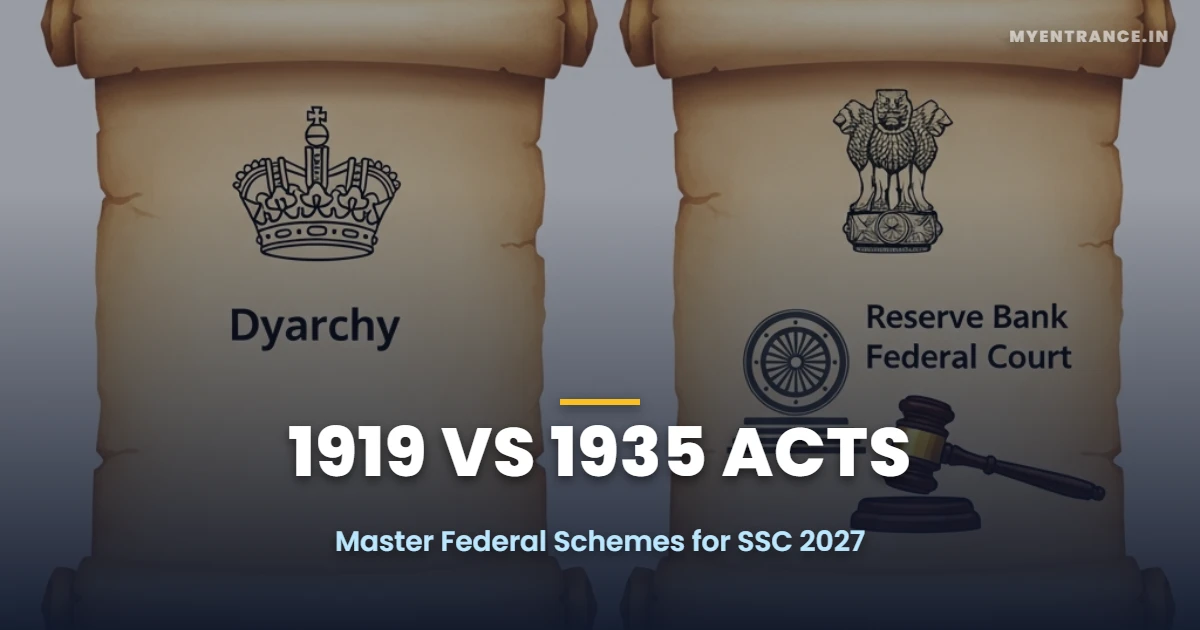
The 1919 Act was a response to the growing nationalist demands and the contribution of India to World War I. Its primary objective was the gradual introduction of responsible government. The key feature was the introduction of Dyarchy (dual government) in the eight major provinces. Under this system, the executive council of the Governor handled ‘Reserved’ subjects (Law and Order, Finance, etc.), while ‘Transferred’ subjects (Education, Health, etc.) were managed by ministers responsible to the Legislative Council. This Act also introduced bicameralism at the center for the first time, consisting of the Council of State and the Legislative Assembly, and extended the principle of communal representation to Sikhs, Indian Christians, Anglo-Indians, and Europeans.
The Government of India Act 1935: A Blueprint for the Future
The 1935 Act was a massive document that served as a major source for the Indian Constitution of 1950. It proposed an All-India Federation consisting of British Indian provinces and Princely States as units. Although the federation never came into existence because the Princely States did not join, the Act fundamentally altered the power structure. It abolished Dyarchy in the provinces and introduced Provincial Autonomy, meaning provinces were no longer under the direct control of the Center for their internal administration. However, Dyarchy was introduced at the Center for federal subjects. The Act also established a Federal Court (1937) and the Reserve Bank of India (1935).
Comparative Analysis for SSC 2027 aspirants
When studying for SSC 2027, focus on these comparative shifts: (1) Dyarchy: 1919 introduced it in Provinces; 1935 abolished it in Provinces but proposed it for the Center. (2) Federal Structure: 1919 maintained a unitary structure with administrative devolution; 1935 proposed a formal Federation. (3) Lists: 1935 introduced the three-fold division of powers—Federal, Provincial, and Concurrent lists—whereas 1919 had a simpler division of central and provincial subjects. (4) Franchise: 1919 granted the right to vote to about 3% of the population; 1935 extended this to about 10% of the total population.
Interactive Flashcard Challenge
Test your knowledge with these 12 interactive flashcards designed for quick revision of the most frequently asked questions in SSC exams.
Detailed Study Guide for SSC 2027: Federal Schemes
To master this topic for SSC 2027, you must understand the evolution of the federal structure. In 1919, the structure was essentially unitary. The central government retained supreme control over the provinces, although some administrative tasks were devolved. By contrast, the 1935 Act envisioned a true federalism. It divided powers through three lists: the Federal List (59 items), the Provincial List (54 items), and the Concurrent List (36 items). Residuary powers, interestingly, were vested in the Viceroy, a point frequently tested in exams.
The impact of these Acts on the modern Indian Constitution cannot be overstated. For instance, the Emergency provisions in our Constitution bear a striking resemblance to the ‘discretionary powers’ of the Governor under the 1935 Act. Furthermore, the division of power into three lists in the Seventh Schedule of our Constitution is a direct descendant of the 1935 legislative structure. For SSC 2027 aspirants, focusing on these legal continuities is the key to solving complex multiple-choice questions.
Why was the 1935 Federal Scheme never implemented?
The proposed All-India Federation of 1935 required a specific number of Princely States to join. Specifically, states representing half the total population of all states and entitled to half the seats in the upper house needed to sign the Instruments of Accession. Due to fears of losing sovereignty and the lack of consensus among rulers, the federation never became a reality, and the central government continued to function under the 1919 Act until 1946.
🚀 Ace your SSC 2027 Preparation!
Need more clarity on the Government of India Acts or any other topic in Indian History and Polity? Our experts are here to help you with personalized guidance and free mock tests.
💬 Chat with our Experts on WhatsApp (+91 9526806124)




