
Introduction: The Pulse of May 2, 2026
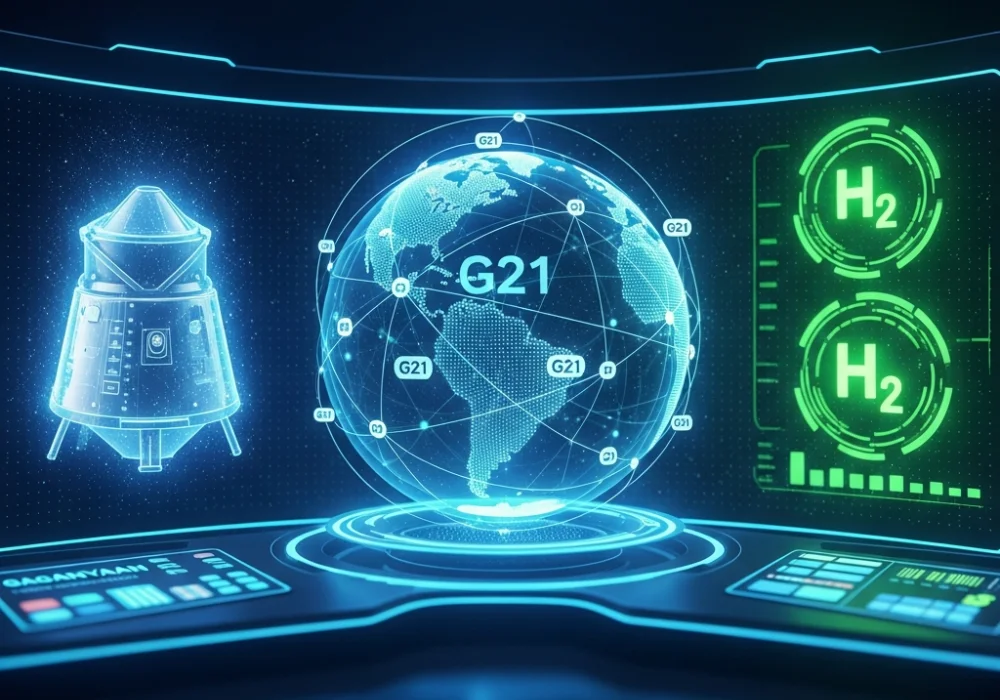
Welcome to www.myentrance.in, your definitive guide for competitive examinations in India. Today, May 2, 2026, marks a pivotal moment in India’s journey toward becoming a global superpower. As aspirants for UPSC, SSC, and Kerala PSC, understanding the nuances of policy shifts and technological advancements is crucial. Today’s analysis covers the monumental progress of ISRO’s Gaganyaan-3, the evolving dynamics of the G21 (formerly G20), and significant milestones in the National Green Hydrogen Mission. Our objective is to provide you with the depth required for Mains answer writing and the precision needed for Prelims and objective-type exams.
1. Space & Technology: The Gaganyaan-3 Paradigm
Today, the Indian Space Research Organisation (ISRO) successfully conducted the ‘Long Duration Hot Test’ of the CE-20 Cryogenic Engine at the ISRO Propulsion Complex (IPRC) in Mahendragiri. This test is the final hurdle before the Gaganyaan-3 mission, India’s most ambitious human spaceflight program slated for late 2026.
Technical Significance
The CE-20 engine powers the cryogenic upper stage of the LVM3 (Launch Vehicle Mark 3). The current test validated the engine’s performance under extreme conditions, ensuring it can withstand the vacuum and thermal stresses of space for the duration of the orbital phase. Unlike the first Gaganyaan mission, which was largely a technology demonstrator, Gaganyaan-3 aims to establish a permanent presence in Low Earth Orbit (LEO).
💡 UPSC Pro-Tip: LVM3 Specifications
The LVM3 is a three-stage heavy-lift vehicle. It consists of two solid rocket boosters (S200), a liquid core stage (L110), and a high-thrust cryogenic upper stage (C25). For Gaganyaan, the vehicle is ‘Human Rated,’ meaning it has added redundancy and an emergency Crew Escape System (CES).
2. Geopolitics: India’s Role in the G21 Digital Infrastructure
As of May 2, 2026, India has chaired a special summit of the G21 (the group having permanently integrated the African Union) focused on ‘Digital Public Infrastructure (DPI) and Global South Sovereignty.’ The primary focus was on the cross-border interoperability of the Unified Payments Interface (UPI) and Ondc (Open Network for Digital Commerce).
Context of G21 Expansion
The inclusion of the African Union under India’s presidency has shifted the focus toward developmental economics rather than just financial stability. India is positioning its ‘India Stack’ as a model for developing nations to bypass legacy banking systems. This is particularly relevant for Kerala PSC aspirants, as the state’s digital literacy missions are being benchmarked by several African nations for local implementation.
Fig 1: Interconnected strategic objectives of India in 2026.
3. Environment: National Green Hydrogen Mission – Phase 2
Today, the Ministry of New and Renewable Energy (MNRE) announced the operationalization of the first three ‘Green Hydrogen Hubs’ in Gujarat, Tamil Nadu, and Odisha. These hubs are designed to produce, store, and export green hydrogen to European and Southeast Asian markets.
Why Green Hydrogen?
Green Hydrogen is produced through the electrolysis of water using renewable energy. By 2026, India aims to produce 5 MMT (Million Metric Tonnes) per annum. The significance of today’s announcement lies in the transition from pilot projects to commercial-scale integration with the national gas grid. This aligns with India’s Net Zero 2070 commitment and reduces the massive import bill for crude oil and LNG.
💡 Click to Reveal: Types of Hydrogen
- Grey Hydrogen: Produced from natural gas (methane) via steam methane reforming; releases CO2.
- Blue Hydrogen: Grey hydrogen but with Carbon Capture and Storage (CCS).
- Green Hydrogen: Produced via electrolysis using renewable electricity; zero emissions.
4. State Focus: Kerala’s SilverLine (K-Rail) Phase 2
In a major development for Kerala PSC candidates, the Union Ministry of Railways today granted ‘In-Principle Approval’ (IPA) for the updated alignment of the SilverLine Semi High-Speed Rail. This project aims to connect Kasaragod to Thiruvananthapuram in less than 4 hours.
Key Highlights
The revised plan focuses on ‘Elevated Corridors’ in flood-prone areas of Alappuzha and Pathanamthitta to mitigate environmental concerns. The project will utilize a Standard Gauge system, different from the Indian Railways’ Broad Gauge, allowing for higher speeds (up to 200 kmph). The funding model involves the Kerala Infrastructure Investment Fund Board (KIIFB) and loans from the Japan International Cooperation Agency (JICA).
5. Economy: The Evolution of Central Bank Digital Currency (e-Rupee)
The Reserve Bank of India (RBI) reported today that the Wholesale e-Rupee (e₹-W) transaction volume surpassed physical currency usage in the interbank call money market for the first time. This marks a significant milestone in India’s financial digitization.
Implications
The transition to CBDC reduces the transaction cost of physical cash management, provides real-time settlement, and minimizes the risk of money laundering. For the general public, the retail e-Rupee (e₹-R) is now being integrated with offline payment modes, enabling transactions in regions with poor internet connectivity, a move specifically targeted at the rural hinterlands of North and Northeast India.
🧠 Interactive Daily Quiz: May 02, 2026
Test your knowledge based on today’s analysis!
Q1. Which engine was recently tested by ISRO for the Gaganyaan-3 mission?
- A) Vikas Engine
- B) CE-20 Cryogenic Engine
- C) Kerolox Engine
- D) Scramjet Engine
✅ Click to Reveal Answer & Deep Explanation
Correct Answer: B) CE-20 Cryogenic Engine
The CE-20 is India’s first high-thrust cryogenic engine, specifically designed for the upper stage of the LVM3. It uses Liquid Oxygen and Liquid Hydrogen. Option A (Vikas) is a liquid engine used in the second stage, whereas Scramjet (Option D) is for air-breathing propulsion still under testing.
Q2. The G20 became the G21 following the permanent inclusion of which organization?
- A) ASEAN
- B) European Union
- C) African Union
- D) BRICS
✅ Click to Reveal Answer & Deep Explanation
Correct Answer: C) African Union
The African Union was officially made a permanent member during India’s G20 Presidency in 2023, effectively making the forum the G21. The EU was already a member. This move was aimed at giving a louder voice to the Global South.
Q3. Green Hydrogen is produced primarily using which process?
- A) Steam Methane Reforming
- B) Fractional Distillation
- C) Water Electrolysis
- D) Nuclear Fission
✅ Click to Reveal Answer & Deep Explanation
Correct Answer: C) Water Electrolysis
Water Electrolysis uses electricity to split water into hydrogen and oxygen. When this electricity comes from renewable sources like solar or wind, the resulting hydrogen is called ‘Green Hydrogen.’ Option A produces ‘Grey’ or ‘Blue’ hydrogen.
Q4. Kerala’s SilverLine project uses which rail gauge?
- A) Broad Gauge (1676 mm)
- B) Meter Gauge (1000 mm)
- C) Standard Gauge (1435 mm)
- D) Narrow Gauge (762 mm)
✅ Click to Reveal Answer & Deep Explanation
Correct Answer: C) Standard Gauge (1435 mm)
Most high-speed and semi-high-speed rail systems globally use Standard Gauge. Indian Railways mostly operates on Broad Gauge, but SilverLine is proposed as a standalone Standard Gauge system to maintain high operational speeds.
Q5. Which Indian state has the highest literacy rate, currently serving as a model for G21 Digital Literacy?
- A) Tamil Nadu
- B) Kerala
- C) Maharashtra
- D) Karnataka
✅ Click to Reveal Answer & Deep Explanation
Correct Answer: B) Kerala
Kerala continues to lead India in literacy. Its Digital Literacy campaigns (like Digi-Keralam) have become benchmarks for developing nations within the G21 framework to ensure equitable access to digital public services.
Q6. What does the ‘W’ stand for in ‘e₹-W’ recently highlighted by the RBI?
- A) Wireless
- B) Wholesale
- C) Wealth
- D) Worldwide
✅ Click to Reveal Answer & Deep Explanation
Correct Answer: B) Wholesale
The RBI launched two versions of the Central Bank Digital Currency: Retail (e₹-R) for the general public and Wholesale (e₹-W) for interbank settlements and institutional use. Wholesale transactions involve larger volumes and fewer parties.
Q7. The MNRE announced three Green Hydrogen Hubs. Which of the following is NOT one of them?
- A) Gujarat
- B) Tamil Nadu
- C) Odisha
- D) Punjab
✅ Click to Reveal Answer & Deep Explanation
Correct Answer: D) Punjab
The three hubs announced today are Gujarat (focusing on chemical industries), Tamil Nadu (focusing on shipping), and Odisha (focusing on steel). Punjab, being landlocked, is not part of the initial maritime-export-focused ‘Hub’ phase.
Q8. India’s target for Green Hydrogen production by 2030 is:
- A) 1 MMT
- B) 5 MMT
- C) 10 MMT
- D) 50 MMT
✅ Click to Reveal Answer & Deep Explanation
Correct Answer: B) 5 MMT
Under the National Green Hydrogen Mission, India aims to build a production capacity of at least 5 Million Metric Tonnes per year by 2030, supported by an addition of about 125 GW of renewable energy capacity.
Q9. Which organization provides major financial backing for the Kerala SilverLine project?
- A) World Bank
- B) IMF
- C) JICA
- D) ADB
✅ Click to Reveal Answer & Deep Explanation
Correct Answer: C) JICA (Japan International Cooperation Agency)
JICA is a primary external funding partner for several high-speed rail and infrastructure projects in India, including the SilverLine in Kerala. They provide long-term, low-interest soft loans.
Q10. Who is the current Chairman of ISRO (as of the Gaganyaan-3 progress in 2026)?
- A) S. Somanath
- B) K. Sivan
- C) G. Madhavan Nair
- D) A.S. Kiran Kumar
✅ Click to Reveal Answer & Deep Explanation
Correct Answer: A) S. Somanath
S. Somanath has been the visionary leader guiding ISRO through the post-Chandrayaan-3 era and into the human spaceflight mission of Gaganyaan. His leadership has seen the successful commercialization of LVM3 and the expansion of the PSLV launch manifest.
Need more guidance or free mock tests?
Our experts are here to help you crack UPSC and Kerala PSC exams with personalized study plans.
💬 Chat with our Experts on WhatsApp (+91 9526806124)




