
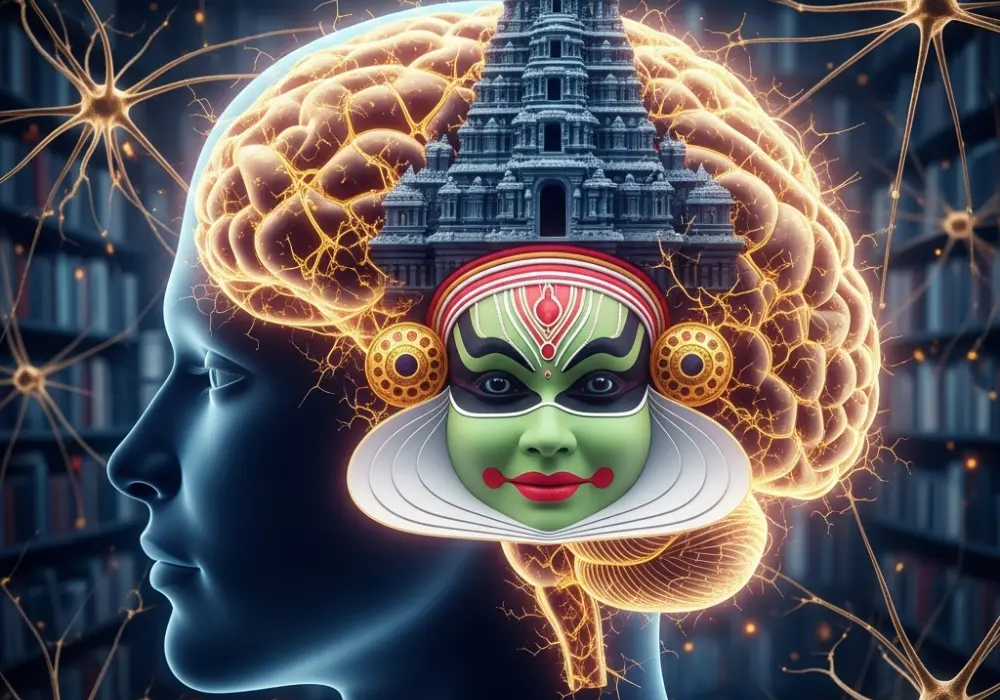
Introduction: Why Culture and Why Mnemonics?
Cultural Knowledge is a goldmine for Kerala PSC exams. Whether it is the LDC, Degree Level, or KAS, questions about Kerala’s ritual arts, Indian classical dances, and legendary poets are guaranteed. However, the sheer volume of names, dates, and locations can be overwhelming. This guide is your secret weapon. As a world-class memory coach, I will teach you how to use visual association, the ‘Method of Loci’, and absurd acronyms to burn these facts into your long-term memory. We are not just studying; we are building a mental library that is impossible to forget. By the end of this guide, you will have mastered over 100+ cultural facts using only 10 powerful memory hacks.
💡 Pro-Tip for Memory Palaces
Always imagine the images as oversized, brightly colored, and moving. If you imagine a ‘Theyyam’ dancer, don’t just see a picture; imagine him jumping into your living room and knocking over a vase. The more emotion and action you add, the stronger the neural connection becomes!
1. The Eight Classical Dances (The Dance Party Story)
Most students struggle to remember all eight classical dances recognized by the Sangeet Natak Akademi. Use this absurd story: ‘KATHA-KALI and MO-HINI met BHARATA at the KUCHI-PUDI shop in ODISSA to eat MANI-PURI and SATTRIYA KATHAK.’
- KATHA-KALI: Kathakali (Kerala)
- MO-HINI: Mohiniyattam (Kerala)
- BHARATA: Bharatanatyam (Tamil Nadu)
- KUCHI-PUDI: Kuchipudi (Andhra Pradesh – Imagine ‘Kuchi’ like a raw ‘Kucha’ poori)
- ODISSA: Odissi (Odisha)
- MANI-PURI: Manipuri (Manipur)
- SATTRIYA: Sattriya (Assam – ‘Sattriya’ sounds like ‘Tea’ which comes from Assam)
- KATHAK: Kathak (North India/UP)
By visualizing these dancers sitting together in a shop eating puris, you instantly link the name of the dance to its origin. Notice how Kerala has two entries? Visualize them as the hosts of the party.
💡 Click to Test Your Knowledge
Which classical dance is from Assam? Answer: Sattriya. (Think: Sattriya = Tea = Assam).
2. The Modern Trio of Malayalam Poetry (The AVU Van)
The three great poets who modernized Malayalam literature are Kumaran Asan, Vallathol Narayana Menon, and Ulloor S. Parameswara Iyer. Forget their long names and remember the AVU Van.
- A: Asan (Kumaran Asan – The poet of freedom and change)
- V: Vallathol (The one who established Kerala Kalamandalam)
- U: Ulloor (The great scholar-poet)
Imagine a bright yellow van with ‘AVU’ written on it. Inside the van, Asan is throwing ‘Apples’ (Asan/Apple), Vallathol is wearing a ‘Violin’ (V for Vallathol), and Ulloor is holding an ‘Umbrella’ (U for Ulloor). This simple visual link prevents you from confusing them with other poets like G. Sankara Kurup.
3. Classical Languages of India (The Timeline Acronym)
India currently recognizes 6 classical languages. The order of recognition is often asked. Use the acronym: ‘T-S-K-T-M-O’ (Tamil Students Keep Telling Malayalam Orations).
- T: Tamil (2004 – The first one!)
- S: Sanskrit (2005)
- K: Kannada (2008)
- T: Telugu (2008)
- M: Malayalam (2013)
- O: Odia (2014)
Imagine a Tamil student standing in 2004, and by the time he finishes his Malayalam Orations, it is 2014. Remembering that Malayalam was added in 2013 is a frequent Kerala PSC question!
4. The Ritual Arts of Kerala (The Masked Trio)
Kerala’s ritual arts often confuse students. Let’s group Theyyam, Mudiyettu, and Padayani. Imagine a ritual fire in the middle of a forest.
- Theyyam: The ‘God’ (Deivam) who walks. (North Malabar)
- Mudiyettu: Imagine a ‘Mudi’ (Hair/Crown). It is about the battle between Kali and Darika. (UNESCO Intangible Heritage)
- Padayani: Imagine a ‘Pada’ (Army) of people wearing masks made of Areca palm. (Central Travancore)
Mnemonic: ‘The Mudi is on Fire for the Pada’. This links Theyyam (Fire/Ritual), Mudiyettu (Mudi), and Padayani (Pada).
💡 UNESCO Fact Alert
Mudiyettu and Koodiyattam are both on the UNESCO Representative List of the Intangible Cultural Heritage of Humanity. Koodiyattam is the oldest surviving theatre form.
5. Martial Arts: The ‘K-S-G-T’ Map
Martial arts are a key part of cultural history. Let’s map India through combat:
- K: Kalaripayattu (Kerala – Mother of all martial arts)
- S: Silambam (Tamil Nadu – ‘S’ for South/Sillu)
- G: Gatka (Punjab – ‘G’ for Guru/Gatka)
- T: Thang-Ta (Manipur – ‘T’ for Top/Manipur is at the top right of the map)
Imagine a fighter starting in Kerala, moving to South Tamil Nadu, flying to the Great Punjab, and ending at the Top in Manipur.
6. Navaratnas of Vikramaditya (The Gem Story)
To remember the 9 gems (Navaratnas) in Vikramaditya’s court: ‘K-V-V-D-S-K-A-G-B’. Use the sentence: ‘King Varahamihira Visited Dhanvantari to See Kalidasa’s Amazing Golden Boat.’
- K: Kalidasa (Poet)
- V: Varahamihira (Astronomer)
- V: Vararuchi (Grammarian)
- D: Dhanvantari (Physician)
- S: Shapanaka (Astrologer)
- K: Kshapanaka
- A: Amarasimha (Lexicographer)
- G: Ghatakarpara (Sculptor)
- B: Betal-Bhatta (Magician)
Focus on Kalidasa (Poetry), Varahamihira (Science), and Dhanvantari (Medicine) as they are the most frequently asked.
7. Painting Schools: ‘M-P-K’ Visuals
Remember the three major painting styles for PSC:
- M: Madhubani (Bihar – Think of ‘Madhu’ (Honey) in Bihar)
- P: Pattachitra (Odisha – ‘Patta’ means cloth in Sanskrit)
- K: Kangra (Himachal Pradesh – ‘Kangra’ sounds like ‘Kangaroo’ in the cold mountains)
Imagine a Kangaroo (Kangra) eating Honey (Madhubani) off a Cloth (Pattachitra).
8. Famous Kerala Festivals: The Season Mnemonic
Chronology of festivals is vital. Vishu -> Onam -> Thiruvathira.
- Vishu: New Year (April – V is for Vitamin D from the summer sun)
- Onam: Harvest (Aug/Sept – O is for Overall abundance)
- Thiruvathira: Winter/Women (Dec/Jan – T is for Temperature drop)
Remember V.O.T. (Voters of Kerala celebrate festivals). V(4), O(8), T(12) representing the months of the year approximately.
9. The Memory Palace of Kerala Museums
Imagine walking through your own house:
- Entrance: Napier Museum (Trivandrum) – Imagine a ‘Napier’ grass carpet at your door.
- Living Room: Hill Palace (Tripunithura/Ernakulam) – Imagine your sofa is on a ‘Hill’.
- Kitchen: Teak Museum (Nilambur/Malappuram) – Imagine your kitchen cabinets are made of ‘Teak’.
- Bedroom: Mural Art Museum (Thrissur) – Imagine ‘Murals’ on your bedroom walls.
By placing these museums in your house, you will never forget their locations during the exam pressure.
10. Quick Revision Table of Mnemonics
| Topic | Mnemonic / Key | Fact Recall |
|---|---|---|
| Classical Dances | Katha-Kali & Mohini met Bharata… | 8 Major Indian Dances |
| Poet Trio | AVU Van | Asan, Vallathol, Ulloor |
| Classical Lang. | T-S-K-T-M-O | Tamil (2004) to Odia (2014) |
| Martial Arts | K-S-G-T Map | Kalari, Silambam, Gatka, Thang-Ta |
Ready to Ace Your Exams?
Don’t let complex cultural facts hold you back. Our experts at MyEntrance are here to provide you with the best mock tests, study materials, and personalized guidance for all Kerala PSC exams.
💬 Chat with our Experts on WhatsApp (+91 9526806124)




