
Table of Contents
- The Science of Learning: Understanding Neuroplasticity
- Key Cognitive Domains for Competitive Exams
- Top Brain Training Techniques for Faster Prep
- Lifestyle Habits to Supercharge Your Brain
- Active Learning vs. Passive Reading Comparison
- Expert Methodology: Why This Works
- Frequently Asked Questions
- Quick Knowledge Check
The Science of Learning: Understanding Neuroplasticity
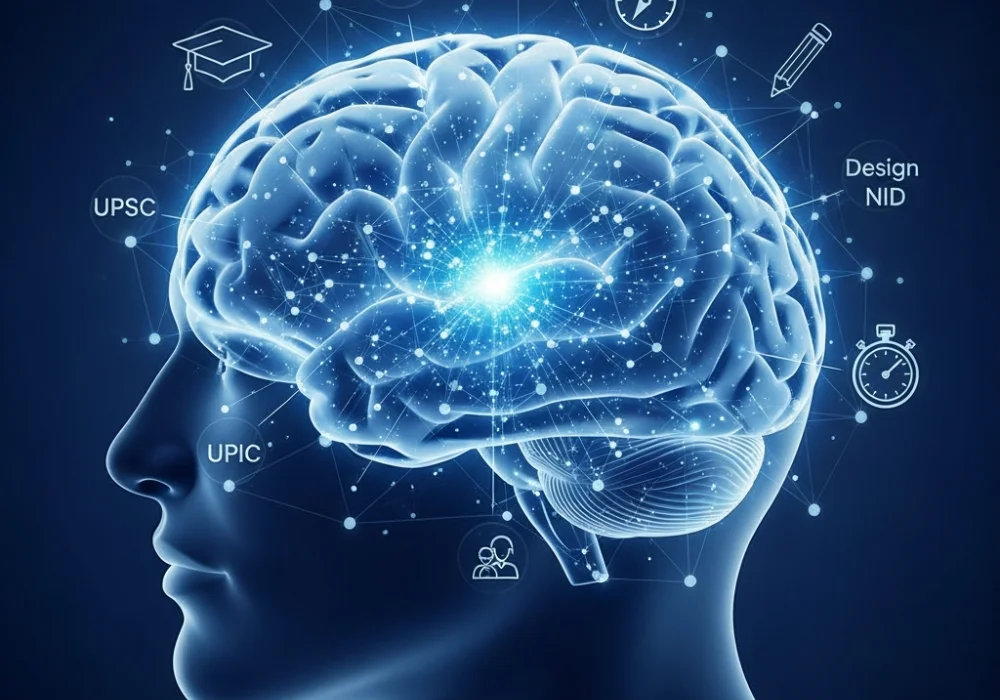
Preparing for high-stakes exams like the UPSC, SSC, or NID DAT requires more than just long hours of reading. It requires an optimized brain. The concept of neuroplasticity is at the heart of cognitive improvement. This is the brain’s remarkable ability to reorganize itself by forming new neural connections throughout life. When you engage in targeted brain training, you are physically re-wiring your brain to handle complex information more efficiently.
For students tackling the Kerala PSC or NIFT GAT, understanding that the brain is like a muscle is the first step. If you challenge it correctly, it grows stronger. Traditional methods often rely on rote memorization, which is a fragile way to store data. By leveraging cognitive science, we move toward deep encoding, ensuring that the latest pattern questions become intuitive rather than a struggle.
💡 Pro Tip: The 10-Minute Principle
Spend just 10 minutes after every 2 hours of study doing a high-intensity cognitive task, like a logic puzzle or a quick mock test segment on myentrance.in, to reset your focus and consolidate memory.
Key Cognitive Domains for Competitive Exams
Success in upcoming exams depends on several distinct cognitive functions. Each requires a different training approach:
- Working Memory: This is your mental workspace. It helps you hold and manipulate information while solving SSC CGL quantitative aptitude problems or logical reasoning tasks.
- Selective Attention: The ability to focus on relevant stimuli while ignoring distractions. Crucial for long UPSC reading comprehension passages.
- Processing Speed: How quickly you can absorb information and respond. This is the difference-maker in time-bound exams like NIFT GAT.
- Pattern Recognition: Essential for NID DAT visual logic and sequence-based questions.
By training these specific domains, you aren’t just learning subjects; you are upgrading the hardware that processes them. Myentrance.in offers mock tests specifically designed to challenge these domains, simulating the mental fatigue of the real exam environment.
Top Brain Training Techniques for Faster Prep
1. Spaced Repetition (The Ebbinghaus Hack)
The Forgetting Curve is a student’s worst enemy. Spaced repetition involves reviewing material at increasing intervals (e.g., 1 day, 3 days, 7 days, 30 days). This forces the brain to retrieve information just as it’s about to be forgotten, strengthening the neural pathway. This is highly effective for the vast syllabus of Kerala PSC and SSC general awareness.
2. Dual N-Back Training
Research suggests that Dual N-Back exercises can improve fluid intelligence and working memory. It involves tracking both a visual and auditory stimulus simultaneously. While it sounds difficult, just 20 minutes a day can significantly increase your ability to multitask during complex exam sections.
3. The Method of Loci (Memory Palace)
Top rankers in the UPSC often use visualization. By mentally placing facts in a familiar physical environment (like your childhood home), you can recall vast lists of historical dates or constitutional articles by simply ‘walking’ through the rooms in your mind.
💡 Practice Tip: Active Recall
Instead of re-reading a chapter, close the book and write down everything you remember. This struggle is what actually signals your brain to store the information permanently.
Lifestyle Habits to Supercharge Your Brain
Cognitive skill isn’t just about puzzles; it’s about biology. To prepare for upcoming exams at peak performance, consider the following:
- Hydration and Brain Fog: Even mild dehydration can shrink brain tissue and impair concentration. Aim for 3 liters of water daily.
- The Sleep-Consolidation Link: Sleep is when your brain moves information from short-term to long-term memory. Missing sleep is equivalent to deleting your day’s work.
- Nutritional Support: Omega-3 fatty acids (found in walnuts and flaxseeds) and antioxidants (berries) support the structural integrity of neurons.
Engaging with high-quality mock tests on myentrance.in works best when your body is fueled and rested. A tired brain cannot form the complex connections needed for NID DAT creativity or SSC speed.
Active Learning vs. Passive Reading Comparison
Which method is better for your exam prep? Use this table to decide where to spend your energy.
| Feature | Passive Reading | Active Brain Training |
|---|---|---|
| Retention Rate | Low (approx. 10-20%) | High (approx. 70-90%) |
| Time Efficiency | Seems fast, requires many re-reads | Slower initially, saves weeks of revision |
| Cognitive Load | Low (leads to boredom) | High (leads to neuroplasticity) |
| Exam Readiness | Poor under pressure | Excellent for current syllabus formats |
Expert Methodology: Why Trust This Content
This guide is developed based on core educational principles cited by institutions like the NCERT and modern cognitive psychology research. Our methodology focuses on “Evidence-Based Learning Strategies” which prioritize retrieval practice over mere exposure. At myentrance.in, we track the performance of thousands of aspirants to identify which training habits lead to the highest percentile shifts in UPSC and SSC results. Our content follows the latest pattern guidelines provided by official exam conducting bodies to ensure you are training for the right challenges.
Frequently Asked Questions
How long does it take to see results from brain training?
Most students report increased focus and faster reading speeds within 2 to 3 weeks of consistent practice. Long-term memory improvements for exams like Kerala PSC usually manifest after one full cycle of spaced repetition (about a month).
Can these techniques help with the NID DAT and NIFT GAT exams?
Absolutely. NID and NIFT require high levels of spatial visualization and creative problem-solving. Techniques like mindfulness and pattern recognition training directly improve the ‘Right Brain’ functions needed for design entrance exams.
Is it better to do mock tests before or after brain training?
Use brain training as a ‘warm-up’. Doing a quick logic drill or visualization exercise before starting a mock test on myentrance.in primes your neurons for higher performance.
Quick Knowledge Check
Test your understanding of cognitive skills for exams!
1. Which technique involves placing facts in a mental room?
💡 Click to Reveal Answer
The Method of Loci (or Memory Palace).
2. What is the main benefit of Active Recall?
💡 Click to Reveal Answer
It strengthens the neural path for retrieval, ensuring you don’t ‘blank out’ during the exam.
3. True or False: Neuroplasticity stops after the age of 20.
💡 Click to Reveal Answer
False. The brain remains plastic and capable of growth throughout your entire life!
Ready to Ace Your Upcoming Exams?
Don’t just study hard, study smart. Access the highest quality mock tests for Kerala PSC, SSC, UPSC, NIFT, and NID DAT on our platform today.
💬 Chat with our Experts on WhatsApp (+91 9526806124)




