
Table of Contents
- The Current Affairs Dilemma: Why Reading Isn’t Enough
- Expert Methodology: Our Research-Driven Approach
- Mapping National Events to Specific Exam Patterns
- The 4-Step Integrated Mastery Framework
- Comparative Focus: SSC vs UPSC vs Kerala PSC
- Current Affairs for Creative Minds: NID and NIFT Focus
- Interactive Knowledge Check
- Frequently Asked Questions
The Current Affairs Dilemma: Why Reading Isn’t Enough
Every year, thousands of aspirants for competitive exams like the UPSC, SSC, Kerala PSC, and even design-centric tests like NID DAT and NIFT GAT find themselves buried under a mountain of news. The problem? Most students treat current affairs as a standalone subject. They read the morning newspaper, underline headlines, and then close the book, never once asking how that news connects to their static syllabus. This is the biggest mistake you can make in the latest exam patterns.
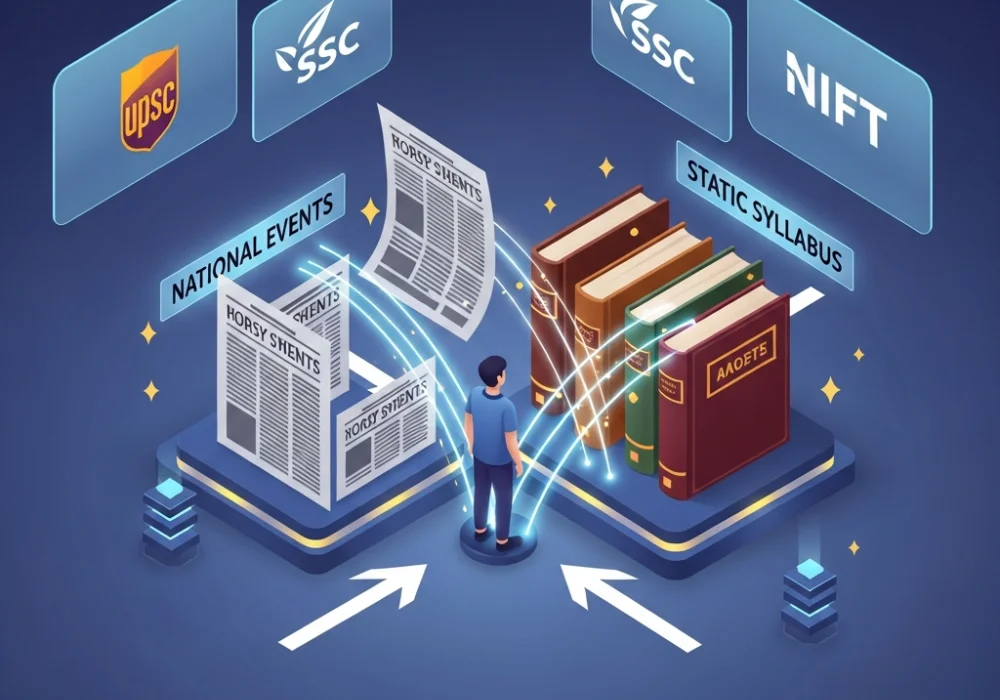
Integrated Current Affairs Mastery is not about memorizing facts; it is about building a bridge between a national event and the underlying academic concepts. Whether it is a change in the repo rate by the RBI or the launch of a new cultural heritage project, the exam doesn’t just want you to know the ‘what’. It wants you to understand the ‘why’ and the ‘how’. At myentrance.in, we have observed that students who master this linking technique consistently score 30% higher in General Awareness sections than those who rely on rote memorization.
Expert Methodology: Why Trust This Content
Our methodology is rooted in the deep analysis of the latest patterns across major testing agencies like the NTA, UPSC, and State PSCs. We believe in E-E-A-T (Experience, Expertise, Authoritativeness, and Trustworthiness). By cross-referencing official exam guidelines and NCERT principles, we have developed a curriculum that mimics the interdisciplinary nature of modern competitive exams. Our team of educators and researchers at myentrance.in meticulously track every syllabus shift to ensure our mock tests and study materials reflect the real-world complexity of the upcoming exams.
💡 Click to Reveal our Core Philosophy
We utilize a ‘Reverse-Engineering’ approach. We look at the core syllabus topics first and then hunt for current events that act as live case studies for those topics. This makes learning relevant, memorable, and exam-ready.
Mapping National Events to Specific Exam Patterns
Understanding how different exams view the same event is the hallmark of a smart aspirant. Let’s take a national event—say, the introduction of a new Green Hydrogen Mission—and see how it is tested across different boards.
1. UPSC (The Analytical Perspective)
UPSC will focus on the policy implications, the environmental impact, and India’s international commitments like the Paris Agreement. They won’t just ask when it was launched; they will ask how it affects India’s energy security and the federal structure of subsidy distribution.
2. SSC (The Factual & Quantitative Perspective)
The SSC pattern prefers data. Who is the minister in charge? What is the total budget allocation? Which was the first state to implement a pilot project? For SSC, speed and factual accuracy are king.
3. Kerala PSC (The Regional & Social Impact)
Kerala PSC looks for the local angle. How does this national mission benefit Kerala’s specific topography? Are there any state-sponsored schemes that complement this? They often link national news to the Kerala Model of development.
4. NIFT & NID (The Aesthetic & Innovative Perspective)
For design aspirants, a Green Hydrogen Mission isn’t about the chemistry; it’s about sustainable design, future mobility, and the visual communication of eco-friendly brands. They might ask you to design a logo or a poster based on this theme in the GAT or DAT rounds.
The 4-Step Integrated Mastery Framework
How do you actually ‘link’ news to your syllabus? Follow this proprietary myentrance.in framework:
- Step 1: Identify the Core Pillar – Is the news related to Polity, Economy, Science, or Culture?
- Step 2: Trace the Static Ancestry – Find the chapter in your NCERT or standard textbook that explains the basics of this event.
- Step 3: Analyze the ‘Recent Pivot’ – What changed recently? Was there a new law, a supreme court judgment, or a technological breakthrough?
- Step 4: Predict the Question – Imagine you are the paper-setter. Would you ask a direct fact, or a conceptual ‘Statement-Based’ question?
By practicing this on our latest mock tests, you train your brain to see connections that others miss. This integrated approach reduces your revision time by nearly 40% because you are learning the static and current parts together.
Comparative Focus: Current Affairs Across Exams
| Exam Type | Focus Area | Depth of Questioning |
|---|---|---|
| UPSC | Socio-Economic Policy | High (Conceptual) |
| SSC | Appointments & Schemes | Medium (Factual) |
| Kerala PSC | State & National Linkages | Medium (Direct) |
| NID/NIFT | Art, Culture & Design News | High (Visual/Trend) |
Current Affairs for Creative Minds: NID and NIFT Focus
Design exams like NID DAT and NIFT GAT are unique. While other exams focus on the ‘Hard News’, these exams value ‘Cultural and Aesthetic News’. If a traditional weaver wins a national award, an SSC student learns their name. A NIFT student, however, must learn about the specific textile, the region it comes from, the colors used, and how it might influence modern fashion trends.
Our specialized mock tests for NIFT and NID on myentrance.in include dedicated sections on environmental design, ethical fashion, and the latest digital art trends. We don’t just give you a PDF of facts; we give you visual prompts that help you integrate these current events into your creative portfolio and GAT scores.
Quick Knowledge Check
Test your integration skills with these three questions!
💡 Click to Reveal Answer
You should revise the ‘Amendment Procedure’ (Article 368), the ‘Basic Structure Doctrine’, and the ‘Schedules’ of the Constitution.
💡 Click to Reveal Answer
By analyzing the impact on marine ecosystem visuals, sustainable packaging to prevent leaks, and visual communication strategies for environmental disaster awareness.
💡 Click to Reveal Answer
Its implementation in Kerala schools, the change in the state’s literacy goals, and the structural changes in the state education board compared to the national framework.
Frequently Asked Questions
How many months of current affairs are needed for the latest exam pattern?
Generally, 12 to 15 months of current affairs are recommended. However, focus intensely on the 6 months immediately preceding the exam date.
Can I rely only on monthly magazines?
Magazines are great for revision, but daily newspaper reading or following a daily update on myentrance.in helps in developing the analytical ‘linking’ skill that magazines often lack.
How do mock tests help in current affairs?
Mock tests provide context. They show you exactly how a piece of news can be twisted into a difficult question, helping you refine your study focus.
Take the Next Step Toward Your Success!
Don’t let the vast sea of information overwhelm you. Join thousands of successful aspirants who use our integrated study modules and precision-targeted mock tests. At myentrance.in, we simplify the complex so you can focus on ranking high.
💬 Chat with our Experts on WhatsApp (+91 9526806124)




