
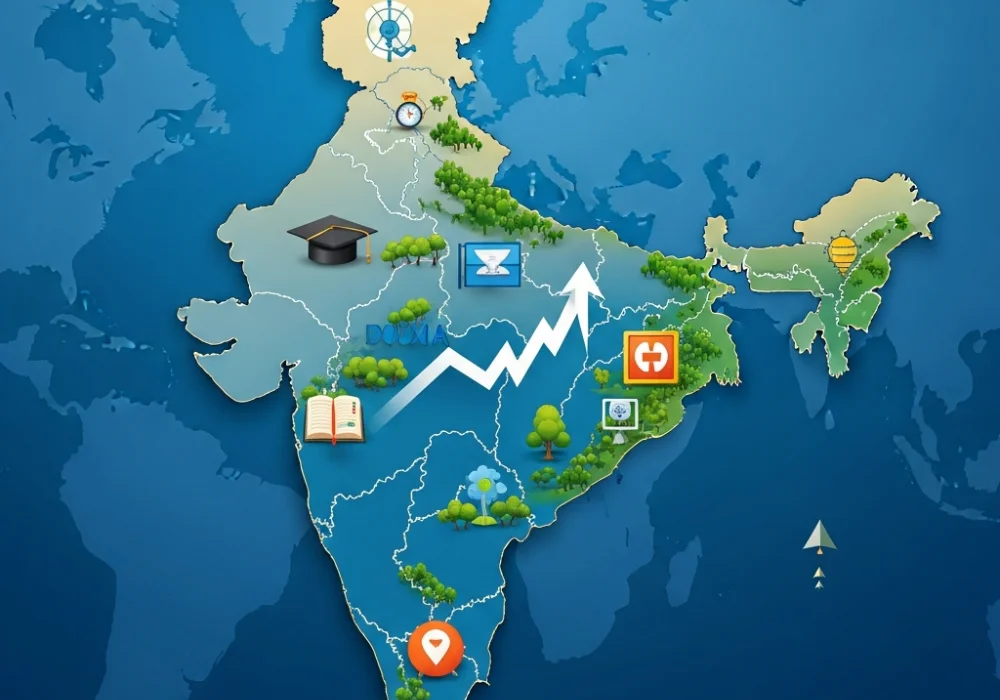
Decoding the Vision: Viksit Bharat 2047 and the Sustainable Development Goals
For any UPSC aspirant, understanding the roadmap to a ‘Developed India’ by 2047 is not just a syllabus requirement; it is the cornerstone of administrative thinking. The transition from a developing economy to a developed one requires a meticulous evaluation of intermediate milestones and their alignment with the United Nations Sustainable Development Goals (SDGs). In the General Studies papers, specifically GS Paper II (Governance and Social Justice) and GS Paper III (Economy and Environment), questions often revolve around the efficacy of government schemes, the structural shifts in the economy, and the progress metrics provided by NITI Aayog. This guide decodes the logic of such questions using high-level analytical frameworks and our signature ‘Ninja Shortcuts’ to help you navigate complex descriptive and objective patterns.
Simulated Question 1: The Multi-Dimensional Poverty Paradox
Question: “While India has seen a significant decline in the Multi-dimensional Poverty Index (MPI) scores as per recent reports, the path to Viksit Bharat 2047 requires addressing the ‘last-mile’ connectivity in health and nutrition. Critically analyze the progress of SDG 1 (No Poverty) and SDG 2 (Zero Hunger) in the context of India’s intermediate milestones.”
Core Concepts
To answer this, one must understand that poverty is no longer defined merely by income. The Multi-dimensional Poverty Index (MPI) tracks deprivations in health, education, and standard of living. India has lifted over 25 crore people out of poverty in the last decade, yet the ‘hunger’ component (Global Hunger Index vs. NFHS data) remains a point of contention. The intermediate milestones for 2047 involve bridging the rural-urban divide through schemes like POSHAN Abhiyaan and the Jal Jeevan Mission.
The Traditional Method
A typical student will list 5 schemes (PDS, MGNREGA, PM-GKAY), cite some data from the Economic Survey, and conclude that progress is good but more needs to be done. This is a 4/10 approach.
The 30-Second Ninja Shortcut
Use the “Triangle of Progress” Framework: Mention 1. Access (Infrastructure), 2. Affordability (Subsidies), and 3. Utilization (Behavioral Change). Focus on ‘Structural Transformation’—mention that as we move toward 2047, we must shift from ‘Calamity Relief’ (free food) to ‘Productivity Enhancement’ (skill building). Keywords: ‘Calorie to Nutrition shift’, ‘Human Capital Index’.
💡 Click to Reveal Examiner’s Tip
Always mention the NITI Aayog SDG India Index. It shows you know the internal monitoring mechanism of the country. Note that Bihar and Jharkhand are catching up faster (Convergence Theory), which is a key milestone for 2047.
Simulated Question 2: Human Capital and the NEP 2020
Question: “The National Education Policy (NEP) 2020 is touted as the foundation for Viksit Bharat. How does the integration of vocational training and digital literacy fulfill SDG 4 (Quality Education) targets?”
Core Concepts
India’s demographic dividend is a double-edged sword. To reach developed nation status by 2047, the Gross Enrolment Ratio (GER) in higher education needs to double. SDG 4 emphasizes lifelong learning opportunities. The intermediate milestones include 100% foundational literacy and numeracy (FLN) by 2026-27 and making India a ‘Global Knowledge Superpower’.
The Traditional Method
Discussing the 5+3+3+4 structure of schooling and the importance of mother tongue education. This is descriptive but lacks the ‘Economic Evaluation’ needed for high marks.
The 30-Second Ninja Shortcut
Apply the “Skill-Stacking” logic. Argue that Viksit Bharat 2047 requires ‘Horizontal Mobility’ (moving between different jobs) and ‘Vertical Depth’ (specialization). Link Digital Infrastructure (DIKSHA, SWAYAM) directly to the reduction of the ‘Digital Divide’—a prerequisite for SDG 10 (Reduced Inequalities).
💡 Click to Reveal Pro-Trick
In UPSC Previous Year Questions, whenever education is mentioned, always link it to ‘Economic Productivity’ and ‘Labor Force Participation’. If the youth are educated but not employable, Viksit Bharat remains a dream. Use the term ‘Employability Quotient’.
Simulated Question 3: The FLFPR and Gender Parity
Question: “Evaluate the trends in Female Labour Force Participation Rate (FLFPR) in India. Can India achieve its 2047 milestones without realizing SDG 5 (Gender Equality)?”
Core Concepts
FLFPR has shown a rising trend recently (Periodic Labour Force Survey), but much of it is in unpaid family labor or agriculture. For a $30 trillion economy (the target for 2047), women’s contribution to GDP must rise significantly. SDG 5 is not just social; it is a hard economic necessity.
The Traditional Method
Writing about ‘Beti Bachao Beti Padhao’ and women’s reservation bill. While relevant, it doesn’t address the ‘Progress Evaluation’ aspect of the prompt.
The 30-Second Ninja Shortcut
Use the “Double Burden” Analysis. Mention that while FLFPR is rising, the ‘Care Economy’ (unpaid domestic work) is the biggest hurdle. Suggest that the 2047 milestone requires ‘Gender-neutral Urban Planning’ and ‘Childcare Infrastructure’ as public goods. Link this to the ‘Care-Work Balance’ mentioned in NITI Aayog Strategy papers.
💡 Click to Reveal Hidden Data
Fact check: According to some estimates, closing the gender gap could add up to 27% to India’s GDP. Mentioning this ‘Potential GDP Gain’ is a high-scoring move in UPSC GS Paper III.
Simulated Question 4: Green Growth and Net Zero
Question: “India’s ‘Panchamrit’ pledge at COP26 and the goal of Net Zero by 2070 seem at odds with the rapid industrialization required for Viksit Bharat 2047. Discuss how SDG 7 (Affordable and Clean Energy) and SDG 13 (Climate Action) can be synchronized with growth.”
Core Concepts
This is the ‘Development vs. Environment’ debate updated for the 21st century. The milestone for 2047 includes 50% non-fossil fuel capacity by 2030 (an intermediate step). The integration involves Green Hydrogen, the International Solar Alliance, and PM-KUSUM. Growth must be ‘Decoupled’ from carbon emissions.
The Traditional Method
Listing the renewable energy targets (500 GW). This is a data dump. It lacks the ‘Evaluation’ of progress toward a developed state.
The 30-Second Ninja Shortcut
Use the “Circular Economy” Concept. Argue that Viksit Bharat isn’t just about ‘Producing More’ but ‘Wasting Less’. Mention the ‘LiFE’ (Lifestyle for Environment) movement launched by India. Frame Green Growth as a ‘New Growth Engine’ (creating jobs in EV, Solar) rather than a ‘Cost’.
💡 Click to Reveal Key Terminology
Use the term “Just Transition”. It means ensuring that as we move away from coal, the workers in the coal belt (Jharkhand, Odisha) are not left behind. This is crucial for SDG 8 (Decent Work).
Simulated Question 5: Governance and Digital Public Infrastructure (DPI)
Question: “Digital Public Infrastructure (DPI) has been a game-changer for India’s governance. To what extent does this progress contribute to SDG 16 (Peace, Justice, and Strong Institutions) and the vision of Viksit Bharat?”
Core Concepts
India’s ‘Stack’ (Aadhaar, UPI, DigiLocker) is now a global model. It promotes transparency, reduces leakages (Direct Benefit Transfer), and ensures ‘Minimum Government, Maximum Governance’. The 2047 milestone is a ‘Paperless, Faceless, Cashless’ administration.
The Traditional Method
Describing how UPI works or listing the number of Jan Dhan accounts. This is too basic for the UPSC Mains.
The 30-Second Ninja Shortcut
Apply the “Trust-as-Infrastructure” logic. Explain that DPI builds ‘Social Trust’ by removing intermediaries (Middlemen). This strengthens the ‘Social Contract’—the core of SDG 16. Use the phrase ‘Democratization of Data’ to show how the common man is empowered.
💡 Click to Reveal Exam Logic
In UPSC Previous Year Questions, governance is often linked to ‘Inclusion’. Mention how DPI has enabled the ‘E-Shram’ portal for unorganized workers, thus bringing the invisible workforce into the formal safety net.
The Master Cheat Sheet: Viksit Bharat vs. SDG Milestones
Use this table for quick revision and to add “Value-Added Points” in your answers.
| Sector | Relevant SDG | 2047 Milestone / Target | Ninja Keyword |
|---|---|---|---|
| Economy | SDG 8 & 9 | $30 Trillion GDP | Middle-Income Trap avoidance |
| Energy | SDG 7 & 13 | Energy Independence | Green Hydrogen Hub |
| Social | SDG 5 & 10 | Saturation of Schemes | Antyodaya to Sarvodaya |
| Innovation | SDG 9 | Global R&D Hub | Anusandhan National Research Foundation |
Final Summary of Progress Evaluation
- Institutional Strength: India is moving from ‘Policy Paralysis’ to ‘Policy Action’ via Gati Shakti.
- Rural Transformation: The Rurban Mission and SVAMITVA are digitizing the rural economy.
- Sustainability: India is the only G20 nation on track to achieve its climate goals before time.
- Strategic Autonomy: Moving from an importer to an exporter (especially in Defense and Electronics).
Ready to Ace the UPSC Exam?
Don’t let complex topics like Viksit Bharat 2047 overwhelm you. Our experts at MyEntrance are here to simplify the journey with personalized mentorship and high-quality mock tests.
💬 Chat with our Experts on WhatsApp (+91 9526806124)




