
Expert Methodology: Why Trust This Guide?
Our curriculum at myentrance.in is developed by seasoned design educators and alumni from premier institutes like NID and NIFT. This guide follows the core principles of visual literacy and spatial reasoning found in NCERT art education guidelines and international design entrance standards. Every exercise listed below is designed to bridge the gap between imagination and execution, ensuring your hand moves as fast as your creative brain. By practicing these, you are not just drawing; you are building the neuro-muscular pathways required for professional design work.
Table of Contents
- The Importance of Sketching in Design Tests
- 1. Master of Lines: Ghosting Technique
- 2. Geometric Primitive Drills
- 3. Rapid Gesture Sketching
- 4. The 8-Head Anatomy Rule
- 5. Perspective Mastery (1, 2, and 3 Point)
- 6. Material Texture Rendering
- 7. Object Transformation Exercises
- 8. Light, Shadow, and Value Scales
- 9. Memory Drawing from Everyday Life
- 10. Orthographic to Isometric Conversion
- Exercise Impact Comparison Table
- Interactive FAQs
- Quick Knowledge Check
The Importance of Sketching in Design Aptitude Tests
In the latest pattern of Design Aptitude Tests (DAT), examiners aren’t looking for the next Leonardo da Vinci. They are looking for candidates who can communicate ideas clearly, quickly, and accurately. Whether you are appearing for the NID DAT or the NIFT Creative Ability Test (CAT), your sketching skills serve as the medium for your Design Thinking. At myentrance.in, we emphasize that sketching is a learned skill, not just an innate talent. Consistent practice with structured exercises can drastically reduce the time you spend on the drawing board during the actual exam.
1. Master of Lines: The Ghosting Technique
Before you draw a single object, you must master the line. A confident, single-stroke line is the hallmark of a trained designer. Avoid ‘chicken scratching’ (multiple small strokes). The Ghosting Technique involves moving your pencil in the air over the path you intend to draw several times before finally touching the paper.
- Goal: Achieve fluid, straight, and purposeful lines.
- Practice: Fill an A4 sheet with parallel lines, concentric circles, and figure-eights using your whole arm, not just your wrist.
💡 Expert Pro-Tip
Always draw from your shoulder for long lines and your elbow for curves. This provides more stability and range of motion than using your wrist alone.
2. Geometric Primitive Drills
Every complex object in the universe—from a smartphone to a spaceship—is composed of basic geometric primitives: cubes, spheres, cones, and cylinders. If you can draw these perfectly in any orientation, you can draw anything.
- Exercise: Draw 50 cubes in different angles. Then, try to ‘hollow out’ the cube or add a cylinder piercing through it.
- Importance: This builds Spatial Reasoning, a key metric in design aptitude evaluations.
3. Rapid Gesture Sketching
Time is your biggest enemy in design exams. Gesture sketching focuses on the ‘essence’ of a pose or object within 30 to 60 seconds. It captures movement and weight rather than fine detail.
- The Drill: Use a timer. Sketch a person sitting, walking, or reaching for something in under 45 seconds. Don’t worry about faces; focus on the Line of Action.
4. The 8-Head Anatomy Rule
Human figures are often required in ‘Scene Drawing’ questions. To avoid awkward proportions, use the 8-Head Rule. This technique suggests that an average adult human is approximately eight ‘heads’ tall.
- Breakdown: The pelvis usually sits at the 4th head mark, and the knees at the 6th.
- Practical Tip: Practice drawing ‘Stick-Man’ skeletons first to get the proportions right before adding volume.
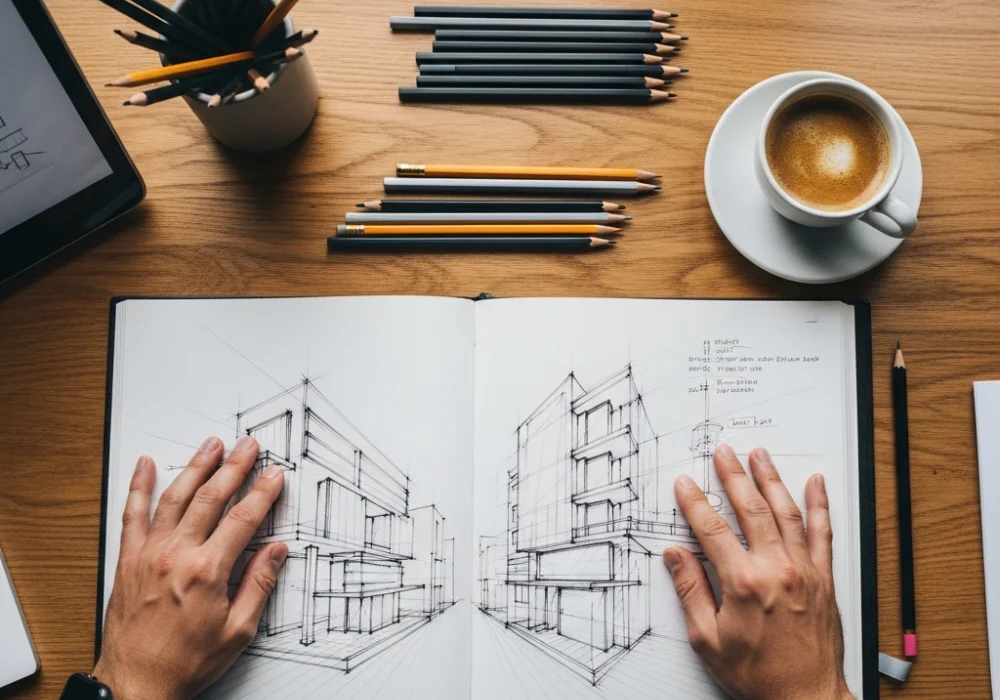
5. Perspective Mastery: The Vanishing Point
Perspective is what gives your drawings 3D depth. For the upcoming exams, you must be proficient in:
- 1-Point Perspective: Looking down a hallway or a straight road.
- 2-Point Perspective: Looking at the corner of a building.
- 3-Point Perspective: An ‘Ant’s Eye’ or ‘Bird’s Eye’ view.
Use these to create realistic environments. Mock tests on myentrance.in often include prompts requiring precise perspective to score high marks.
6. Material Texture Rendering
Can you make a drawing ‘feel’ like cold metal or soft velvet? Designers must communicate materials through hatching, cross-hatching, and stippling techniques.
- Activity: Draw three identical spheres. Render one as Polished Chrome, one as Rough Wood, and one as Transparent Glass.
7. Object Transformation Exercises
This is a favorite in NID DAT. You might be asked to ‘Transform a stapler into a futuristic vehicle.’ This tests your creative flexibility and form development skills.
- How to practice: Take any household object (a spoon, a remote, a bottle) and sketch it morphing into an animal or a building in four distinct steps.
8. Light, Shadow, and Value Scales
Shadows define form. Without them, your drawing is just a flat outline. Practice creating a 10-step Value Scale from absolute white to the darkest black your pencil allows.
- Tip: Identify the Light Source before you start shading. Consistent shadows across all objects in a scene are crucial for realism.
💡 Click to Reveal: The Secret of Reflected Light
Never make the shadow-side of an object completely black. A small amount of ‘reflected light’ from the floor usually hits the underside of the object, making it look 3D and professional.
9. Memory Drawing from Everyday Life
In many exams, you won’t have a reference. You’ll be asked to ‘Draw a scene of a busy railway station.’ This requires a strong Visual Library.
- Practice: Spend 10 minutes observing your kitchen. Go to another room and try to draw it from memory, including details like the stove knobs and the texture of the tiles.
10. Orthographic to Isometric Conversion
This is essential for Product Design and Architecture aspirants. Orthographic drawings are 2D ‘flat’ views (Front, Top, Side). Isometric is the 3D representation.
- Exercise: Find a simple object. Draw its Top and Side views. Then, attempt to draw it in a 30-degree Isometric perspective.
Exercise Impact Comparison Table
| Exercise Name | Difficulty Level | Skill Targeted | Exam Weightage |
|---|---|---|---|
| Perspective Drills | High | Spatial Depth | Very High |
| Gesture Sketching | Medium | Speed & Proportion | High |
| Line Ghosting | Low | Confidence & Neatness | Medium |
| Material Rendering | Medium | Detailing | Medium |
Frequently Asked Questions (FAQs)
How many hours should I practice sketching daily?
Consistency is key. 1 to 2 hours of focused practice daily is more effective than an 8-hour marathon once a week. Use the mock tests at myentrance.in to time yourself.
Which pencils are best for the Design Aptitude Test?
A standard set of H, HB, 2B, 4B, and 6B pencils is sufficient. Use ‘H’ for light construction lines and ‘6B’ for deep shadows.
Is it necessary to use color in the exam?
Unless the question specifically asks for color (e.g., poster design or color theory), a well-rendered monochromatic pencil sketch is often enough to score top marks.
Quick Knowledge Check
Test your design exam readiness with these quick questions!
1. Which perspective is typically used for a ‘Bird’s Eye’ view?
💡 Click to Reveal Answer
3-Point Perspective. It uses three vanishing points to create vertical convergence.
2. According to the standard rule of human proportions, how many ‘heads’ tall is an average adult?
💡 Click to Reveal Answer
8 Heads. This helps in maintaining realistic scale in scene drawings.
3. What is the main purpose of the ‘Ghosting Technique’ in sketching?
💡 Click to Reveal Answer
To improve line quality and accuracy by mentally and physically mapping the stroke before the pencil touches paper.
Ready to Ace Your Exam?
Mastering these exercises is the first step toward your dream design career. At myentrance.in, we provide the latest pattern mock tests and expert guidance to help you clear NID, NIFT, and other top design entrance exams with confidence. Join thousands of successful students today!
💬 Chat with our Experts on WhatsApp (+91 9526806124)




