
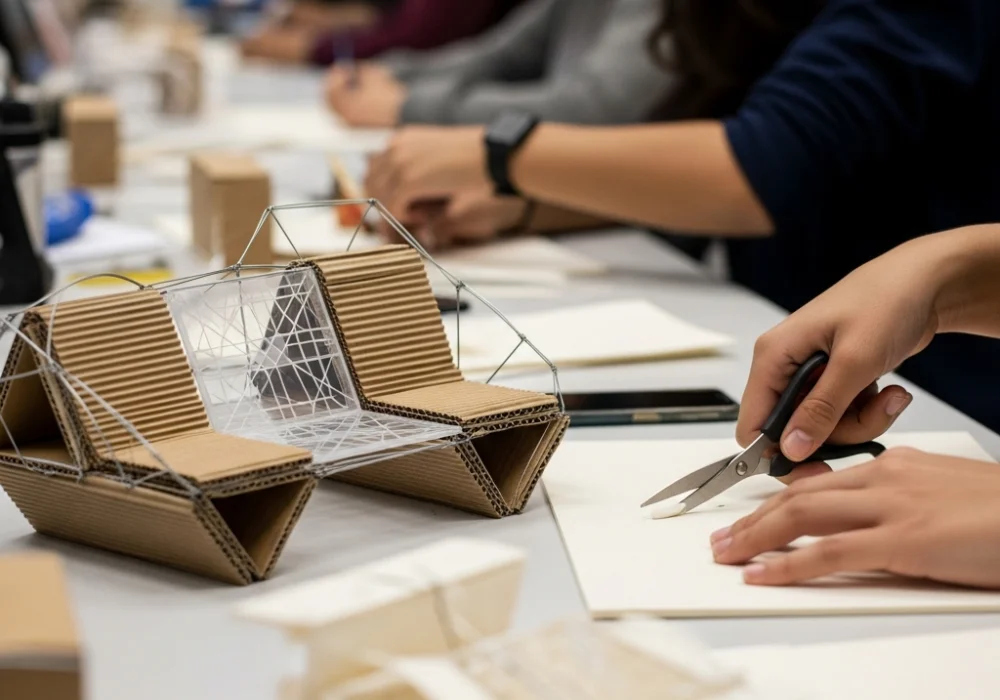
Introduction: The Future of Transit Comfort
Welcome, future designers. As an elite panelist for the NIFT entrance examination, I have seen thousands of models. The difference between a ‘good’ candidate and a ‘selected’ candidate lies in their ability to solve complex socio-spatial problems through three-dimensional thinking. Today, we tackle a prompt that is highly relevant to our current global landscape: Developing an adaptive, modular seating system for a public transport hub that adjusts for passenger density and physical distancing.
This scenario isn’t just about making a chair; it is about ergonomics, public psychology, structural integrity, and the intelligent use of materials within a strict 3-hour window. This guide will walk you through the conceptual, technical, and aesthetic requirements to ace this specific Situation Test challenge.
Decoding the Examiner’s Mind: Evaluation Criteria
Before you touch your glue stick, you must understand what we, the panelists, are grading you on. We don’t just look for a pretty model; we look for a ‘Design Process’.
- Innovation & Creative Interpretation: How unique is your solution? Instead of standard rows of chairs, did you think of hexagonal pods, sliding benches, or vertical leaning posts?
- Functional Ability: Does the model actually work? If you say it’s ‘modular’, can the pieces be rearranged in your model to demonstrate that?
- Material Manipulation: Have you used the material to its full potential? (e.g., scoring cardboard to create curves, weaving thread to create texture).
- Aesthetic Appeal: Is the final product neat? Are there visible glue marks? Is the color scheme cohesive?
- The Write-Up: Does your 100-word explanation clearly articulate the ‘why’ behind your design?
💡 Pro-Tip: The ‘X-Factor’
The X-Factor is empathy. Mention in your write-up how your seating system accommodates the elderly, children, or people with disabilities. This shows you understand universal design principles.
Phase 1: Ideation & Conceptualization (The First 15 Minutes)
Do not start building immediately. Spend the first quarter of an hour sketching and planning. For a transport hub, the design must be Durable, Scalable, and Flexible.
The Concept of ‘Adaptive Modularity’
Modular design uses a single unit or a set of units that can be combined in various ways. For physical distancing, your units should be able to ‘expand’ or ‘lock’. Imagine a ‘concertina’ or ‘accordion’ style bench that can be pulled out when a family needs to sit together, or pushed in to create individual islands of seating during high-density hours where distancing is required.
Phase 2: Masterclass on Material Handling
In the NIFT Situation Test, you are often given a limited kit. Here is how to use them for this specific model:
- Corrugated Sheet: Use this for the base or the heavy structural support. Remove the top layer of the paper to reveal the ‘flutes’ for a corrugated aesthetic that looks modern and industrial.
- Ivory Sheet/Card Paper: Perfect for the actual seating surfaces. Use ‘Scoring’ (running a cutter lightly without cutting through) to create crisp, clean folds.
- Copper/GI Wire: Use this for the ‘adaptive’ mechanism. Wires can act as railings or the sliding tracks along which your modular seats move.
- Transparent Sheet: Ideal for creating physical distancing barriers or ‘shields’ between seats without blocking the visual flow of the hub.
- Straws: Use them as legs or pillars. Reinforce them by inserting wire inside so they don’t buckle under the weight of the card paper.
Step-by-Step Construction Strategy
Step 1: The Base (Foundation)
Create a sturdy base using a thick corrugated sheet. Cover it with a neutral-colored paper to represent the floor of the transport hub. Mark out ‘tracks’ or ‘zones’ where the seating will reside.
Step 2: Creating the ‘Mother Module’
Design one single seating unit. A sleek, L-shaped ergonomic fold is better than a bulky cube. Ensure the height is proportional (usually 2-3 cm in model scale). Duplicate this unit at least 4 to 6 times to demonstrate modularity.
Step 3: The Movement Mechanism
This is where you win points. Use wire to create a ‘rail’ system. Attach your seats to these rails using small paper loops. This allows you to slide the seats closer together (for families) or further apart (for distancing). Visual cue: Use a red thread or a colored marker to indicate ‘Safe Distance’ marks on the floor or the mechanism itself.
Step 4: Integration of Technology (The 2027 Edge)
Since the prompt mentions a future context, add small ‘tech’ details. Use tiny bits of silver foil to represent charging ports or touch-screen interfaces on the armrests. This shows forward-thinking.
Step 5: Aesthetics and Neatness
Ensure no ‘fuzz’ from the glue gun is visible. All edges should be straight. If you are using a cutter, use a metal scale to ensure 100% straight lines. Precision is the hallmark of a professional designer.
The Write-Up: Selling Your Vision
The 100-word write-up is your ‘Elevator Pitch’. It must be concise. Here is a structure you can follow:
“My design, ‘The Flexi-Hub’, is a modular seating solution tailored for the high-traffic needs of future public transport. Utilizing a rail-and-pivot system, the seats can transition from individual pods to communal benches. During high-density scenarios, the integrated sensors (represented by foil accents) guide the mechanical distancing of units. I have used corrugated flutes to represent the industrial strength of the hub and transparent acrylic sheets for non-intrusive safety barriers. The design prioritizes ergonomics, adaptability, and passenger safety.”
💡 Practice Quiz: Test Your Strategy
Question: If your model is falling apart due to weak glue, what is the best immediate fix?
Answer: Do not just add more glue. Use ‘Mechanical Fastening’. Create a small slit in the base and tuck the leg of the chair into it, then apply a tiny drop of glue for reinforcement. This is much stronger and cleaner.
Common Mistakes to Avoid
- Over-decorating: NIFT is a design school, not a craft school. Avoid using too much glitter or unnecessary decorations. Focus on the structure.
- Ignoring Scale: If your seat is as tall as a skyscraper compared to the base, you lose marks for ‘Proportion’. Keep a human-centric scale in mind.
- Weak Structure: If the examiner touches your model and it collapses, it is an automatic failure in ‘Structural Ability’. Always test the stability of your modules.
- Poor Time Management: Many students build one beautiful chair but fail to finish the ‘system’. It is better to have 4 simple, finished modules than 1 elaborate, unfinished one.
Final Checklist Before Submission
- Is the model stable on its base?
- Does it fulfill the ‘Modular’ aspect of the prompt?
- Is the ‘Physical Distancing’ mechanism clearly visible?
- Have you used at least 3 different materials from the kit?
- Is your workstation clean and the scrap material disposed of?
The Situation Test is a test of your nerves as much as your skills. Stay calm, keep your cuts clean, and remember that every piece of material in your kit is an opportunity to show your creativity. Good luck!
Need Personalized Feedback on Your Models?
Our experts at MyEntrance are here to help you refine your 3D modeling skills and write-up techniques. Don’t leave your NIFT dream to chance!
💬 Chat with our Experts on WhatsApp (+91 9526806124)




