
Introduction: The Paradigm Shift in NIFT Evaluation
Welcome, future designers. As an elite panelist who has observed thousands of models, I can tell you that the Situation Test is not a craft competition; it is a test of your innovation, material handling, and narrative capability. The current design landscape values sustainability and storytelling above all else. This masterclass will dissect a complex scenario: creating a 2027 Space Tourism lounge that honors lunar history using a ‘repurposed industrial’ aesthetic.
In the upcoming entrance cycle, jurors are looking for students who can bridge the gap between high-tech concepts and raw, tactile execution. This specific prompt requires you to balance the sleekness of space travel with the ruggedness of industrial materials, all while maintaining a clear thematic link to the history of the moon landing.
The Panelist’s Lens: What We Secretly Look For
When I walk past your workstation, I am looking for three primary pillars of excellence. If your model lacks any of these, your score will inevitably dip below the competitive threshold.
- Conceptual Innovation: Did you just build a room, or did you build an experience? A lounge for 2027 should feel ‘next-gen’. Avoid clichés like simple boxes. Think about fluid dynamics and zero-gravity ergonomics.
- Material Sensitivity: The prompt specifies ‘repurposed industrial materials’. This is a hint to use textures. How do you make cardboard look like rusted iron? How do you make wire look like high-tension cabling?
- Aesthetic Composition: We evaluate the 360-degree view of your model. Is it balanced? Does the ‘history of lunar exploration’ element (the museum aspect) flow naturally into the ‘lounge’ element (the comfort aspect)?
💡 Click to Reveal: The ‘Golden Rule’ of Neatness
Jurors detest visible glue marks. Use ‘Fevicol’ or ‘Anabond’ sparingly. If we see strings of glue or messy edges, it signifies a lack of precision. Use the ‘invisible joinery’ technique where tabs are hidden beneath the surface.
Scenario Breakdown: Space Tourism Lounge 2027
The Theme: Lunar History Meets Industrial Chic
To succeed in this specific task, you must understand the ‘Industrial Repurposing’ trend. This involves taking ‘waste’ or raw materials—like gears, pipes, and beams—and turning them into luxury decor. For a space lounge, this creates a sense of ‘Space-Age Heritage’.
Key Design Elements to Include:- The Artifact Pedestal: A dedicated zone showcasing a 3D representation of an Apollo lunar module or a moon footprint, made from wire or textured paper.
- Industrial Seating: Chairs that look like they were salvaged from a space shuttle engine but are designed for comfort.
- Lighting Fixtures: Use translucent materials to simulate the cold, bright light of the lunar surface.
“Design is not just what it looks like and feels like. Design is how it works in the context of the user’s journey.” – This should be your mantra while building.
Mastering the Materials: Step-by-Step Strategy
In the Situation Test, you are often provided with a limited kit: Cardboard, wire, sandpaper, straws, mesh, and various papers. Here is how to manipulate them for an industrial space theme:
1. Creating Industrial Textures
Use sandpaper not just for finishing, but as a material. Its grit resembles the regolith (lunar soil). Use it for the floor of your exhibit. For a ‘metal’ look, use the silver side of chocolate wrappers or graphite from your pencil to buff the surface of ivory sheets.
2. Wire Manipulation for Structures
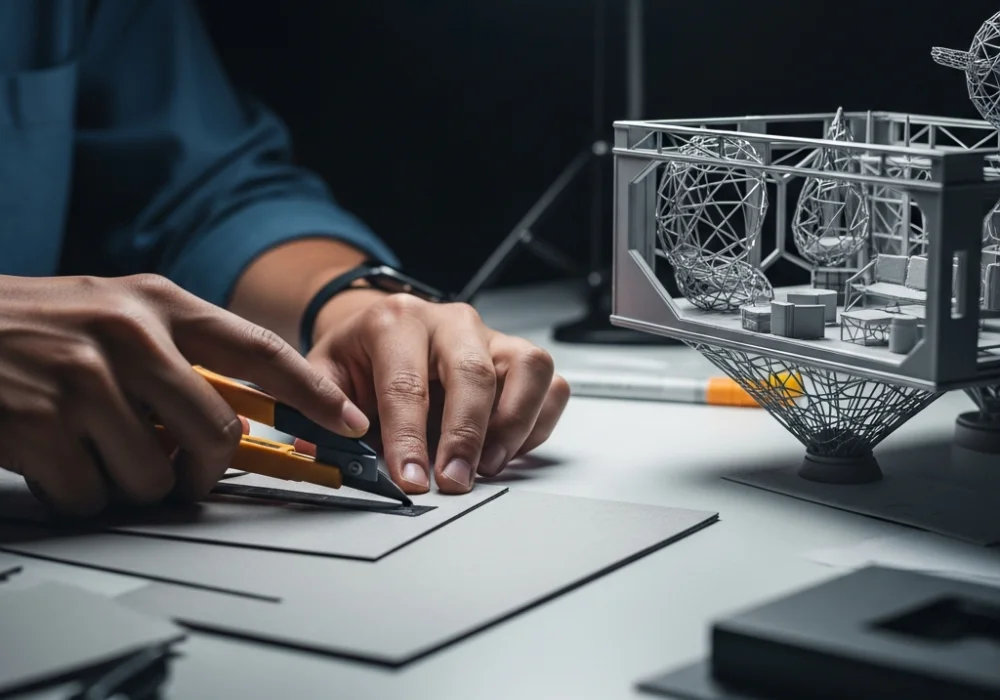
Wire represents the ‘skeletal’ nature of industrial design. Don’t just leave it straight. Coil it around a pencil to create ‘springs’ or hydraulic-looking pipes. Use it to create the outer frame of your lounge’s dome to give it a high-tech, architectural feel.
3. The Art of Scoring and Pleating
To create the curved walls of a futuristic lounge, use the scoring technique on cardboard. Cut through only the top layer of the board to allow it to bend smoothly without snapping. This creates a professional, aerodynamic silhouette.
💡 Pro-Tip: How to create ‘Gears’ and ‘Cogs’
Cut small strips of corrugated cardboard and peel off the top layer to reveal the ‘teeth’. Roll these strips into circles. These look exactly like industrial gears for your ‘repurposed’ theme.
The Execution Timeline (2 Hours)
Time management is the difference between a topper and a failure. Follow this 120-minute breakdown:
- 0-15 Mins: Conceptualization & Sketching. Do not touch the materials yet. Draw a rough 3D view of your lounge. Identify where the ‘Lunar History’ exhibit sits.
- 15-45 Mins: Structural Foundation. Build the base and the main walls. Ensure the structure is sturdy. A model that collapses when moved is an automatic disqualification.
- 45-90 Mins: Detailing & Furniture. Create your ‘industrial’ chairs, the lunar artifact, and the ceiling elements. Use the wire and mesh here.
- 90-110 Mins: Refining & Cleaning. Remove glue webs. Ensure all edges are sharp. Add ‘texture’ using sandpaper or color accents if allowed.
- 110-120 Mins: The Write-up. Spend the last 10 minutes writing a powerful explanation of your concept.
The Write-Up: Your Silent Pitch
Your write-up should be roughly 100 words. It must explain: What you made, Why you chose specific materials, and How it fulfills the prompt. Use keywords like ‘Sustainability’, ‘Ergonomics’, ‘Heritage’, and ‘Industrial Aesthetic’.
Common Pitfalls to Avoid
As a panelist, I often see students make these fatal errors:
- Literalism: Making a rocket ship. The prompt asks for a *lounge* that *highlights* history, not a toy store. Be subtle and sophisticated.
- Over-crowding: Don’t put 50 things in your model. Three well-executed elements are better than ten messy ones.
- Ignoring the ‘Repurposed’ aspect: If your model looks brand new and sleek everywhere, you ignored half the prompt. Ensure there is a ‘roughness’ that signifies the industrial heritage.
💡 Click to Reveal: The Panelist’s ‘X-Factor’
We love ‘Dynamic Elements’. If your model has a part that actually moves (like a rotating exhibit stand or a sliding door), it demonstrates superior engineering and creative thinking.
Ready to Ace Your NIFT Situation Test?
Preparing for the latest NIFT exam requires personalized feedback and expert mentorship. Don’t leave your design career to chance!
💬 Chat with our Experts on WhatsApp (+91 9526806124)




