
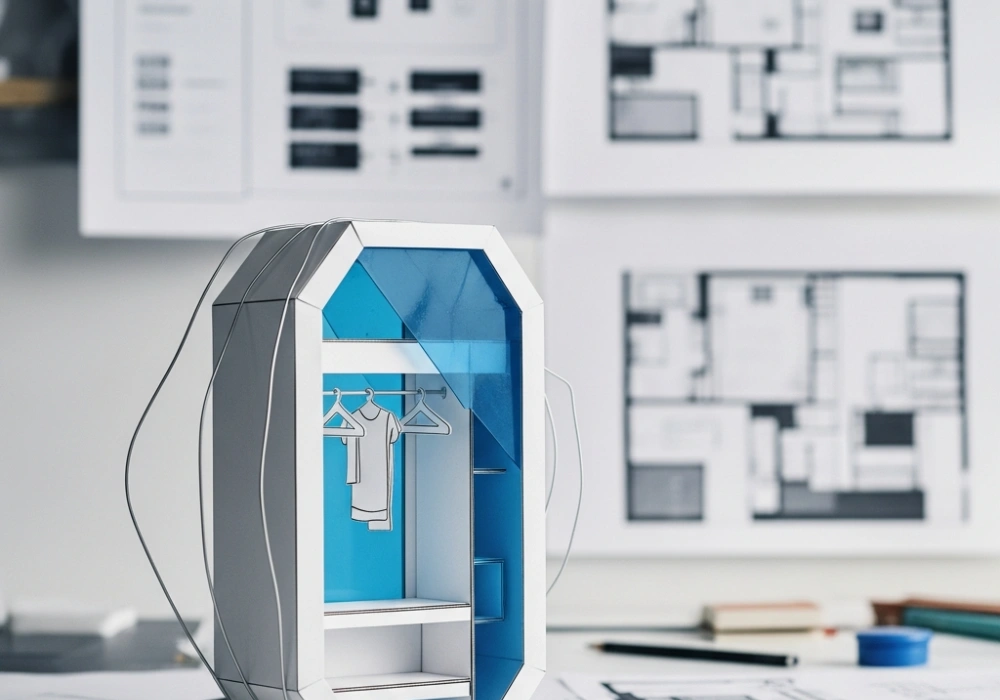
Introduction: The Future of Urban Living
Welcome, future designers. As an elite panelist for the NIFT entrance exam, I have witnessed thousands of students struggle with the transition from 2D thinking to 3D execution. The Situation Test is not merely an art competition; it is a test of your cognitive ability to solve real-world problems using limited resources. Today, we tackle a highly relevant and futuristic scenario: Constructing a 3D model of a ‘Smart Wardrobe’ organizer for the year 2027.
In the upcoming years, urban migration will continue to shrink living spaces. The challenge lies in creating an organizer that doesn’t just ‘hold’ clothes but actively manages them using AI-driven sorting and garment care features. This guide, curated specifically for students on www.myentrance.in, will provide a deep dive into the technical, conceptual, and aesthetic requirements to ace this specific challenge.
💡 Why is this topic important for the current NIFT pattern?
NIFT is increasingly focusing on ‘System Design’ rather than just product design. A Smart Wardrobe requires you to think about technology, space management, and sustainability simultaneously—qualities that the latest evaluation criteria prioritize heavily.
Decoding the Scenario: AI and Urban Constraints
The year 2027 implies a world where Artificial Intelligence is invisible and ubiquitous. Your model must reflect this. When the problem mentions ‘Small Urban Apartments’, it is a cue for verticality, modularity, and multi-functionality. Your wardrobe cannot be a bulky rectangular box; it must be a sleek, space-saving intervention.
Key Features to Incorporate:
- AI-Driven Sorting: How does the machine know where the clothes go? Think about scanners, RFID sensors, or robotic arms.
- Garment Care: In a world of fast-paced living, the wardrobe should handle steaming, UV-sanitization, and moisture control.
- Compact Footprint: Utilize folding mechanisms or telescoping rods to ensure it fits into a micro-apartment corner.
Panelist Secret: We are looking for ‘Smart’ thinking, not just a label that says ‘Smart’. Show the mechanism. If there is a UV-filter, use a specific material like tinted cellophane to represent it.
The Secret Evaluation Criteria: What We Secretly Grade
To score in the top 1%, you must understand the five pillars of our marking scheme. While most students focus on making the model ‘look pretty’, we are looking for the following:
1. Concept Innovation (25%)
Does the model solve a problem? If your wardrobe just has shelves, you haven’t used the ‘AI’ aspect of the brief. Maybe your wardrobe rotates like a vending machine to bring the selected outfit to the front. That is innovation.
2. Material Manipulation (25%)
Can you make paper look like metal? Can you make wire look like a sensor? We grade you on how you transform the mundane materials in the kit into specialized components.
Avoid using too much glue. A messy model suggests a messy mind. Neatness is non-negotiable.
3. Aesthetic Appeal and Proportion (20%)
The scale of the components must be realistic. If the ‘AI screen’ is larger than the hanging area, the proportion is off. Use the golden ratio or simple symmetry to make the model pleasing to the eye.
4. Functional Detailing (20%)
If you say there is a ‘steam vent’, I should see small perforations or a mesh. If there is a ‘sorting arm’, it should be movable or clearly articulated. Detail is the difference between a toy and a prototype.
5. The Write-up (10%)
Your 100-word explanation must be crisp. It should explain the ‘Why’ and ‘How’ of your design. Do not just describe what I can see; tell me the story behind it.
Material Management: Tips for the Studio
In the NIFT Situation Test, you will receive a fixed kit. Here is how to handle the common materials for a ‘Smart Wardrobe’ concept:
- Cardboard/Mount Board: Use this for the primary structural frame. Always ‘score’ (half-cut) the board to get sharp 90-degree bends instead of cutting separate pieces and taping them.
- Wire: Perfect for representing the ‘AI interface’ or robotic hangers. Use the wire to create a skeleton that allows parts of your model to move.
- Translucent Sheets/Cellophane: Use these for ‘touch screens’ or ‘UV-cleaning windows’. It adds a high-tech feel to the model.
- Thread/Yarn: Use these to represent the ‘sorting paths’ or the cables that move the internal mechanisms.
- Clay: Use sparingly for ‘sensors’ or small knobs. Do not build the whole model out of clay; it is too heavy and looks amateur.
💡 Pro-Tip: The ‘Invisible’ Joint
To hide ugly tape marks, use a ‘double-fold’ technique with paper or hide the tape inside the hollow structure of your cardboard. A model that stands without visible support or messy adhesive marks always gets a higher score.
Step-by-Step Model Making Strategy
Phase 1: Planning (15 Minutes)
Do not touch the materials yet! Sketch three quick thumbnails. Choose the one that maximizes vertical space. For a smart wardrobe, a cylindrical tower design or a wall-mounted modular grid works better than a traditional box.
Phase 2: The Core Structure (45 Minutes)
Build the external shell. If it’s for a small apartment, perhaps the shell is retractable. Use your mount board to create a sturdy base. Ensure the model is stable and doesn’t wobble. A ‘Smart’ device must look structurally sound.
Phase 3: The AI Mechanism (45 Minutes)
This is where you show the ‘Sorting’ feature. Create a central ‘Elevator’ or ‘Carousel’ using wire and straw. This represents the AI moving clothes to the user based on the day’s weather or schedule. Add a small ‘Control Hub’ using a piece of tinted sheet to act as the AI interface.
Phase 4: Garment Care Features (30 Minutes)
Identify a section for ‘Care’. Use silver foil or mesh to represent a sterilization chamber. Add small paper ‘garments’ folded neatly to show how the system organizes them. Detail the ‘Steam Vents’ using pin-pricks in the paper.
Phase 5: Finishing Touches (15 Minutes)
Clean up any stray glue strands. Ensure all edges are smooth. If you have extra time, add a ‘Power Indicator’ using a small bead of colored clay.
Writing the Design Narrative
Your write-up is the voice of your model. Structure it as follows:
- Design Goal: To revolutionize urban clothing management through AI.
- Key Features: Vertical carousel sorting, UV-C garment sanitization, and voice-command interface.
- User Benefit: Saves 40% floor space and reduces the need for manual laundry sorting.
Example Snippet: “The ‘Aura 2027’ is a vertical, cylindrical wardrobe designed for 200 sq. ft. apartments. It utilizes a central AI-driven elevator that scans garment tags and organizes them by fabric type and frequency of use. Integrated UV-lights ensure hygiene without water, fitting the sustainable needs of the future.”
Final Checklist Before Submission
- Is the model stable and not leaning?
- Is the ‘AI’ element visible through design, not just labels?
- Did you use at least 3-4 different materials effectively?
- Is the workspace clean? (Yes, panelists observe your process!)
Success in the NIFT Situation Test comes to those who can bridge the gap between imagination and execution. Practice building complex geometric shapes at home using only newspaper and tape to master the art of structural integrity.
Ready to Ace Your NIFT Entrance?
Don’t leave your design career to chance. Get personalized feedback on your models and expert tips for the Situation Test and Interview rounds.
💬 Chat with our Experts on WhatsApp (+91 9526806124)




