
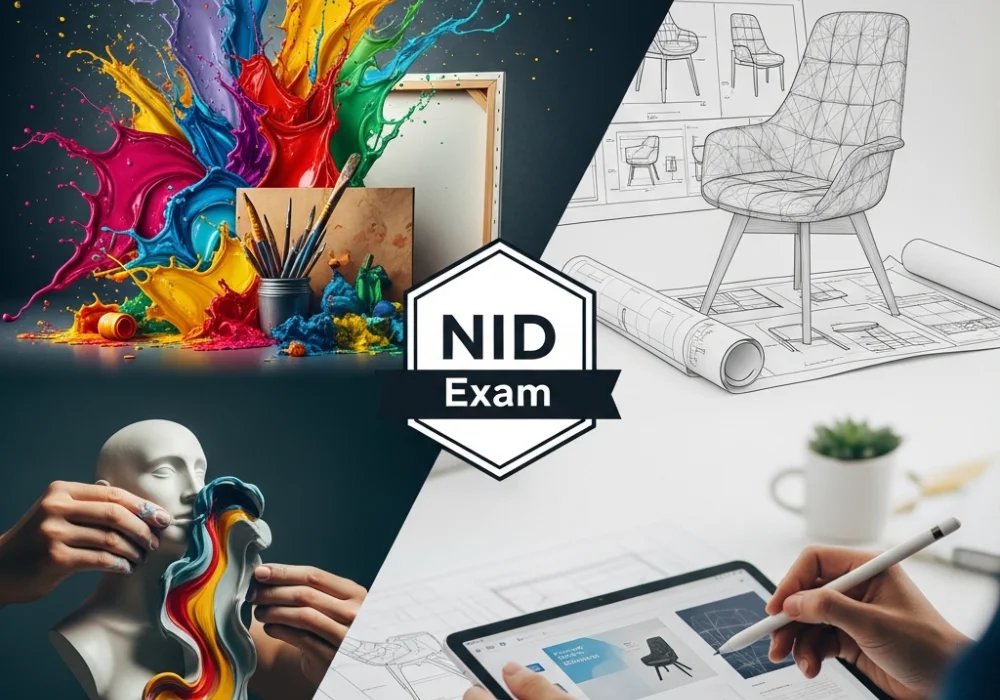
Introduction: Decoding the Eternal Debate for NID Aspirants
For any student eyeing a seat at the National Institute of Design (NID), one of the most fundamental hurdles is understanding the distinction between Art and Design. While the two fields share common tools—colors, shapes, lines, and textures—their objectives, processes, and results are worlds apart. In the NID Design Aptitude Test (DAT), the examiners are not looking for your ability to create a beautiful masterpiece; they are testing your ability to solve a specific human problem through design thinking.
Many talented students fail the NID entrance because they approach the questions with an ‘artist’s mindset’—focusing purely on aesthetics and self-expression. To succeed, you must adopt the ‘designer’s mindset,’ which prioritizes utility, user experience, and objective solutions. This article provides an exhaustive deep-dive into the comparison of Art vs. Design, tailored specifically for the competitive landscape of NID preparation on MyEntrance.
💡 Why does NID care about this distinction?
NID looks for designers, not illustrators. Art is about the ‘Me’ (the creator), while Design is about the ‘Them’ (the user). If you draw a beautiful water bottle that is impossible to hold, you have created a piece of art, but you have failed at design. NID questions test your ability to balance these two.
1. The Philosophy of Art: Self-Expression and Interpretation
Art is a journey inward. It is the externalization of the artist’s internal thoughts, emotions, and worldview. When an artist creates a painting, a sculpture, or an installation, they are often not seeking to solve a problem. Instead, they are seeking to evoke a reaction, provoke a thought, or share a personal truth.
Key characteristics of Art include:
- Subjectivity: There is no ‘right’ or ‘wrong’ in art. A single piece of art can mean ten different things to ten different people. This ambiguity is its strength.
- Expression: Art is driven by the artist’s need to communicate their identity, political views, or emotional state.
- Aesthetics over Utility: While art can be beautiful, it does not need to serve a practical purpose. A painting on a wall doesn’t need to help you perform a task better; its ‘job’ is simply to exist and be perceived.
In the context of the NID exam, if you are asked to design a tool for a farmer and you focus only on making it look ‘pretty’ without considering the ergonomics or the soil type, you are thinking like an artist, which will result in low scores in the Design Aptitude Test.
2. The Philosophy of Design: Problem-Solving and Objectivity
Design is a journey outward. It starts with a problem and ends with a solution. Whether it is a chair, a mobile app, or a public transport system, design exists to make life easier, safer, or more efficient for a specific target audience. Unlike art, design is functional.
Key characteristics of Design include:
- Objectivity: Design is measurable. If a signpost is designed to guide people in an airport but they still get lost, the design has failed. The success of a design is based on how well it solves the intended problem.
- User-Centricity: In design, the ‘User’ is king. Every curve of a product or every pixel on a screen is placed there with the user’s comfort and psychology in mind.
- Constraints: Design works within limitations—budget, materials, manufacturing processes, and timelines. An artist might wait for inspiration, but a designer works with a brief.
NID emphasizes ‘Human-Centered Design.’ This means you must show empathy for the person using your creation. If the problem is ‘Design a transport system for the elderly,’ your solution must prioritize accessibility and safety over abstract visual concepts.
3. Comparative Analysis: Art vs. Design Table
To help you memorize the key differences for your theory papers and interviews, here is a structured comparison:
| Feature | Art | Design |
|---|---|---|
| Primary Goal | To express and evoke emotion. | To solve a specific problem. |
| Audience | General public / Critics (Interpretive). | Specific target users (Functional). |
| Success Criteria | Measured by aesthetic impact. | Measured by usability and utility. |
| Starting Point | An internal spark or vision. | A user need or a design brief. |
| Interpretation | Open-ended; many meanings. | Clear and direct; one intended use. |
4. Historical Evolution: From Renaissance to Bauhaus
Historically, the lines between art and design were often blurred. Renaissance masters like Leonardo da Vinci were both artists (painting the Mona Lisa) and designers (scheming flying machines and war engines). However, the Industrial Revolution created a massive divide. As mass production became possible, the world needed people who could create functional items that were also aesthetically pleasing.
The Bauhaus Movement in Germany (1919-1933) is arguably the most important historical reference for NID students. The Bauhaus philosophy was ‘Form Follows Function.’ This means the shape and look of an object should be dictated by its purpose. This movement essentially birthed ‘Modern Design’ as we know it today, moving away from decorative art toward utilitarian design.
💡 Practice Question for DAT
Question: ‘Redesign a traditional Indian broom for a modern apartment.’ If you simply draw a broom with gold patterns, you’ve done ‘Art.’ If you create a collapsible, ergonomic, dust-trapping tool with a hanging mechanism for small spaces, you’ve done ‘Design.’ Focus on the ‘Why’ behind every line you draw.
5. The Overlap: Where Art Meets Design
It is important not to view these as two mutually exclusive boxes. There is a significant overlap known as Aesthetics in Design. A product that works perfectly but looks terrible will fail in the market because users are drawn to beauty. This is where a designer uses artistic principles (symmetry, color theory, balance) to enhance a functional solution.
For example, Apple products are a masterclass in this overlap. They are functional (Design) but have an aesthetic appeal that feels like Art. In your NID exam, you should first solve the problem, and then use your artistic skills to make that solution look professional and appealing.
Final Verdict: Which is Better for Your Career?
There is no ‘better’—there is only ‘best for the context.’ If your heart beats for self-expression and you want to challenge societal norms through visual mediums, Fine Arts is your calling. However, if you love solving puzzles, understanding human psychology, and creating products that improve daily life, Design is the path for you.
For NID aspirants, the verdict is clear: Design Thinking is your primary tool. You must use your artistic skills as a secondary support to communicate your design solutions effectively. In the studio test and the DAT, prioritize empathy, observation, and logical reasoning over complex shading and intricate detailing.
Ready to Ace the NID Exam?
Don’t let the confusion between Art and Design hold you back. Our expert mentors at MyEntrance are here to help you refine your design thinking and build a winning portfolio.
💬 Chat with our Experts on WhatsApp (+91 9526806124)




