
The Calm Before the Creative Storm
Tomorrow is the day you have been working toward for months. The National Institute of Design (NID) entrance exam is not just a test of your drawing skills or your aptitude; it is a test of your temperament. As an exam psychologist, I have seen brilliant students falter due to anxiety, while steady, calm students excel beyond their own expectations. The next 24 hours are not about learning new concepts—they are about optimization.
You are currently in a state of high physiological arousal. Your brain is likely oscillating between ‘I’ve got this’ and ‘I’ve forgotten everything.’ This is normal. This guide is designed to anchor you, providing a structured, step-by-step roadmap to ensure your mind is as sharp as your pencils when you walk into that hall. Take a deep breath. Let’s begin.
💡 Click to Reveal: The Psychologist’s Secret Tip
The ‘Zeigarnik Effect’ suggests we remember uncompleted tasks better than completed ones. This creates mental clutter. Spend 5 minutes writing down every worry you have on a piece of paper, then physically throw it away. This ‘externalizes’ the stress and clears your cognitive load for tomorrow.
1. The Psychological Anchor: Managing Your Mindset
NID is a ‘Design’ exam, which means it requires Divergent Thinking. If your brain is in ‘Fight or Flight’ mode (high stress), your ability to think creatively shuts down. Stress narrows your focus, making you see only the obvious solutions. To find the unique, out-of-the-box answers NID examiners love, you must stay relaxed.
Visualization Exercise: Spend 10 minutes today sitting in a quiet corner. Close your eyes and visualize yourself in the exam hall. See yourself opening the paper, feeling a sense of curiosity rather than dread. Visualize your hand moving smoothly across the paper. When you visualize success, you prime your neural pathways to remain calm during the actual event.
Remember, the CAT (Creative Ability Test) section rewards perspective and storytelling. You cannot tell a good story if your mind is racing. Treat the exam like a conversation between your imagination and the paper.
2. The Forbidden List: What NOT to Do
Success in the final 24 hours is often defined by what you avoid. Protect your energy like it is a precious resource.
- No New Topics: Do not try to learn a new rendering technique or study a new design movement today. It will only highlight what you ‘don’t know,’ triggering panic.
- Avoid Stressed Peers: Anxiety is contagious. If you have a friend who is panicking, kindly tell them you’ll talk after the exam. Do not engage in ‘How much have you finished?’ conversations.
- No Late-Night Cramming: Sleep is when your brain consolidates memory and restores motor skills (essential for drawing). A tired brain lacks the precision needed for fine lines and clean shading.
- Limit Screen Time: Blue light interferes with melatonin production. More importantly, social media is full of ‘last-minute tips’ that might confuse you. Switch off by 8 PM.
💡 Click to Reveal: Why ‘Active Recall’ is your enemy today
While active recall is great for studying, doing it today can lead to ‘False Forgetting’—where you feel you’ve forgotten a concept because you’re stressed. Trust that the information is there and will surface when you see the prompt tomorrow.
3. Nutritional Strategy: Fueling the Creative Brain
What you eat today directly affects your cognitive speed and hand-eye coordination tomorrow. Your brain uses about 20% of your body’s energy.
- Hydration: Dehydration leads to fatigue and headaches. Drink at least 3 liters of water today, but taper off toward the evening to ensure you don’t have broken sleep.
- The ‘Slow-Burn’ Dinner: Avoid heavy, greasy, or spicy foods that might cause indigestion. Opt for complex carbohydrates like brown rice, oats, or whole-wheat pasta. These release glucose slowly, keeping your energy stable.
- Magnesium-Rich Foods: Almonds, spinach, and dark chocolate (in moderation) contain magnesium, which helps regulate the stress response.
- Avoid Excessive Caffeine: Too much coffee will give you the jitters, which is the last thing you want when trying to draw a steady circle or a straight line.
4. The Minute-by-Minute Countdown
Follow this schedule to maintain a sense of control and rhythm.
- 02:00 PM – 04:00 PM: Light review of your own sketchbook. Look at your best work to boost your confidence. Do not compare it to others.
- 04:00 PM – 05:00 PM: Pack your bag. Do it now so you don’t rush in the morning. (See the checklist below).
- 05:00 PM – 06:30 PM: Go for a walk. Physical movement lowers cortisol levels. Observe the world around you—the way shadows fall, the gait of people walking. This is ‘active observation’ without the stress.
- 07:00 PM: Light dinner. No screens.
- 08:30 PM: Listen to calming music or a podcast. Avoid anything related to design or exams.
- 10:00 PM: Lights out. Even if you can’t fall asleep immediately, keep your eyes closed and body still. Rest is still happening.
- 06:30 AM (Exam Day): Wake up, light stretching, and a healthy breakfast. No last-minute notes!
5. The Ultimate NID Exam Hall Checklist
Double-check your bag tonight. Having everything ready eliminates ‘decision fatigue’ in the morning.
- ✅ Admit Card: Printed clearly (color or B&W as per instructions).
- ✅ Valid Photo ID: Aadhaar, Passport, or Voter ID (Original).
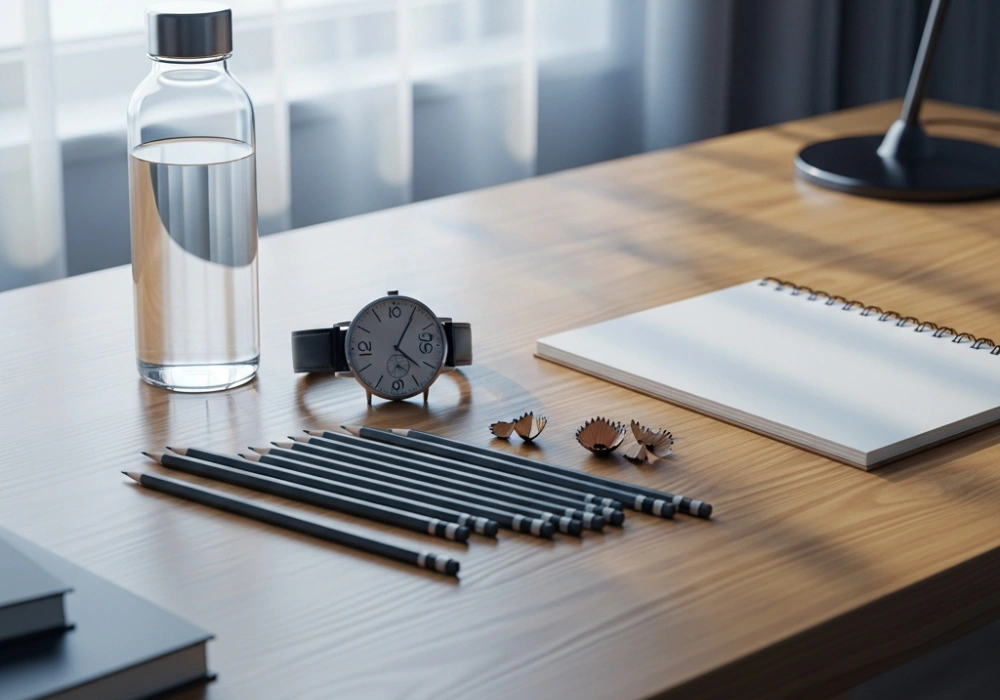
- ✅ Pencils: A range (HB, 2B, 4B, 6B) sharpened and ready.
- ✅ Sharpeners & Erasers: Carry two of each. A kneadable eraser is a plus.
- ✅ Coloring Kit: High-quality color pencils, pastels, or whatever is permitted. Ensure they are organized.
- ✅ Pens: Black and Blue ballpoint pens for the GAT section.
- ✅ Water Bottle: Transparent, without any labels.
- ✅ Analog Watch: To track time without relying on the hall clock.
- ✅ Confidence: The most important tool in your kit!
💡 Click to Reveal: Time Management Pro-Tip
During the exam, follow the 20-60-20 rule. Spend 20% of the allotted time for a question planning and sketching thumbnails, 60% on final execution, and the last 20% on detailing and cleaning up. Never start the final drawing without a plan!
Final Words of Encouragement
NID looks for potential, not just perfection. They want to see how you think, how you solve problems, and how you perceive the world. If you make a mistake in a drawing, don’t panic. Incorporate it. Adapt. That is what designers do. You have worked hard, and you are ready. Trust the process, trust your hands, and trust your intuition. We are all rooting for you at MyEntrance.
Need Last Minute Clarification or Moral Support?
Our mentors are available to help you settle those final nerves or answer any quick doubts you might have before the big day.
💬 Chat with our Experts on WhatsApp (+91 9526806124)




