
Welcome to the Situation Test Masterclass
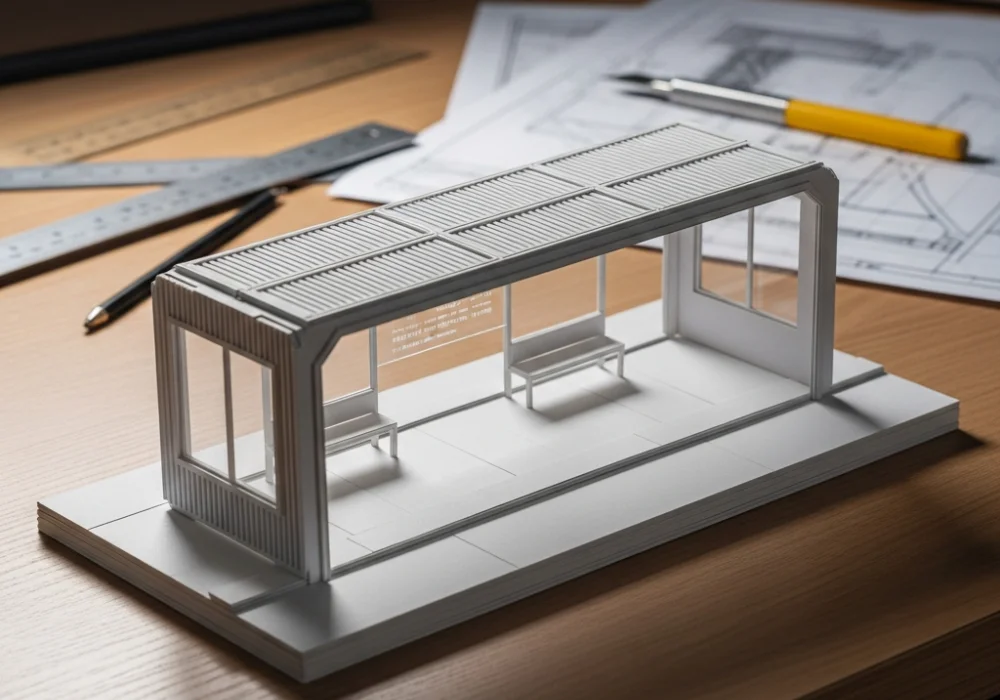
As an elite panelist who has observed thousands of students during the NIFT Situation Test, I can tell you that the difference between an average score and a top rank isn’t just creativity—it is the ability to translate a complex concept into a stable, aesthetically pleasing, and functional three-dimensional model. In today’s masterclass, we are diving deep into a high-probability scenario: Designing a futuristic smart-city bus stop using modular construction techniques.
This particular problem statement tests your ability to work with rigid materials like corrugated sheets and delicate, flexible materials like OHP (Overhead Projector) transparencies. The goal is to create a structure that feels ‘smart,’ ‘modular,’ and ‘futuristic’ while maintaining structural integrity within the 2-hour time limit. This guide is curated specifically for students preparing with myentrance.in to ensure they stand out in the eyes of the jury.
The Panelist’s Lens: What We Are Secretly Looking For
Before you pick up your cutter, you must understand the four pillars of evaluation that we use to grade your performance. Many students focus solely on the model, but the jury looks at the holistic process.
- Creative Interpretation (25%): How have you interpreted ‘Smart’ and ‘Futuristic’? Does it just look like a regular bus stop, or have you integrated features like solar panels, digital interfaces, or ergonomic seating?
- Material Utility (25%): Are you using the corrugated sheet for strength and the OHP sheet for aesthetic transparency? Using materials for their inherent properties scores higher than forcing a material to do something it isn’t meant for.
- Structural Stability and Neatness (25%): A model that wobbles or has visible glue marks (fevicol blobs or messy tape) will immediately lose marks. Your ‘modular’ joints must be clean.
- Write-up Quality (25%): The 50-100 word explanation is your chance to sell your design. We look for design vocabulary—terms like ‘scalability,’ ‘aerodynamics,’ ‘translucency,’ and ‘ergonomics.’
💡 Click to Reveal: The ‘Modular’ Secret
In NIFT terms, ‘Modular’ means your design should look like it is made of repeatable units. If you can show that your bus stop can be expanded by adding more ‘blocks’ or ‘units’ if the city grows, you demonstrate a high-level design thinking that panelists love.
Material Mastery: Corrugated Sheets and OHP Transparencies
Handling materials efficiently is half the battle won. These two materials require very different technical approaches.
1. Working with Corrugated Sheets
Corrugated sheets have a ‘grain’ or a ‘flute’ direction. If you try to bend against the flute, the board will crack and look messy. To achieve a clean curve, you must score the board (cut only the top layer) at regular intervals of 0.5cm on the inside of the curve.
2. Working with OHP Transparencies
OHP sheets represent glass or digital screens in your model. They are notoriously difficult to stick with Fevicol because they are non-porous. Expert Tip: Use double-sided tape or create ‘slots’ in your corrugated board where the OHP sheet can slide in. This creates a much cleaner finish than using messy glue. To make the OHP sheet look like a futuristic display, you can use a fine-liner marker to draw subtle UI/UX elements (like a digital map or a clock) on it.
💡 Pro-Tip: Scoring vs. Cutting
Never cut through the entire board if you want to make a 90-degree corner. Just score the top layer and the ‘zig-zag’ middle layer, then fold it. This keeps the exterior corner seamless and professional.
Step-by-Step Model Strategy: The Smart-City Bus Stop
Follow this systematic workflow to ensure you finish 15 minutes before the bell, leaving time for the write-up and clean-up.
Phase 1: Conceptualization and Sketching (10 Minutes)
Do not skip this. On the rough sheet provided, sketch a basic 3D view. Decide on a L-shaped or U-shaped modular unit. Think about where the ‘Smart’ elements go. Is there a touch-screen kiosk? Is the roof tilted for solar energy? Is there a charging station? Sketching prevents ‘maker’s block’ mid-way.
Phase 2: Building the Primary Modular Shell (30 Minutes)
Cut three identical frames from the corrugated sheet. These will be your modules. Each module should have a floor, one side wall, and a roof segment. By aligning these three modules together, you create a long, continuous bus stop. This proves the ‘modular’ aspect of the brief.
Phase 3: Integrating the ‘Glass’ (20 Minutes)
Use your OHP sheets to create the back wall or a protective side shield. Cut the OHP sheet slightly larger than the opening in your corrugated frame. Create a ‘sandwich’ effect by gluing thin strips of cardboard over the edges of the OHP sheet to lock it into the frame. This hides the glue and looks like a professional window frame.
Phase 4: Adding Smart Features (30 Minutes)
This is where you score the highest points. Use leftover corrugated scraps to build a small kiosk. Use a small piece of OHP sheet as the ‘screen.’ Use colorful threads (if provided) to represent wiring or internet fiber. Create a ‘green roof’ effect by texturing a piece of paper or using green materials provided in the kit.
Phase 5: The Base and Stability (10 Minutes)
Mount your entire bus stop on a thick cardboard base. A model without a base feels unfinished and fragile. Ensure the modules are perfectly aligned and glued firmly to this foundation.
The Art of the Write-Up
Your write-up should be professional and concise. Avoid saying “I made a bus stop.” Instead, use descriptive, active language. Here is a template for this specific scenario:
“The design presents a ‘Modular Urban Nexus’—a smart-city bus stop engineered for scalability. Utilizing the structural rigidity of corrugated sheets, the model employs a repeating hexagonal framework that allows for rapid assembly. OHP transparencies are utilized to mimic high-tech interactive glass interfaces, providing real-time data to commuters. The slanted roof is optimized for solar collection, while the modular nature ensures the structure can be expanded based on commuter density, reflecting a sustainable and future-ready urban infrastructure.”
💡 Check your Design Vocabulary
Did you use these words? 1. Ergonomic (Comfortable), 2. Sustainable (Eco-friendly), 3. Scalable (Easy to grow), 4. Minimalistic (Clean design), 5. Kinetic (Moving parts – if any).
Common Pitfalls to Avoid
- Over-gluing: If we see Fevicol dripping from the OHP sheet, it’s an automatic deduction. Use glue sparingly on the edges only.
- Scale Issues: Ensure your seating is at a logical height relative to the roof. If the seat is too high, the ‘ergonomics’ are lost.
- Ignoring the Back: Don’t just decorate the front. The jury will walk around the table to see the back and sides of your model.
- Time Management: Students often spend 1 hour just on the base. Remember, the ‘Smart’ features carry more weight than a perfectly flat floor.
Frequently Asked Question
Q: Can I use the OHP sheet to make a curved roof?
A: Yes! OHP sheets are excellent for creating ‘barrel vaults’ or ‘curved canopies.’ However, you must anchor them firmly into slots in the corrugated board so they don’t ‘pop’ out during the evaluation process.
Ready to Ace your NIFT Entrance?
Don’t leave your design journey to chance. Join the thousands of successful students at myentrance.in and get personalized feedback on your models and sketches from top NIFT alumni.
💬 Chat with our Experts on WhatsApp (+91 9526806124)




