
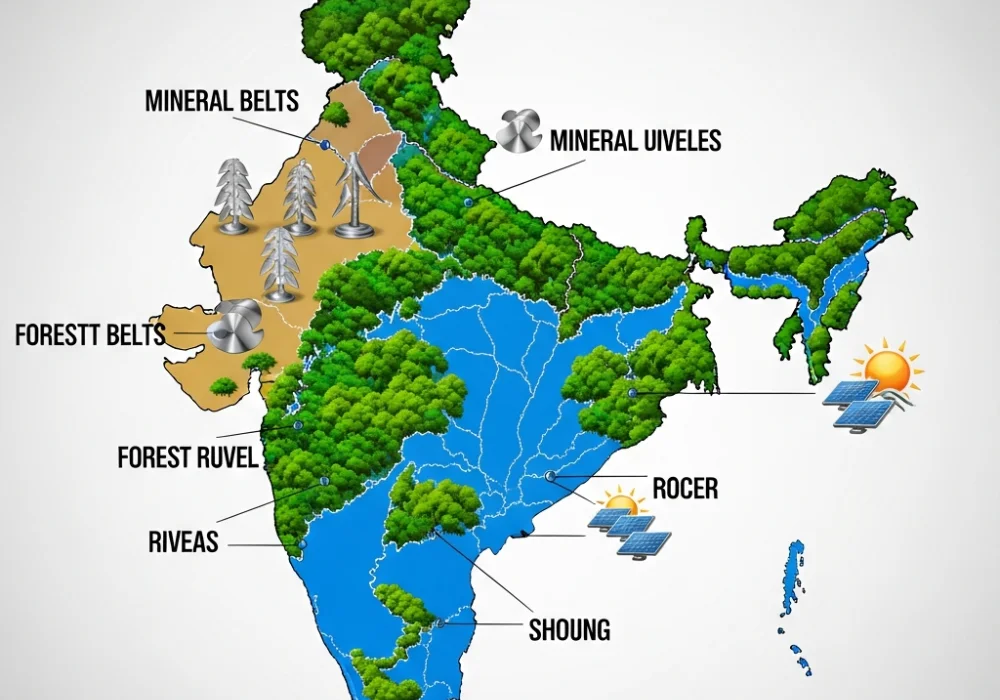
1. Introduction: The Bedrock of Indian Economy
Natural resources are the primary factors of production that determine the economic trajectory of a nation. For a UPSC aspirant, understanding the spatial distribution, utility, and conservation of these resources is critical under the General Studies Paper I (Geography) and Paper III (Economic Development) syllabus. India, with its diverse physiography, is endowed with a rich variety of natural resources ranging from the fertile alluvial plains of the North to the mineral-rich peninsular plateau.
The management of these resources has shifted from mere extraction to Sustainable Resource Management, aligning with India’s commitment to the United Nations Sustainable Development Goals (SDGs), particularly SDG 12 (Responsible Consumption and Production) and SDG 15 (Life on Land).
ℹ UPSC Syllabus Perspective
Questions in Mains often link natural resources with regional development disparities and environmental impact assessments. Always focus on the ‘why’ behind the location of industries relative to resource belts.
2. Mineral Resources: The Industrial Backbone
India’s mineral wealth is concentrated in the oldest geological formations. The Chota Nagpur Plateau is often termed the ‘Ruhr of India’ due to its massive deposits of coal, iron ore, and manganese.
A. Metallic Minerals
- Iron Ore: India is one of the leading producers. Major belts include the Odisha-Jharkhand belt (Badampahar mines), Durg-Bastar-Chandrapur belt (Bailadila mines), and Bellary-Chitradurga-Chikmagalur belt in Karnataka.
- Bauxite: The primary ore for aluminum. Odisha is the largest producer, with the Panchpatmali deposits being particularly significant.
B. Non-Metallic & Energy Minerals
Coal: Over 97% of coal in India belongs to the Gondwana age (bituminous coal found in Damodar, Mahanadi, and Godavari valleys). Tertiary coal is found in the North-Eastern states like Assam and Meghalaya.
Critical Minerals: In recent years, the Ministry of Mines has identified 30 critical minerals (including Lithium, Cobalt, and Nickel) essential for India’s high-tech and green energy transition. The discovery of Lithium reserves in Jammu & Kashmir (Reasi) and Rajasthan is a strategic milestone for India’s EV ambitions.
3. Land and Soil Resources
Land is a finite resource. India’s total geographical area is 328.7 million hectares, but land degradation affects nearly 30% of it. The Indian Council of Agricultural Research (ICAR) classifies Indian soils into eight categories:
- Alluvial Soils: Most widespread, covering about 40% of the area. Highly fertile, rich in potash but poor in phosphorus.
- Black Soils (Regur): Formed from volcanic rocks (Deccan Trap). Ideal for cotton cultivation.
- Red and Yellow Soils: Developed on crystalline igneous rocks. Red due to diffusion of iron.
- Laterite Soils: Result of intense leaching in high rainfall areas. Good for cashew nuts and coffee with heavy manuring.
ℹ Pro-Tip: Soil Health Card Scheme
Introduced in 2015, this scheme helps farmers understand the nutrient status of their soil, reducing the indiscriminate use of fertilizers (NPK ratio) and promoting sustainable land management.
4. Water Resources: Scarcity Amidst Abundance
India possesses roughly 4% of the world’s renewable water resources but supports nearly 18% of the world’s population. This discrepancy creates high water stress.
Surface vs. Ground Water
The Ganga-Brahmaputra-Meghna basin accounts for 60% of the total surface water discharge. However, ground water is the lifeline of Indian agriculture, providing 60% of irrigation. Over-exploitation in Punjab, Haryana, and Rajasthan has led to critical water table depletion.
Key Government Initiatives:
- Jal Jeevan Mission (JJM): Aims to provide Functional Household Tap Connections (FHTC) to every rural household by 2024.
- PM Krishi Sinchayee Yojana (PMKSY): Focuses on ‘Per Drop More Crop’ through micro-irrigation.
- Inter-linking of Rivers (ILR): Projects like Ken-Betwa seek to transfer water from surplus to deficit basins.
5. Forest and Wildlife Resources
According to the India State of Forest Report (ISFR) 2021, the total forest and tree cover is 24.62% of the geographical area. The National Forest Policy (1988) targets a 33% coverage to maintain ecological balance.
Ecological Importance: Forests act as carbon sinks, crucial for meeting India’s Net Zero 2070 target. The diverse climatic conditions support 16 different forest types, from Tropical Evergreen in the Western Ghats to Alpine forests in the Himalayas.
Threats: Shifting cultivation (Jhum), infrastructure projects, and forest fires remain significant challenges. The Forest (Conservation) Amendment Act, 2023 has recently sparked debates regarding its impact on border areas and diverse ecosystems.
6. Energy Transition: The Shift to Renewables
As part of the ‘Panchamrit’ strategy announced at COP26, India is rapidly diversifying its energy basket. Natural resources are no longer limited to coal and oil.
- Solar Energy: India has the 4th highest installed solar capacity globally. The PM-KUSUM scheme targets solarisation of agriculture.
- Wind Energy: Primarily concentrated in Tamil Nadu, Gujarat, and Maharashtra.
- Green Hydrogen: The National Green Hydrogen Mission aims to make India a global hub for production and export of green hydrogen, utilizing renewable water and energy resources.
UPSC Interactive Mock Quiz: Natural Resources
Test your knowledge with these high-difficulty Prelims-style questions.
Q1. With reference to coal reserves in India, consider the following statements:
1. Gondwana coal accounts for more than 95% of India’s coal reserves.
2. Gondwana coal is generally free from moisture and contains a high amount of sulphur.
3. Tertiary coal is mainly found in the states of Assam, Arunachal Pradesh, and Meghalaya.
Which of the statements given above is/are correct?
- A) 1 and 2 only
- B) 1 and 3 only
- C) 3 only
- D) 1, 2, and 3
✅ Click to Reveal Answer & Deep Explanation
Correct Answer: B) 1 and 3 only
Statement 1 is correct: Over 97% of coal reserves are of Gondwana age. Statement 3 is correct: Tertiary coal is found in the NE states and is of younger geological age. Statement 2 is incorrect because while Gondwana coal is low in sulphur, it is Tertiary coal that is characterized by high sulphur and moisture content, making it less suitable for heavy industrial use without processing.
Q2. Which of the following states possesses the largest reserves of Bauxite in India?
- A) Jharkhand
- B) Odisha
- C) Gujarat
- D) Maharashtra
✅ Click to Reveal Answer & Deep Explanation
Correct Answer: B) Odisha
Odisha is the leading producer and holds the largest reserves of Bauxite in India. Major deposits are found in Kalahandi, Sambalpur, Bolangir, and Koraput. The Panchpatmali deposits in Koraput district are the most significant for the aluminum industry in the country.
Q3. Consider the following statements regarding the Indian State of Forest Report (ISFR) 2021:
1. Madhya Pradesh has the largest forest cover in the country area-wise.
2. Mizoram has the highest forest cover as a percentage of total geographical area.
3. The report shows a decrease in the total forest and tree cover compared to the 2019 assessment.
Which of the statements given above is/are correct?
- A) 1 and 2 only
- B) 2 and 3 only
- C) 1 only
- D) 1, 2, and 3
✅ Click to Reveal Answer & Deep Explanation
Correct Answer: A) 1 and 2 only
Statement 1 is correct: Madhya Pradesh remains the top state by area. Statement 2 is correct: Mizoram leads in percentage (84.53%). Statement 3 is incorrect because the ISFR 2021 actually reported an overall increase of 2,261 sq km in the forest and tree cover compared to the 2019 report.
Q4. “Rare Earth Elements” (REE) are crucial for green energy. In India, these are primarily found in which of the following natural resources?
- A) Alluvial gold deposits
- B) Monazite sands in coastal areas
- C) Kimberlite pipes in Andhra Pradesh
- D) Gondwana coal seams
✅ Click to Reveal Answer & Deep Explanation
Correct Answer: B) Monazite sands in coastal areas
In India, Monazite is the principal source of Rare Earths and Thorium. It occurs in beach sand placer deposits along the coasts of Kerala, Tamil Nadu, Odisha, and Andhra Pradesh. Indian Rare Earths Limited (IREL) is the state body responsible for its processing.
Q5. With reference to ‘Water Management’ in India, consider the following statements:
1. Agriculture consumes more than 80% of India’s total water resources.
2. The Central Ground Water Authority (CGWA) was constituted under the Environment (Protection) Act, 1986.
3. India has the highest area under micro-irrigation globally.
Which of the statements given above is/are correct?
- A) 1 only
- B) 1 and 2 only
- C) 2 and 3 only
- D) 1, 2, and 3
✅ Click to Reveal Answer & Deep Explanation
Correct Answer: B) 1 and 2 only
Statement 1 is correct: Agriculture is the dominant user of water. Statement 2 is correct: CGWA was indeed constituted under the Environment (Protection) Act to regulate ground water. Statement 3 is incorrect: While India is rapidly expanding its micro-irrigation footprint under PMKSY, it does not currently hold the highest area globally; China and the USA have extensive systems as well.
Need Personal Guidance for UPSC?
Our experts at MyEntrance are ready to help you crack the Civil Services Examination with tailored study plans and mock tests.
∙ Chat with our Experts on WhatsApp (+91 9526806124)




