
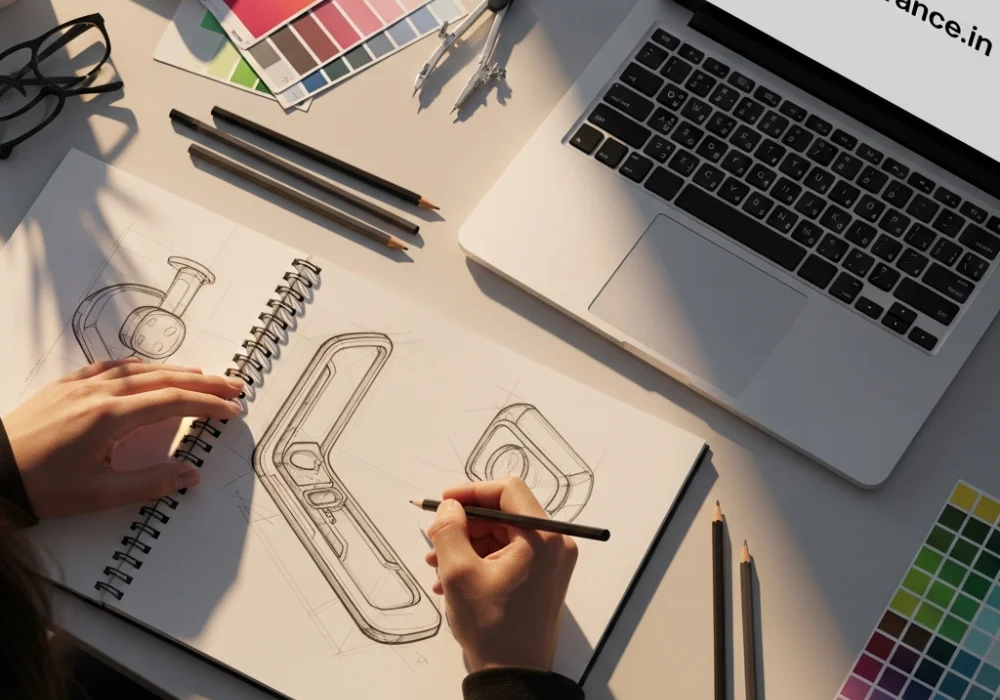
How do you solve complex problems in the NID DAT exam?
Solving complex design problems in the NID DAT requires a blend of creative lateral thinking, precise visual communication, and a human-centric approach. Success is achieved by deconstructing the question brief, identifying the core user need, and applying structured design frameworks like SCAMPER or the 5 Whys. By practicing with a comprehensive NID DAT question bank, students can develop the speed and agility required to translate abstract ideas into impactful visual solutions.
Table of Contents
The Philosophy Behind the NID DAT Question Bank
The National Institute of Design (NID) Design Aptitude Test (DAT) is not a conventional entrance exam. It does not just test your ability to draw; it evaluates your perception, empathy, and ability to innovate under pressure. The NID DAT question bank is designed to push students beyond their comfort zones.
Understanding the intent behind a question is the first step toward solving it. Most problems in the latest pattern focus on social issues, environmental sustainability, and everyday user experience. When you approach the question bank, look for patterns in how questions are framed to challenge your assumptions.
Using resources like myentrance.in allows you to access a curated question bank that mimics the actual exam environment. This helps in building the cognitive stamina required for the three-hour Prelims challenge.
Lateral Thinking: Solving the Unsolvable
What is Lateral Thinking in Design?
Lateral thinking is the process of solving problems through an indirect and creative approach. In the NID DAT, this often manifests as questions that ask you to find unusual uses for common objects or to visualize abstract concepts.
To master this, you must practice “Associative Thinking.” For example, if asked to design a device for the elderly, don’t just think of a walking stick. Think about their emotional needs, their environment, and their physical constraints.
💡 Pro-Tip: The SCAMPER Method
Use the SCAMPER technique (Substitute, Combine, Adapt, Modify, Put to another use, Eliminate, Reverse) to generate unique ideas for any design brief in your question bank. This ensures your solution is original and multifaceted.
Mastering Visual Literacy and Composition
Visual literacy is your ability to interpret and negotiate meaning from information presented in the form of an image. In NID DAT, this means your drawings must communicate a clear story without needing extensive text explanations.
Focus on perspective, light and shadow, and human proportions. A complex design problem might ask you to illustrate a scene from the perspective of an ant or a giant. Practicing these “Bird’s Eye” and “Worm’s Eye” views is crucial.
- Line Quality: Use varied line weights to create depth and focus.
- Composition: Follow the Rule of Thirds to make your visual answers more dynamic.
- Storyboarding: Break down a complex process into 4-6 clear, sequential frames.
At myentrance.in, our mock tests provide detailed feedback on visual composition, helping you refine these skills before the big day.
Comparison of Major Question Categories
To allocate your time effectively, it is vital to understand the weightage and difficulty of different sections in the NID DAT question bank.
| Category | Skill Tested | Complexity Level |
|---|---|---|
| Object Drawing | Observation & Rendering | Medium |
| Problem Identification | Empathy & Analysis | High |
| Metaphorical Illustration | Abstract Thinking | Very High |
| Memory Drawing | Recall & Perspective | Medium |
The Step-by-Step Design Thinking Process
When faced with a complex problem, don’t jump straight to the final drawing. Follow this professional design workflow to ensure your solution is well-thought-out:
1. Deconstruct the Brief
Circle the keywords in the question. What is the context? Who is the user? What is the core problem? Use the first 2 minutes just to think and analyze.
2. Ideation and Thumbnailing
Roughly sketch 3-4 small ideas (thumbnails) in the corner of your sheet. This prevents “designer’s block” and allows you to choose the most creative path.
3. Execution and Detailing
Once you have the best idea, draw it with confidence. Focus on the main elements first, then add textures, shadows, and labels to explain your thought process clearly.
💡 Click to reveal the secret to high marks
Always include a ‘User Persona’ or a brief note on ‘Design Intent’. Explaining *why* you chose a specific design shows the examiner that you are thinking like a professional designer, not just an artist.
Why Mock Tests are Essential for NID DAT Success
The NID DAT is as much about time management as it is about creativity. Most students fail not because they aren’t creative, but because they run out of time. Practicing with the current syllabus mock tests on myentrance.in helps you internalize the pacing required.
Our mock tests provide a realistic simulation of the actual exam, covering visual spatial ability, mental acuity, and general knowledge. By regularly timing yourself, you learn how to balance the objective Part A with the intensive drawing tasks in Part B.
Quick Knowledge Check
Test your design aptitude with these quick questions!
1. What does the term ‘Negative Space’ refer to in a composition?
💡 Click to Reveal Answer
Negative space is the empty space around and between the subjects of an image. Mastering it helps create balanced and intriguing designs.
2. Which design principle focuses on making the most important element stand out?
💡 Click to Reveal Answer
Emphasis or Focal Point. This is achieved through contrast, size, or color.
3. What is the first step in the Design Thinking process?
💡 Click to Reveal Answer
Empathy. You must understand the user’s needs and feelings before attempting to solve their problem.
Frequently Asked Questions (FAQs)
Is drawing skill more important than creativity in NID DAT?
No, NID values the ‘Idea’ more than the technical execution. However, your drawing must be clear enough to communicate your idea effectively.
How can I improve my speed for Part B?
Regularly practice with a timer using the NID DAT question bank from myentrance.in. Focus on sketching quickly with a light hand before finalizing lines.
Are color pencils allowed in NID DAT?
Yes, typically color pencils and pens are allowed. Check the latest pattern admit card instructions for the specific list of permitted stationery.
Ready to Ace your Design Exams?
Get access to premium mock tests, solved question banks, and expert guidance tailored for NID, NIFT, and more.
💬 Chat with our Experts on WhatsApp (+91 9526806124)




