
Introduction: The Business of Fashion in NIFT GAT
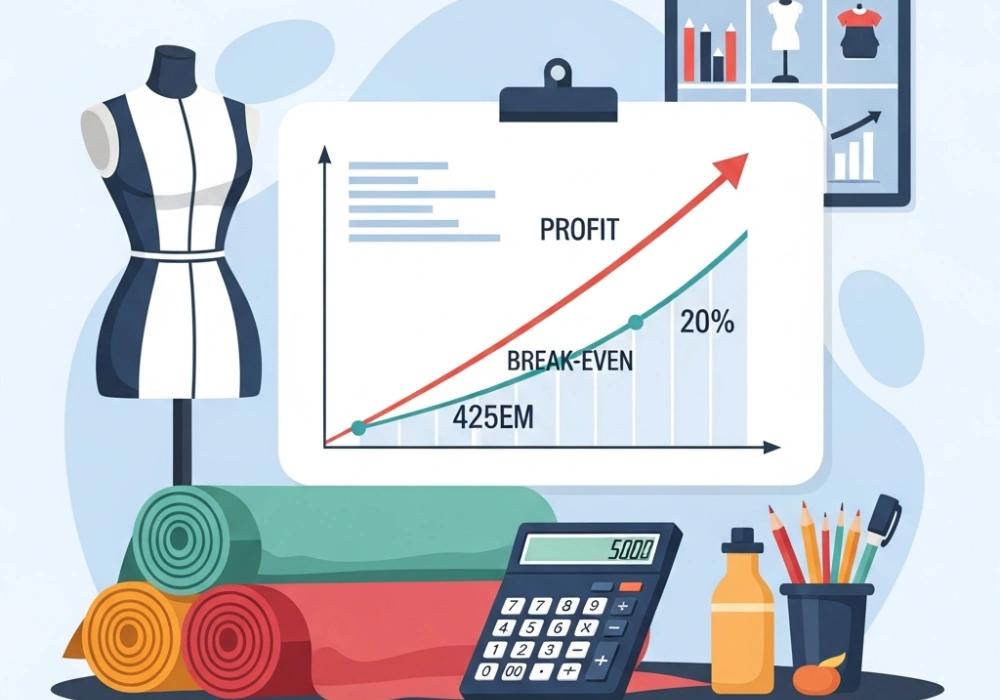
For a NIFT aspirant, the Quantitative Ability section isn’t just about numbers; it’s about the commerce behind the creativity. One of the most recurring and challenging themes in Previous Year Questions involves Profit and Loss analysis specifically applied to the fashion industry. Understanding how a boutique manages overhead costs like studio rent, tailor salaries, and marketing, while finding the elusive ‘Break-Even Point,’ is essential for any future fashion manager or designer.
This guide decodes the logic used in past entrance exams, providing you with both the conceptual depth needed to understand the ‘why’ and the ‘Ninja Shortcuts’ needed to crack the ‘how’ in under 30 seconds. We will look at five simulated scenarios based on Previous Year Questions patterns to ensure you are exam-ready.
💡 Why focus on Overheads?
In the NIFT GAT, questions rarely ask for simple profit. They include ‘hidden’ costs like transportation, electricity, and labor. If you ignore these, your profit calculation will be incorrect. Always remember: Total Cost = Cost Price + Overhead Expenses.
Question 1: The Designer’s Markup Trap
Scenario: A boutique owner in Hauz Khas buys a designer fabric for ₹4,000. She spends ₹800 on tailoring and ₹200 on transit. She then marks up the price to earn a 25% profit on the total cost. However, during a season-end sale, she offers a 10% discount on the marked price. What is her final profit percentage?
- 1. Calculate Total Cost Price (CP) = 4000 + 800 + 200 = ₹5,000.
- Calculate Marked Price (MP) for 25% profit: 5000 + (0.25 * 5000) = ₹6,250.
- Calculate Discount: 10% of 6250 = ₹625.
- Selling Price (SP) = 6250 – 625 = ₹5,625.
- Profit = 5625 – 5000 = ₹625.
- Profit % = (625 / 5000) * 100 = 12.5%.
Use the Successive Percentage formula: Net % = a + b + (ab/100)
Where a is profit markup (+25) and b is discount (-10).
Net % = 25 – 10 + (25 * -10 / 100) = 15 – 2.5 = 12.5%. No need to calculate the actual rupee values!
💡 Pro-Tip: When to ignore the numbers?
If the question asks for a ‘percentage’ and provides both rupee values and percentages, try the Successive Percentage shortcut first. Most NIFT Previous Year Questions are designed to see if you can find the ratio relationship rather than doing heavy arithmetic.
Question 2: Finding the Break-Even Point
Scenario: A sustainable fashion label has monthly fixed overheads (rent + salaries) of ₹1,20,000. The variable cost (fabric + labor) to produce one organic cotton dress is ₹1,500. If each dress is sold for ₹3,500, how many dresses must the label sell per month to break even?
Let ‘x’ be the number of dresses. Total Revenue = Total Cost.
3500x = 1,20,000 + 1500x
2000x = 1,20,000
x = 1,20,000 / 2000 = 60 dresses.
Break-Even Units = Fixed Costs / Contribution Margin
Contribution Margin = Selling Price – Variable Cost.
CM = 3500 – 1500 = 2000.
Units = 120,000 / 2000 = 60 units.
💡 Concept Deep Dive: Contribution Margin
Think of the Contribution Margin as the money ‘left over’ from each sale to pay off your rent. Once your total leftovers equal your rent, every sale after that is pure profit!
Question 3: Rent Inflation and Sales Targets
Scenario: Following Question 2, if the boutique’s rent increases by ₹20,000 and the designer wants to make a monthly profit of ₹40,000, how many total dresses must be sold?
New Fixed Costs = 1,20,000 + 20,000 = 1,40,000.
Desired Total Revenue = Total Cost + Desired Profit.
3500x = (1,40,000 + 1500x) + 40,000
2000x = 1,80,000
x = 90 dresses.
Required Sales = (Fixed Costs + Desired Profit) / Contribution Margin
Required Sales = (1,40,000 + 40,000) / 2000
Required Sales = 1,80,000 / 2000 = 90 dresses.
Question 4: Margin vs. Markup Confusion
Scenario: A fashion startup prices its handbags such that they have a 25% profit margin on the Selling Price. If the overhead-inclusive cost of producing one bag is ₹3,000, what is the Selling Price?
Let Selling Price be SP.
Profit = 0.25 * SP.
CP = SP – Profit.
3000 = SP – 0.25SP
3000 = 0.75SP
SP = 3000 / 0.75 = ₹4,000.
Use the Fraction Conversion table:
25% Margin on SP = 1/4 of SP.
This is always equal to 1/3 of CP (Markup).
Profit = 1/3 of 3000 = 1000.
SP = 3000 + 1000 = ₹4,000.
💡 The Fraction Trick Table
1/2 of SP = 1/1 of CP
1/3 of SP = 1/2 of CP
1/4 of SP = 1/3 of CP
1/5 of SP = 1/4 of CP
Memorizing this helps solve margin Previous Year Questions instantly.
Question 5: Weighted Average Multi-Product Break-Even
Scenario: A boutique sells two items: Luxury Scarves (Price ₹2,000, VC ₹1,000) and Designer Belts (Price ₹1,500, VC ₹500). They sell 2 scarves for every 3 belts. If monthly fixed costs are ₹70,000, what is the total number of items they need to sell to break even?
Let units be 2k and 3k.
Total Revenue = (2000*2k) + (1500*3k) = 4000k + 4500k = 8500k.
Total Variable Cost = (1000*2k) + (500*3k) = 2000k + 1500k = 3500k.
Break-even: 8500k = 3500k + 70,000
5000k = 70,000 -> k = 14.
Total items = 5k = 5 * 14 = 70 items.
Calculate Weighted Average Contribution Margin (WACM).
CM Scarf = 1000, CM Belt = 1000.
Since both have the same CM, the average is 1000.
Break-even = 70,000 / 1000 = 70 units.
Cheat Sheet: Quick Revision Formulas
| Concept | Formula |
|---|---|
| Total Cost | Fixed Costs + Variable Costs + Overheads |
| Contribution Margin | Selling Price – Variable Cost (per unit) |
| Break-Even (Units) | Fixed Costs / Contribution Margin |
| Sales for Target Profit | (Fixed Costs + Target Profit) / Contribution Margin |
| Margin to Markup | Markup = [Margin / (1 – Margin)] |
Ready to Ace the NIFT GAT?
Don’t let complex math stand between you and your dream design college. Our mentors specialize in breaking down the most difficult Previous Year Questions into simple, actionable steps.
💬 Chat with our Experts on WhatsApp (+91 9526806124)Get free guidance, mock tests, and personalized doubt clearing for your NIFT entrance prep.





