
Table of Contents
Introduction to the NIFT Situation Test
The NIFT Situation Test is the second stage of the entrance examination for the Bachelor of Design (B.Des) program. After clearing the GAT and CAT, students must demonstrate their creative aptitude in a hands-on environment. This test evaluates your ability to handle materials, innovate within constraints, and communicate your design thought process. At myentrance.in, we understand that moving from 2D sketches to 3D models can be daunting, which is why mastering material handling is critical. This guide provides an authoritative look at the latest pattern of the exam, focusing on technical skill and conceptual depth.
Unlike the written exams, the Situation Test is a practical assessment of your spatial intelligence. You are given a set of materials and a specific theme—ranging from social issues to futuristic concepts—and asked to create a 3D model within a limited time. The key is not just to build something beautiful, but to build something that is stable, innovative, and directly addresses the problem statement.
Decoding the Material Kit
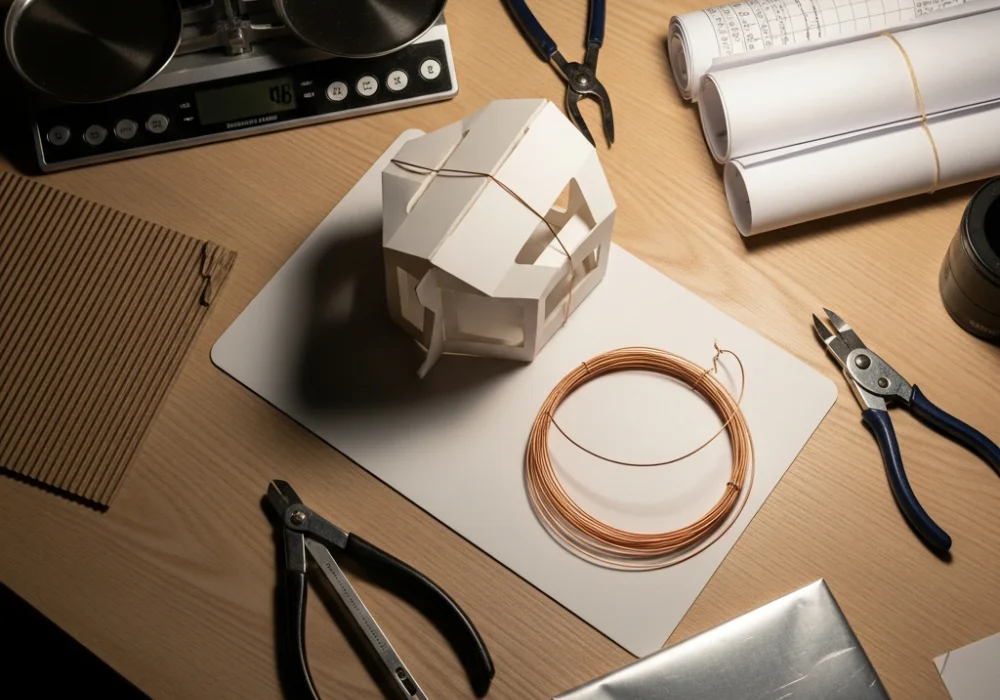
The materials provided in the exam are often mundane, but your task is to transform them into extraordinary components of a narrative. A typical kit might include cardboards, translucent sheets, aluminum foil, copper wires, cotton wool, straw, and clay. Understanding the inherent properties of each material is the first step toward mastery.
- Cardboard/Ivory Sheets: These provide the structural skeleton. Ivory sheets are flexible for curves, while cardboard offers rigidity.
- Wire: Ideal for creating outlines, adding movement, or providing internal support for heavy structures.
- Aluminum Foil: Use this for texture, metallic finishes, or molding organic shapes that hold their form.
- Fabric/Thread: Great for adding softness, tension, or representing elements like water or wind.
💡 Pro-Tip: Material Economy
Do not use all materials just because they are provided. Use only what is necessary to convey your concept. Over-utilization can lead to a cluttered, unstable model. Focus on quality over quantity.
Advanced Paper Manipulation Techniques
Paper is the most versatile material in your kit. To score high marks, you must move beyond simple folding. Techniques like scoring involve running a cutter lightly over the paper surface without cutting through, allowing for crisp, sharp folds. Pleating adds volume and rhythmic texture, while quilling can be used for intricate detailing.
Stability through Geometry
Triangular structures are inherently more stable than rectangular ones. When building a base or a tall structure, use triangular prisms to ensure your model doesn’t collapse under its own weight. At myentrance.in, our mock tests often include feedback on structural integrity, which is a common area where students lose marks. Ensure that your joints are clean and that you don’t leave excessive glue marks, as neatness is a major evaluation criterion.
Material Property Comparison
Choosing the right material for the right purpose is vital for efficiency. Use the table below to understand which materials suit different design needs.
| Material | Primary Strength | Common Use Case |
|---|---|---|
| Mount Board | Rigidity & Support | Bases, Walls, Platforms |
| Copper Wire | Flexibility & Linear Form | Human Figures, Tree Branches |
| Aluminum Foil | Malleability & Texture | Water, Metallic Surfaces |
| Thread/Yarn | Tension & Softness | Suspension Bridges, Hair |
Working with Wire and Foil
Wire handling is a skill that separates average models from expert ones. Wire can be used to create skeletons or to represent flow. For example, if you are asked to design a playground, wire can become the frame of a swing set. When using aluminum foil, avoid crumpling it into a ball. Instead, try folding it into geometric shapes or using it as a skin over cardboard to simulate metal. Combining wire and foil allows you to create dynamic, organic shapes like futuristic vehicles or flowing garments.
Remember to hide your joints. Using tape or glue visible to the examiner’s eye can suggest a lack of finesse. Try to lock wire ends by twisting them into the base or wrapping them around themselves for a cleaner finish.
Applying Design Principles in 3D
Your model must demonstrate an understanding of design principles. Balance (symmetrical or asymmetrical) ensures your model doesn’t look like it’s about to tip over. Rhythm can be achieved by repeating certain shapes, while Emphasis highlights the focal point of your model. For instance, if your theme is ‘Modern Transportation,’ the vehicle should be the emphasis, while the surroundings provide context and balance.
Think about ‘Positive and Negative Space.’ Don’t just fill every inch of your base. Sometimes, the space you leave empty tells as much of a story as the physical parts of the model. This sophisticated approach is what NIFT evaluators look for in top-tier candidates.
Drafting the Winning Write-up
The write-up is as important as the model. It is your opportunity to explain your creative choices. Usually limited to 100-150 words, it should cover: The Concept (What did you make?), The Inspiration (Why?), and Material Choice (How did you use the items provided?). Use design terminology like ‘ergonomics,’ ‘aesthetics,’ ‘sustainability,’ and ‘contrast’ to show your professionalism. Be concise and legible.
💡 Writing Strategy
Write your explanation in the last 15 minutes. Plan it in your head while you are building. Ensure the write-up links back to the core theme given in the question paper.
Frequently Asked Questions (FAQs)
Can I bring my own materials to the exam?
No. You are only allowed to use the materials provided in the official kit by NIFT. Bringing outside materials is strictly prohibited and can lead to disqualification.
What tools should I carry for the Situation Test?
While NIFT provides materials, you must bring your own toolkit including a sharp cutter, scissors, glue (Fevicol/Glue stick), a scale, a compass, and a pencil. Check the latest guidelines for any specific tool restrictions.
Is color paper always provided?
Not necessarily. If color is not provided, you must rely on texture and form to create visual interest. Sometimes pastel sheets or colored translucent sheets are included.
Quick Knowledge Check
Test your readiness for the Situation Test with these quick questions!
1. Which technique is used to create sharp, accurate folds in thick paper or ivory sheets?
Click to Reveal Answer
The correct answer is Scoring. It involves making a shallow cut on the surface of the sheet.
2. Why are triangular structures preferred over square ones for building 3D models?
Click to Reveal Answer
They provide better Structural Stability and resistance to deformation under weight.
3. What is the primary purpose of the explanatory write-up?
Click to Reveal Answer
To communicate the concept, design thought process, and material justification to the evaluators.
Ready to Crack the NIFT Situation Test?
Our expert-curated mock tests and material handling workshops at myentrance.in are designed to help you build confidence and precision. Don’t leave your design career to chance—practice with the best!
💬 Chat with our Experts on WhatsApp (+91 9526806124)




