
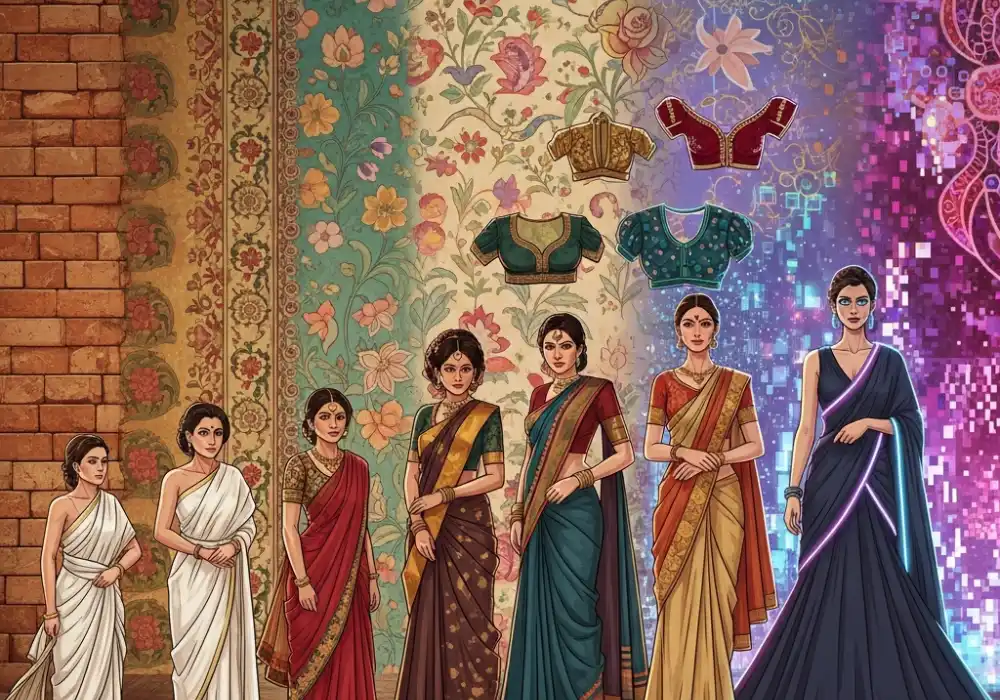
The Saree: A 5,000-Year Journey of Elegance and Engineering
An Essential Deep-Dive for NIFT GAT and CAT Preparation
Introduction for Fashion Aspirants
For any student eyeing a seat at the National Institute of Fashion Technology (NIFT), understanding the saree is not merely a cultural lesson—it is a fundamental study in textile engineering, draping science, and socio-political history. The saree, a single unstitched length of fabric ranging from 4.5 to 9 meters, represents one of the oldest continuously worn garments in human history. In the NIFT General Ability Test (GAT), questions frequently appear regarding regional weaves, historical periods, and the terminology of traditional textiles. In the Creative Ability Test (CAT), the saree often serves as a primary inspiration for design motifs, silhouettes, and conceptual illustrations. This blog post provides a detailed interactive timeline of the saree’s evolution, from the Indus Valley’s simple cotton wraps to the high-tech, 3D-printed drapes of the modern era.
As you navigate this timeline, pay close attention to how external influences—such as the Mughal invasion, British colonialism, and the rise of the Indian film industry—have reshaped the aesthetic and structural DNA of this garment. Understanding the ‘why’ behind these changes will give you a significant edge in your exam interviews and situation tests, where critical thinking and cultural context are highly valued.
2800 – 1800 BCE
The Indus Valley Civilization: Origins of Cotton
The roots of the saree can be traced back to the Indus Valley Civilization. Archaeological findings of terracotta figurines suggest that women wore a cloth draped around the waist like a wrap, leaving the upper body largely bare. For NIFT students, the key fact here is the cultivation of cotton (Gossypium arboreum) and the early use of natural dyes like indigo. This era established the ‘unstitched’ nature of Indian clothing, a concept rooted in the Vedic belief that stitched cloth was ‘impure’. Understanding this period is crucial for questions related to the origin of Indian textiles.
1500 – 500 BCE
The Vedic Period: Nivi and Vasas
During the Vedic era, the evolution of the saree progressed into three distinct parts: the ‘Nivi’ (lower garment), the ‘Vasas’ (upper wrap), and the ‘Adhivasa’ (a veil or shoulder wrap). This tripartite structure is the ancestor of the modern saree-blouse-petticoat ensemble. In NIFT exams, you may be asked about ancient terminology; remember that the term ‘Sattika’ used in early Buddhist and Jain literature eventually evolved into the word ‘Saree’. This era emphasized the importance of draping as an art form rather than a functional necessity.
322 BCE – 550 CE
The Mauryan and Gupta Ages: Silk and Sophistication
This ‘Golden Age’ of India saw the saree evolve into a symbol of status. Sculptures from the Mauryan and Sunga periods show elaborate drapes with pleats tucked at the front. The introduction of silk via the Silk Road and the development of gold and silver embroidery (the precursor to Zari) transformed the garment. For your NIFT portfolio, note the heavy ornamentation and the use of ‘Antariya’ (the lower wrap) seen in Ajanta and Ellora cave paintings. This period defines the luxury aspect of traditional Indian costume history.
1526 – 1857 CE
The Mughal Influence: Motifs and Persian Flare
The arrival of the Mughals introduced Persian aesthetics to the saree. This period is vital for NIFT GAT preparation regarding textile motifs. The introduction of ‘Butas’ (floral patterns), ‘Paisleys’, and ‘Jal’ (lattice work) became common in Banarasi weaves. The use of fine Muslins from Dhaka (Mulmul) and the refinement of Zardosi (gold embroidery) are key takeaways. The Mughal era also influenced the ‘Parda’ system, leading to the saree being draped more conservatively to cover the head, which eventually became the modern ‘Pallu’.
1870 – 1920 CE
The British Raj: Jnanadanandini Devi’s Revolution
The modern way we drape a saree (the Nivi drape) was popularized by Jnanadanandini Devi, the sister-in-law of Rabindranath Tagore. Influenced by Victorian modesty, she introduced the concept of wearing a ‘blouse’ (chemise) and a ‘petticoat’ underneath the saree. Before this, sarees were often worn without an upper garment in many parts of India. For NIFT aspirants, this is a crucial point of ‘Westernization’ in Indian fashion history, marking the transition from traditional wraps to a structured ensemble suitable for modern social settings.
1920 – 1947 CE
The Swadeshi Movement: Saree as Political Identity
During the independence struggle, the saree became a tool of political protest. Mahatma Gandhi’s call to boycott British goods and embrace ‘Khadi’ turned the saree into a symbol of national pride. Women from all social strata wore coarse, hand-spun cotton sarees to signal their participation in the movement. In your NIFT Situation Test or GAT, understanding the symbolic power of textiles like Khadi is essential. This period proved that fashion is not just aesthetic but deeply ideological and socio-economic.
1950 – 1980 CE
The Bollywood Era: Chiffons and Glamour
Post-independence, Indian cinema became the primary trendsetter for sarees. The 1960s saw the ‘Mumtaz’ style (wrap-around saree), while the 1970s and 80s popularized lightweight synthetic fabrics like Chiffon, Georgette, and Nylon. Maharani Gayatri Devi’s preference for elegant chiffon sarees set a high-fashion standard. For NIFT students, this era marks the rise of the ‘Fashion Designer’ as a household name and the shift from community-specific weaves to mass-produced, trend-based sarees influenced by visual media.
2000 – Present
The Revival and Fusion: Sustainable Tech-Sarees
Today, the saree is undergoing a renaissance. Designers like Sabyasachi, Manish Malhotra, and Ritu Kumar have brought traditional weaves back to the global stage. Simultaneously, fusion drapes—like saree gowns, dhoti-sarees, and sarees paired with belts or sneakers—are targeting Gen Z. Technological advancements like digital printing and sustainable fibers (banana yarn, recycled plastic) are the current focus. For NIFT aspirants, this is the most relevant era: focus on ‘Sustainable Fashion’ and ‘Handloom Revival’ as these are hot topics for current entrance exams.
Mastering the Saree: Study Guide for NIFT Aspirants
To score high in your NIFT exams, you must go beyond basic history. Here is a curated checklist of topics you should master:
- Regional Weaves: Identify the states for Banarasi (UP), Kanjeevaram (Tamil Nadu), Paithani (Maharashtra), Patola (Gujarat), Chanderi (MP), and Sambalpuri (Odisha).
- Terminology: Understand terms like Pallu (the end piece), Zari (metallic thread), Warp and Weft (weaving directions), and Motifs (design elements).
- Draping Variations: Recognize that India has over 80 documented ways of wearing a saree, including the Madisar, Nauvari, and Mekhela Chador.
- Fabric Science: Distinguish between natural fibers (Silk, Cotton, Linen) and synthetic fibers (Rayon, Polyester) used in modern saree production.
Sample Practice Questions for GAT
1. Which textile is known as the ‘Queen of Silks’ in South India?
2. Who is credited with introducing the blouse and petticoat to the Indian saree drape?
3. The ‘Shakuntala’ painting by Raja Ravi Varma showcases which style of saree drape?
Pro Tip: When drawing a saree for your CAT (Creative Ability Test), focus on the ‘fall’ and ‘flow’ of the fabric. Use light shading to indicate the translucency of materials like Organza or Chiffon versus the stiff, heavy drapes of Kanjeevaram silk.
Need Help with NIFT Exam Preparation?
Don’t let your fashion dreams wait! Whether you need help with Textile History, Design Sketching, or General Knowledge, our experts at MyEntrance are here to guide you to your dream NIFT campus.
💬 Chat with our Experts on WhatsApp (+91 9526806124)




