
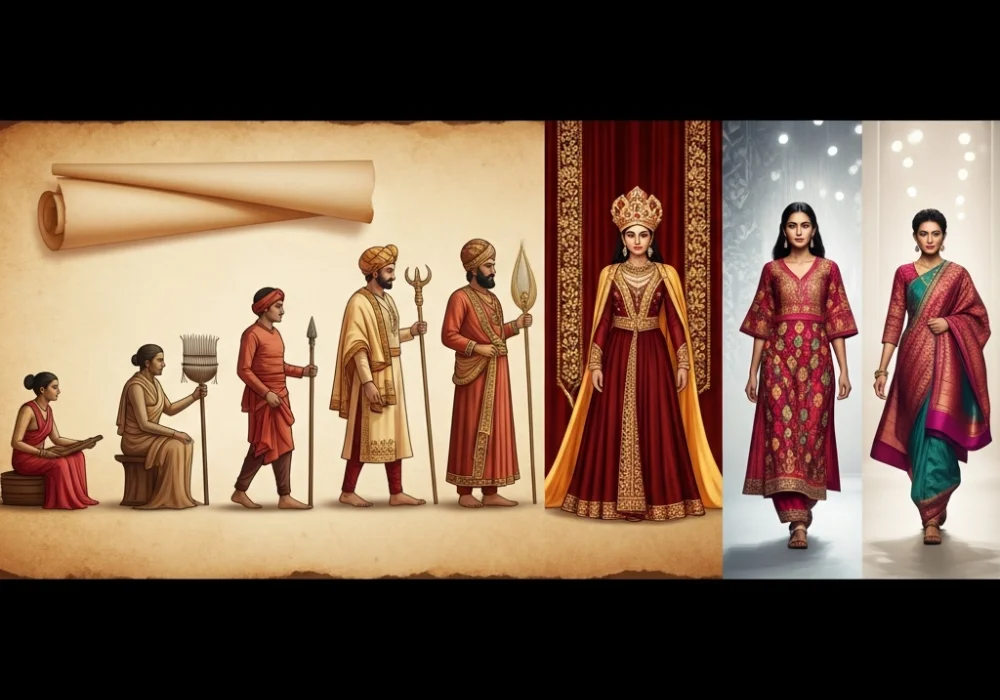
The Chronological Thread: Navigating the Evolution of Indian Textiles
For any NIFT (National Institute of Fashion Technology) aspirant, understanding the history of Indian textiles is not just a part of the syllabus; it is the foundation of their creative identity. India’s textile heritage is a vibrant tapestry woven with threads of culture, trade, religion, and politics. From the humble cotton found in the ruins of Mohenjo-daro to the high-fashion runways of Milan, Indian fabrics have dictated global trends for millennia. This comprehensive guide serves as an interactive study tool designed specifically for the GAT (General Ability Test) and CAT (Creative Ability Test) sections of the NIFT entrance exam. We will explore the technical nuances, the regional diversities, and the historical milestones that every future designer must memorize.
The study of textiles in the Indian context involves understanding fiber origins, dyeing techniques, weaving patterns, and the socio-economic impacts of the industry. As you prepare for your entrance, pay close attention to the terminology used in this timeline—terms like ‘Hiranya,’ ‘Jamdani,’ and ‘Muslin’ are frequent features in the NIFT General Knowledge papers. Let us embark on this chronological journey through time to see how India became the textile capital of the ancient and modern world.
3300 – 1300 BCE
Indus Valley Civilization: The Birth of Cotton
The roots of Indian textiles lie in the Indus Valley Civilization. Archaeological excavations at Mohenjo-daro revealed traces of cotton fabric dyed with madder, suggesting that Indians were pioneers in both cotton cultivation and the art of mordant dyeing. For NIFT, remember the significance of the ‘Priest-King’ statue, which depicts a trefoil-patterned shawl, indicating early expertise in embroidery or block printing. This era established India as the earliest producer of fine cotton in the world.
1500 – 500 BCE
The Vedic Period: Golden Threads and Ritualistic Garments
During the Vedic age, textiles became deeply intertwined with social status and religious rituals. The Rigveda mentions ‘Hiranya-Drapi’ or garments made of gold, which are early precursors to the Zari work we see today. The concept of ‘Paridhana’ (lower garment) and ‘Uttariya’ (upper garment) began to take shape. This period is crucial for NIFT aspirants to understand the evolution of draped clothing, as the sari and dhoti find their conceptual origins here, long before the advent of tailored garments.
321 BCE – 550 CE
Mauryan and Gupta Eras: The Silk Road Influence
As trade routes expanded, particularly the Silk Road, India became a hub for textile exchange. The Arthashastra by Chanakya details various types of wool, cotton, and silk produced in different regions like Kashi (Varanasi) and Vanga (Bengal). The Gupta period is often called the Golden Age of Indian Art; during this time, the depiction of diaphanous silks in Ajanta murals showcases the high level of transparency and fineness achieved in weaving. This era is vital for understanding the regional specialization of textile clusters.
1526 – 1857 CE
The Mughal Empire: Persian Elegance and Royal Ateliers
The Mughals brought a revolution in Indian textiles by blending indigenous techniques with Persian aesthetics. Emperors like Akbar established ‘Karkhanas’ (royal workshops) to produce exquisite fabrics like Jamdani, Muslin, and Pashmina shawls. The introduction of the ‘Buta’ (floral motif) and the refinement of Zardosi embroidery occurred during this time. For the NIFT exam, focus on the influence of Mughal floral patterns on modern Indian bridal wear and the global fame of ‘Dhaka Muslin’ which was described as ‘woven air’.
10th – 18th Century
Medieval South India: Temple Silks and Ikat Traditions
While the North was influenced by Persian styles, South India developed its own distinct textile identity under dynasties like the Cholas and Vijayanagara. This era saw the rise of the Kanjeevaram silk saree, characterized by its heavy gold borders and temple-inspired motifs. Additionally, the complex double-ikat technique of Patola from Gujarat gained prominence. Understanding the difference between warp-based and weft-based Ikat is a common technical question in NIFT’s textile science sections.
1858 – 1947 CE
The British Raj: Industrialization vs. The Charkha
The colonial period was a double-edged sword for Indian textiles. On one hand, British textile mills in Manchester led to the decline of traditional Indian handlooms through unfair trade practices. On the other hand, this sparked the Swadeshi movement. Mahatma Gandhi turned the ‘Charkha’ (spinning wheel) and Khadi into symbols of self-reliance and resistance. This period is historically significant for NIFT because it redefined textiles as a tool for political and social identity.
1947 – 1990 CE
Post-Independence: Institutional Revival and Handicrafts
After 1947, the Indian government made concerted efforts to revive dying crafts. Figures like Kamaladevi Chattopadhyay and Pupul Jayakar played pivotal roles in establishing the All India Handlooms and Handicrafts Board. This era saw the creation of NIFT itself (in 1986) to professionalize the industry. The focus was on preserving traditional weaves like Chanderi, Maheshwari, and Pochampally by providing weavers with better market access through state emporiums.
1991 – Present Day
The Contemporary Era: Global Fusion and Sustainability
Today, Indian textiles are at the forefront of the global ‘Sustainable Fashion’ movement. Contemporary designers like Sabyasachi, Ritu Kumar, and Anita Dongre are bringing traditional Indian crafts like block printing and hand-embroidery to the global stage. Innovations in eco-friendly fibers like lotus silk and hemp are merging with ancient techniques. For NIFT aspirants, this era emphasizes the importance of ‘Ethical Fashion’ and ‘GI Tags’ (Geographical Indications) for protecting regional crafts.
NIFT Study Guide: Essential Textile Terminology
To excel in the NIFT entrance, you must go beyond the timeline and master the specific categories of Indian textiles. Here is a curated list of high-yield topics for your revision:
- 1. Dyeing & Printing: Understand the difference between Ajrakh (geometric blocks from Gujarat/Rajasthan), Bagru (natural mud-resist printing), and Bandhani (tie-dye).
- 2. Embroidery Styles: Learn to identify Chikankari from Lucknow, Kantha from West Bengal, Phulkari from Punjab, and Kasuti from Karnataka.
- 3. Handloom Weaves: Study the structural differences between Banarasi Brocade, Paithani from Maharashtra (known for peacock motifs), and Sambalpuri (Ikat from Odisha).
- 4. Geographical Indications (GI): Keep a list of textiles that have been granted GI status, as these are frequently asked in the GAT section.
Exam Preparation Tips for Textile History
The NIFT exam often tests your visual recognition skills. We recommend maintaining a ‘Swatches Scrapbook’ where you paste images of different fabrics alongside their history and origin. In the CAT (Creative Ability Test), you might be asked to design a modern outfit inspired by a historical era—for instance, a contemporary dress using Mauryan drape techniques. Use the timeline above to draw inspiration for such creative challenges.
Furthermore, stay updated with the Ministry of Textiles’ initiatives. Schemes like ‘Samarth’ for capacity building and the celebration of National Handloom Day (August 7th) are crucial current affairs topics. Remember, the evolution of Indian textiles is a story of resilience; despite the onslaught of fast fashion, the soul of India remains in its hand-spun threads.
Ready to Ace your NIFT Entrance? 🎓
Don’t let complex history and design theories overwhelm you. Get expert mentorship, free study materials, and access to exclusive mock tests with MyEntrance.
💬 Chat with our Experts on WhatsApp (+91 9526806124)




