
Introduction: The Panelist’s Perspective
Welcome, future designers. As an elite admission panelist for the NIFT Entrance Exam, I have witnessed thousands of students navigate the high-pressure environment of the Situation Test. While the General Ability Test (GAT) and Creative Ability Test (CAT) measure your logic and 2D visualization, the Situation Test is where we see your 3D problem-solving skills and material sensitivity in real-time. The latest trends in design education emphasize ‘narrative building’—we don’t just want a model; we want a story told through materials. Today, we dive deep into one of the most challenging and rewarding prompts: Constructing a fashion ramp based on the theme ‘Metamorphosis’.
This scenario is not just about making a pretty stage. It is about capturing the emotional and physical tension between restriction and expansion. In the current design landscape, ‘Avant-Garde’ implies pushing boundaries beyond wearable norms, and your model must reflect that audacity. You have limited materials and a ticking clock. Let’s explore how you can turn a few sheets of paper and wire into a masterpiece that earns you a top-tier rank at your dream NIFT campus.
💡 Why is the ‘Situation Test’ the real tie-breaker?
The Situation Test holds 20% weightage. Often, students with similar CAT scores are separated by their performance here. We look for ‘Productive Thinking’—the ability to look at a simple straw and see it as a structural pillar for a runway.
Decoding the Theme: Metamorphosis & Avant-Garde
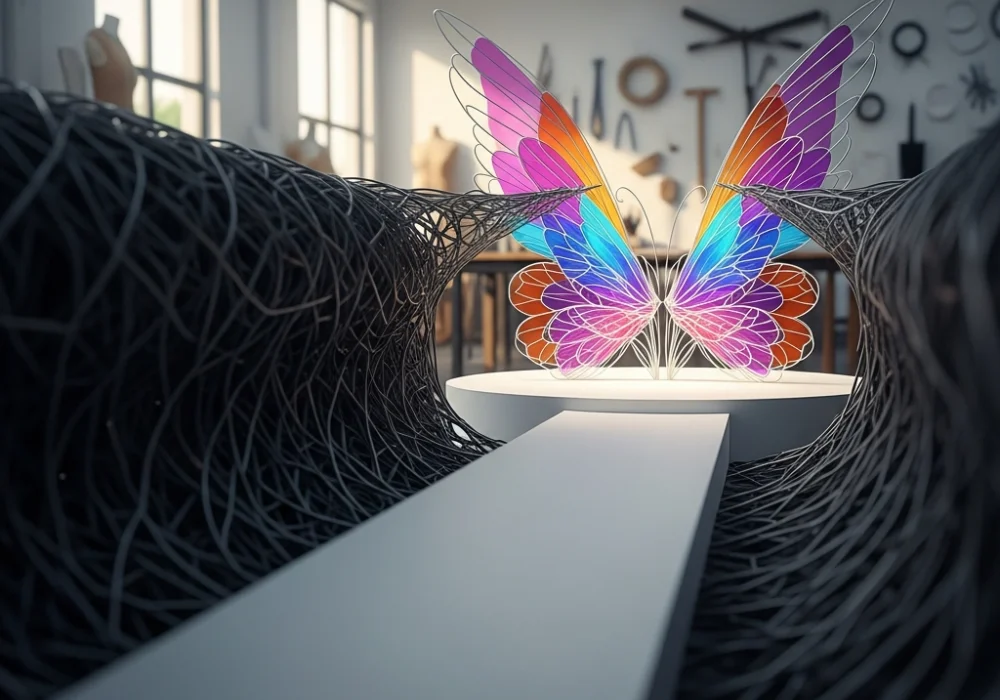
To score high, you must first understand the keywords. Metamorphosis is a biological process of transformation. In fashion, it symbolizes growth, evolution, and the shedding of old identities. The prompt specifically asks for a transition from a restrictive cocoon to an expansive butterfly. This implies a visual journey on the ramp.
What is Avant-Garde?
Avant-garde refers to experimental or innovative ideas. For your fashion ramp, this means avoiding a standard rectangular catwalk. Think of asymmetrical shapes, exaggerated scales, and unconventional structural supports. Since it is for a Spring-Summer collection, your color palette and material choices should lean towards light, airy, and vibrant elements, even within the restrictive phase.
- Restrictive Cocoon: Tight spaces, monochrome colors, heavy textures, opacity, and jagged edges.
- Expansive Butterfly: Open spaces, translucent materials, fluid lines, vibrant colors, and symmetry.
💡 Pro-Tip: The ‘Hook’ Factor
Don’t just place a butterfly at the end. Use ‘Gradation’. Let the ramp start as a narrow, claustrophobic tunnel and gradually widen and rise into a grand, winged stage. This physical movement mimics the theme perfectly.
Secret Evaluation Criteria: What We Secretly Look For
As panelists, we use a rubric that goes beyond ‘neatness’. Here is how we evaluate your work:
1. Concept Clarity (20%)
Does the model immediately scream ‘Metamorphosis’? If I have to read your write-up for five minutes to understand the theme, you have failed. The visual impact should be instantaneous.
2. Innovation in Material Handling (30%)
We provide the same kit to everyone. The student who wins is the one who transforms the material. For example, instead of just folding paper, did you quill it? Did you weave it? Did you crinkle it to create a cocoon texture?
3. Aesthetic Appeal & Composition (20%)
Proportion and scale are vital. If your butterfly wings are too small compared to the ramp, the model looks imbalanced. We look for a ‘wow’ factor in the final silhouette.
4. Neatness and Technique (20%)
Visible glue marks, ragged paper edges, and unstable structures lead to heavy negative marking. Your model must be sturdy enough to be moved without falling apart.
5. The Write-Up (10%)
Your explanation should be a bridge between your model and your mind. Use design terminology like ‘Juxtaposition’, ‘Organic Forms’, and ‘Dynamic Balance’.
Material Alchemy: Tips for Construction
In the upcoming NIFT Situation Test, you will likely be given card sheets, corrugated sheets, wire, thread, beads, and translucent paper. Here is how to use them for this theme:
- Corrugated Sheet: Best for the base of the ramp. Peel off the top layer to reveal the ‘ridges’—this looks like the segmented body of a caterpillar.
- Wire: Perfect for the ‘Expansive’ part. Use wire to create the skeletal structure of butterfly wings. It provides height and stability.
- Handmade/Translucent Paper: Use these for the wings to allow light to pass through, symbolizing the lightness of spring-summer.
- Thread/Yarn: Wrap these around the ‘cocoon’ section to represent the silk threads of a real chrysalis.
“Design is not what it looks like and feels like. Design is how it works. In the Situation Test, your model must ‘work’ as a visual metaphor.”
Step-by-Step Model Making Strategy
Phase 1: The Foundation (0-20 Minutes)
Spend the first 10-15 minutes sketching and planning. Decide on the ‘Path of the Model’. A spiral ramp works beautifully for metamorphosis as it represents the cycle of life. Cut your base from a thick corrugated sheet (approx 10×10 inches).
Phase 2: The Restrictive Cocoon (20-60 Minutes)
Construct a narrow, dark, and enclosed entry point for the models. Use gray or black card sheet. Create a ‘tunnel’ effect. Use the ‘pleating’ technique to make the walls look cramped and suffocating. This represents the struggle before the transformation.
Phase 3: The Transition Point (60-90 Minutes)
This is the middle of your ramp. Start breaking the walls of the tunnel. Use wire to create ‘bursting’ effects. This is where you introduce the first pops of Spring-Summer colors (pinks, yellows, light blues). Use ‘paper curling’ to represent the unfolding of wings.
Phase 4: The Expansive Stage (90-150 Minutes)
The end of the ramp should be a wide, open platform. Elevate this platform to show the ‘flight’ of the butterfly. Construct two massive, intricate wings on either side of the stage using wire frames and translucent paper. Ensure the wings are symmetrical and have ‘filigree’ work (small cut-outs) to show intricate detail.
Phase 5: Detailing & Finishing (Last 30 Minutes)
Check for glue stains. Add tiny beads to the wings to represent morning dew (Spring element). Ensure the model is structurally sound. If it wobbles, add a ‘buttress’ or a support pillar hidden underneath the stage.
The Final Step: The Design Write-up
Most students ignore this, but it’s where you justify your design. Your write-up for this topic should look like this:
Title: The Chrysalis Ascent
Concept: My model depicts the journey of an avant-garde Spring-Summer collection from the confinement of winter (cocoon) to the liberation of spring (butterfly). I used a spiral ramp to represent the continuous cycle of fashion evolution. The textures transition from heavy, opaque corrugated walls to light, wire-mesh wings, symbolizing the physical metamorphosis of the wearer.
Techniques Used: Quilling for floral accents, wire-bending for structural integrity, and paper-layering to create 3D depth.
💡 Click to reveal common mistakes to avoid
1. Over-using glue (makes the model messy). 2. Not using the full base. 3. Making the ‘wings’ too heavy so they sag. 4. Forgetting the ‘Spring-Summer’ aspect (keep it colorful!).
Need Personalized Guidance for your Situation Test?
Don’t leave your NIFT dream to chance. Join our latest mock test series and get feedback from actual NIFT alumni!
💬 Chat with our Experts on WhatsApp (+91 9526806124)




