
Introduction: Navigating the Edge of Dystopia
Welcome, future designers. As an elite admission panelist, I have witnessed thousands of models, but the ones that truly stand out are those that bridge the gap between abstract thought and physical reality. The ‘Cyber-Punk’ scenario is a classic yet complex challenge in the NIFT Situation Test. It demands more than just a model; it requires a narrative. You are tasked with creating a ramp model that captures a dystopian world where nature is no longer the ruler, but a reclaimed asset of high technology. This masterclass will guide you through every nuance of this specific prompt, ensuring your work screams innovation, technical skill, and conceptual depth.
In this guide, we will explore how to use aggressive geometric forms to convey the harshness of a digital future and how metallic textures can be simulated using the limited materials provided in your kit. Remember, in the latest entrance standards, we aren’t just looking for a ‘pretty’ model; we are looking for a designer who can think under pressure and manipulate materials to tell a story.
Decoding the Brief: What the Panelists Are Secretly Looking For
When we walk around the examination hall, we evaluate your model based on four pillars. If your ‘Cyber-Punk’ model misses even one, your score will reflect it.
- Conceptual Clarity: How well did you interpret ‘Nature reclaimed by technology’? Did you just stick a paper leaf on a cardboard box? Or did you weave wire ‘vines’ through a metallic ‘circuitry’ skeleton?
- Innovative Material Handling: This is the soul of the Situation Test. Can you make paper look like steel? Can you make plastic look like glowing neon? We look for techniques like scoring, quilling, pleating, and layering.
- Aesthetic of Aggression: The brief specifies ‘aggressive geometric forms’. This means sharp angles, triangles, trapezoids, and spikes. Rounded, soft shapes will cost you marks here.
- The Write-Up: Your 100-word explanation must justify every fold and every material choice. It is the roadmap to your creative mind.
💡 Click to Reveal the Secret Scoring Tip
Panelists love ‘negative space’. Don’t just build a solid block. Leave gaps in your geometric structures to simulate the hollow, skeletal feeling of a dystopian city. It shows advanced structural understanding.
Material Handling: Simulating the ‘Cyber-Punk’ Look
The standard NIFT kit includes cardboard, colored paper, wire, thread, buttons, and straws. To achieve a metallic, futuristic texture, you must manipulate these mundane objects.
1. Achieving Metallic Sheen
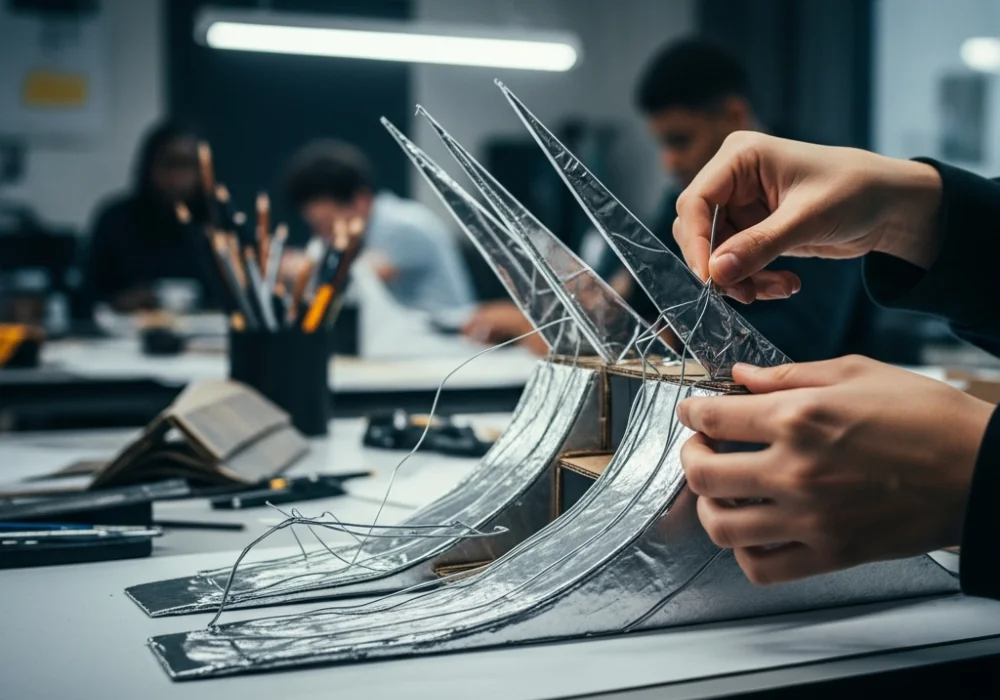
Since you won’t have actual metal, use the silver foil (if provided) or the glossy side of magazine paper. If those aren’t available, burnish your lead pencil over a small area of white paper to create a graphite metallic sheen. Layering transparent plastic sheets over dark paper also gives a high-tech, reflective ‘screen’ appearance.
2. Creating Aggressive Geometry
Avoid simple squares. Use Triangulation. Triangles are the strongest and most aggressive shapes. Create 3D pyramids and prisms by scoring (cutting halfway through) the cardboard. This allows for sharp, crisp bends that catch the light and create the ‘cityscape’ feel.
3. The ‘Nature’ Element
Nature in a cyberpunk world is often distorted. Use green thread or wire to create ‘synthetic vines’. Instead of cutting a leaf shape, cut a leaf out of translucent plastic or wrap wire into a leaf-like silhouette. This suggests nature is being ‘mimicked’ or ‘hacked’ by technology.
Step-by-Step Construction Strategy
Follow this timeline to ensure you complete the model within the 2-hour limit:
Phase 1: The Structural Skeleton (20 Minutes)
Construct a stable base. For a ramp model, the ‘ramp’ itself should be part of the dystopian landscape. Build a multi-level platform using thick cardboard. Use ‘L-joints’ for stability. Ensure the base is neat; glue marks are a design sin.
Phase 2: The Model Silhouette (30 Minutes)
Focus on the human form (the ramp model). Since this is Cyber-Punk, the model’s silhouette should be exaggerated. Think ‘power shoulders’ or asymmetric headgear. Use wire to create a dynamic pose—perhaps the model is ‘glitching’ or leaning forward into a digital wind.
Phase 3: Geometric Armor and Textures (40 Minutes)
Attach sharp, geometric plates to the model. Use the technique of layering. Small, overlapping silver-colored triangles can mimic the look of futuristic dragon scales or armor plating. Use drinking straws to create ‘pipes’ or ‘cables’ that connect the model to the base, symbolizing the nature-tech connection.
Phase 4: Details and Refinement (20 Minutes)
Add the ‘nature’ reclaim elements. Intertwine green wire or frayed thread around the geometric structures. Add small ‘buttons’ as nodes or sensors. Ensure there are no visible tape marks. Use the ‘invisible gluing’ method (applying glue with a toothpick).
Phase 5: The Final Write-up (10 Minutes)
Do not leave this for the end. Write it alongside your model. Explain why you used triangles (stability and aggression) and why the metallic texture represents the loss of organic warmth.
Interactive Practice: Test Your Design Intuition
Before you start your mock practice, answer these quick design questions to sharpen your focus:
❓ Which color palette best suits Cyber-Punk?
Answer: High-contrast combinations. Deep blacks/blues paired with neon accents (electric pink, green, or silver). Avoid pastels or earthy browns unless they are being ‘overtaken’ by the tech elements.
❓ How do you show ‘Aggression’ in a non-living model?
Answer: Use cantilevered structures (parts that hang out without visible support), sharp points pointing upwards or towards the viewer, and asymmetric balance. Symmetry is often too ‘peaceful’ for a dystopian theme.
Expert Pro-Tips for the Finishing Touch
“A designer doesn’t just build; they curate. Every scrap of material on your table should either be on the model or in the trash. A messy workstation often leads to a messy mind during the evaluation.”
Here are some final expert tips to elevate your model from ‘Good’ to ‘NIFT-Ready’:
- Scale and Proportion: Ensure your model looks like it could exist in a real-world cityscape. If your ‘pipes’ (straws) are too thick, they will look like columns. Scale them down by splitting them.
- Gravity-Defying Elements: Use the wire provided to suspend small geometric bits in mid-air around the model. This creates a ‘magnetic’ or ‘holographic’ effect common in cyberpunk aesthetics.
- Texture Contrast: Place a very rough, crinkled piece of paper (nature) next to a perfectly smooth, flat metallic piece (technology). The contrast will tell the story of ‘Nature Reclaimed’ without you saying a word.
Common Mistakes to Avoid
1. Over-gluing: If we see a ‘sea’ of Fevicol, we deduct marks for lack of finesse.
2. Literal Interpretations: Don’t just make a robot. The brief asks for a ramp model representing a collection. It should look like high-fashion, not a toy.
3. Ignoring the ‘Cityscape’: The prompt mentions a dystopian cityscape. Ensure the base or the background of your model hints at architecture.
Need Personalized Feedback on Your Models?
The Situation Test is the final hurdle between you and your dream campus. Don’t leave it to chance. Join our intensive mock sessions and get direct feedback from NIFT alumni and industry experts.
💬 Chat with our Experts on WhatsApp (+91 9526806124)




