
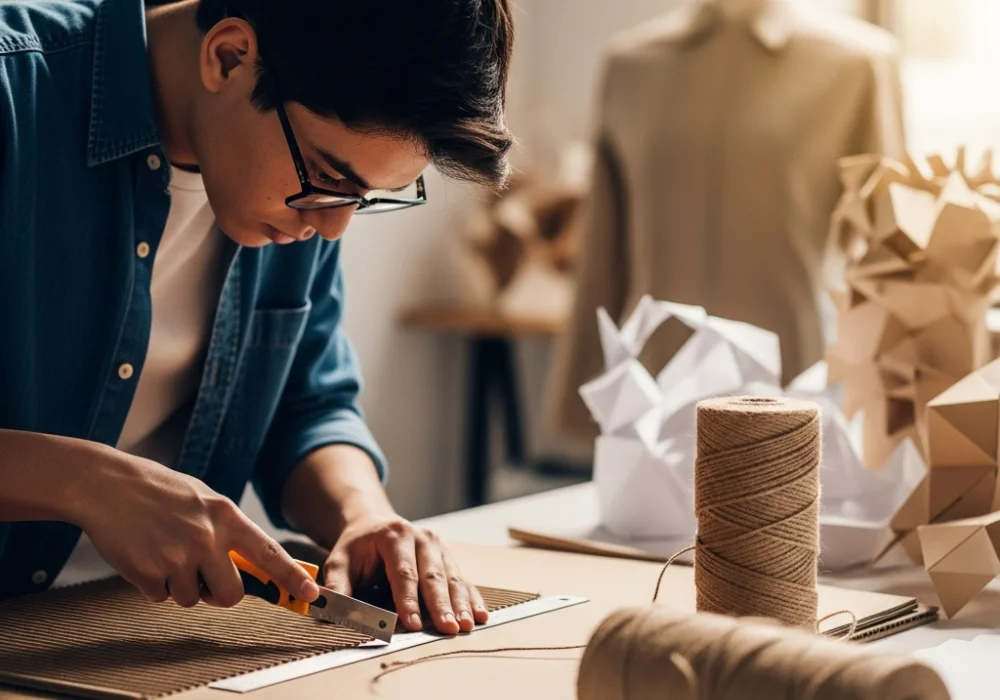
The Elite Perspective: Understanding the NIFT Situation Test
Welcome, future designers. As an elite panelist for the NIFT entrance exam, I have witnessed thousands of students navigate the high-pressure environment of the Situation Test. This specific challenge—designing a sustainable toy for a 5-year-old using jute and cardboard—is a classic scenario that tests more than just your manual dexterity. It evaluates your empathy for the user, your understanding of material physics, and your commitment to sustainability. In this masterclass, we will deconstruct the strategy required to score the highest marks in the upcoming session.
The Situation Test is a three-dimensional manifestation of your design thinking. When you are handed a packet of materials, the jury isn’t just looking for a ‘pretty’ model. We are looking for a solution. A toy for a 5-year-old must be safe, engaging, and durable. By adding the ‘sustainable’ constraint, we are testing your ability to innovate within the circular economy. Using jute and cardboard means you must transform two very different textures into a cohesive, functional product.
💡 Click to Reveal: The Secret Evaluation Criteria
The jury evaluates you on four main pillars: Innovation (How unique is the toy concept?), Material Manipulation (How well have you changed the inherent state of jute and cardboard?), Aesthetics and Finish (Is the model neat and stable?), and the Concept Note (Can you articulate your design logic effectively?).
Material Mastery: Working with Jute and Cardboard
The Character of Cardboard
Cardboard is your structural foundation. It provides the strength and skeleton of your model. However, many students fail because they treat cardboard as a flat surface only. To impress the panel, you must demonstrate structural innovation. Use techniques like scoring to create curves, corrugation exposure to add texture, and interlocking joints to avoid messy glue marks. For a 5-year-old, avoid sharp edges; always sand or cover the edges with a secondary material.
The Versatility of Jute
Jute is your tactile and aesthetic element. It is fibrous, organic, and represents the ‘sustainable’ core of your project. Instead of just sticking jute strings onto cardboard, think of textile manipulation. You can braid it to create sturdy handles, weave it to create a soft seating area for a toy figure, or fray it to simulate the mane of an animal. Jute provides the ‘grip’ that a child needs, making it a functional choice for ergonomics.
💡 Pro-Tip: Making Cardboard Flexible
To create a perfect cylinder or organic curve without the cardboard ‘cracking,’ lightly score the back of the board at 2mm intervals. This allows the rigid material to flow into a curve, perfect for creating toy wheels or animal bodies.
User-Centric Design: Thinking Like a 5-Year-Old
A 5-year-old is in the ‘Exploratory and Roleplay’ stage of development. Their motor skills are developing, but they can still be clumsy. When designing your toy, consider the following:
- Safety First: No small parts that could be choking hazards. Ensure all jute fibers are trimmed so they don’t get into the eyes or mouth.
- Scale: The toy should fit comfortably in a child’s hand or be large enough for them to interact with on the floor.
- Tactile Feedback: Children love textures. The contrast between the smooth cardboard and the rough jute provides sensory stimulation.
- Durability: A 5-year-old’s play is vigorous. Your model must be structurally sound. If it collapses during the jury’s inspection, your marks will drop significantly.
“Design is not just what it looks like and feels like. Design is how it works.” – This quote should be the guiding principle for your model’s ergonomics.
Step-by-Step Model Construction Strategy
Follow this systematic approach to ensure you finish your model within the latest time limits set by the NIFT panel:
Phase 1: Ideation (15 Minutes)
Don’t start cutting immediately. Sketch three quick thumbnails. For this prompt, let’s assume we are building a ‘Sustainable Pull-Along Elephant’. The body will be cardboard, and the decorative elements and pull-rope will be braided jute.
Phase 2: Skeleton Construction (45 Minutes)
Construct the main body of the toy. Use double-layered cardboard for the base to ensure it can withstand the weight. Create the wheels by cutting multiple cardboard circles and gluing them together for thickness. Use a central cardboard axle.
Phase 3: Material Integration (60 Minutes)
This is where the jute comes in. Wrap the cardboard ‘trunk’ of the elephant in jute to give it a realistic, rough texture. Create ‘ears’ by weaving jute onto a cardboard frame. This shows the jury that you can combine materials seamlessly. Use the jute to hide any visible glue marks or rough cardboard joins.
Phase 4: Finishing Touches (30 Minutes)
Clean your model. Remove glue ‘spiderwebs.’ Ensure the toy actually moves. If it’s a pull-along toy, the wheels must rotate. A functional model always scores higher than a static one.
💡 Quick Quiz: Which adhesive is best for Jute-to-Cardboard?
While the test center provides basic glue, the secret is using hot glue (if allowed) for structural joints and thin layers of Fevicol for surface textures. Use paper tape to hold joints in place while they dry to maintain a clean finish.
Drafting the Perfect Concept Note
The concept note is 20% of your total score. It must be concise, professional, and explain the ‘why’ behind your design. Here is a structure specifically for our sustainable toy scenario:
1. Design Philosophy
Explain your inspiration. “My design, ‘The Gentle Giant,’ is a pull-along toy inspired by the need to reconnect modern children with natural materials. It uses the strength of cardboard and the tactility of jute to create a sensory play experience.”
2. Material Eco-friendliness
Highlight the sustainability. “By using biodegradable jute and recyclable cardboard, this toy minimizes the carbon footprint typically associated with plastic toys. It is 100% plastic-free and uses organic textures to promote environmental consciousness from an early age.”
3. Safety Features
Address the 5-year-old’s needs. “Safety is integrated through rounded cardboard corners and the use of natural jute fibers that are tightly woven to prevent fraying. The scale of the toy ensures no small parts are detachable, making it safe for exploratory play.”
4. Functionality
Describe how it works. “The toy features a functional axle system allowing the child to pull it across various surfaces, aiding in the development of gross motor skills.”
Expert Tips for the Final Countdown
As you prepare for your current NIFT attempt, keep these final panelists’ observations in mind:
- Keep your workstation clean: An untidy desk often leads to an untidy model. The invigilators notice your work ethics.
- Don’t over-complicate: It is better to finish a simple, well-executed model than to leave a complex, brilliant idea half-finished.
- The 5-Minute Rule: Spend the last 5 minutes of the exam writing your name and roll number clearly and placing your model in the designated area safely.
The Situation Test is a test of your nerves as much as your talent. Stay calm, visualize the user (the 5-year-old), and let the materials speak through your hands. Your journey to the latest design world starts here.
Ready to ace the NIFT Situation Test?





