
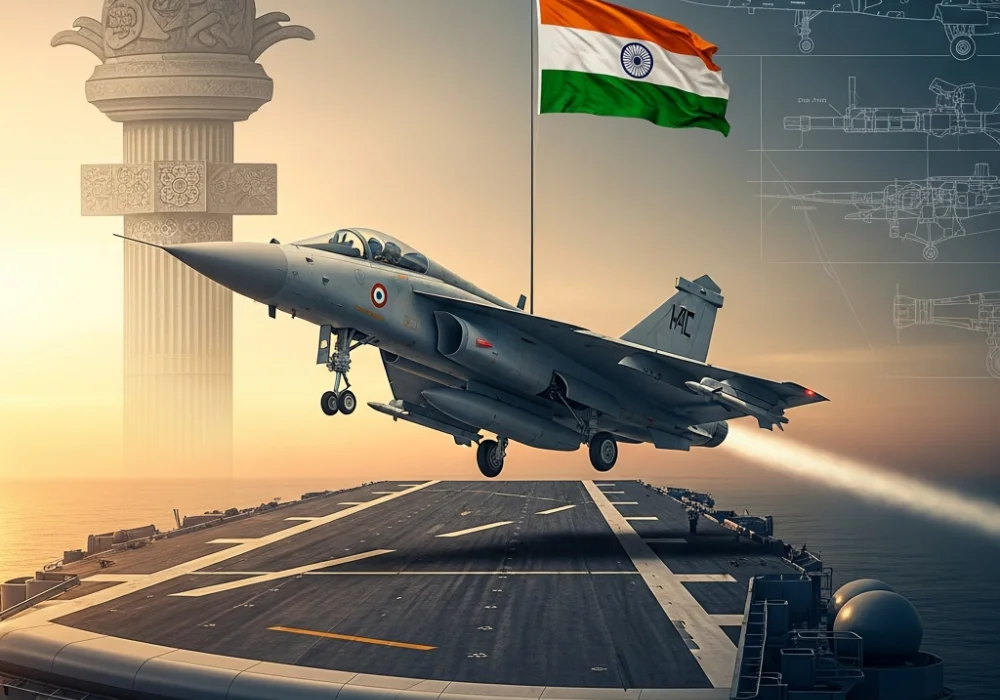
I. Introduction: The Strategic Shift in Indian Defence
The Indian defence sector has traditionally been viewed through the prism of national security. However, in the context of the UPSC Civil Services syllabus, particularly under Economic and Social Development, it represents a gargantuan engine of industrial growth, technological innovation, and fiscal management. Historically, India stood as one of the world’s largest importers of arms, a position that exerted significant pressure on the country’s Foreign Exchange (Forex) reserves and current account balance. Today, the narrative is shifting from ‘Buyer’s Choice’ to ‘Make in India’.
This masterclass explores how India is leveraging its defence requirements to fuel its dream of a $5 trillion economy. We will analyze the transition from the legacy of the Ordnance Factory Board (OFB) to the corporatization of 7 new Defence Public Sector Undertakings (DPSUs), the rise of the private sector, and the strategic importance of the Positive Indigenization Lists.
💡 UPSC Pro-Tip: The ‘Multiplier Effect’
When discussing defence economics in your Mains answer, mention the ‘Multiplier Effect.’ Every rupee invested in indigenous defence production generates nearly 2.2 times the economic output by stimulating auxiliary industries like metallurgy, electronics, and chemicals.
II. Economic Contribution and The Atmanirbhar Bharat Initiative
The defence sector is a major component of India’s Capital Expenditure (CapEx). In the Union Budget 2024-25, a significant portion of the total expenditure was allocated to the Ministry of Defence, with a heavy emphasis on modernization and infrastructure. The primary goal is Strategic Autonomy—the ability to act according to national interests without being hindered by foreign dependencies during geopolitical crises.
- FDI Reforms: To attract global expertise, the government increased the Foreign Direct Investment (FDI) limit in the defence sector to 74% through the automatic route and up to 100% via the government route (where there is access to modern technology).
- MSME Integration: Over 12,000 MSMEs are now part of the defence supply chain. This decentralization of production fosters regional economic development and creates high-skilled employment.
- Import Substitution: By reducing the import bill, the government aims to reduce the fiscal deficit. The ‘Positive Indigenization Lists’ have identified thousands of items—from simple components to complex weapon systems—that will only be procured from domestic manufacturers.
The economic logic is simple: By spending within the country, the government ensures that the tax revenue remains within the domestic ecosystem, fueling further cycles of investment and consumption.
III. Policy Framework: DAP 2020 and The Strategic Partnership Model
The Defence Acquisition Procedure (DAP) 2020 is the Bible for defence procurement in India. It focuses on simplifying the procurement process and prioritizing ‘Buy (Indian-IDDM)’—Indigenously Designed, Developed and Manufactured products.
Key features include:
- Reservation for Indigenous Firms: Specific categories of procurement are reserved exclusively for Indian companies.
- Leasing: A new category introduced to enable the armed forces to lease equipment (like transport aircraft or tankers) instead of buying them outright, thereby spreading the financial burden over time.
- Strategic Partnership Model: This aims to revitalize the private sector by encouraging tie-ups between Indian private firms and Global Original Equipment Manufacturers (OEMs). This is currently being implemented for projects like P-75I (Submarines) and Light Utility Helicopters.
💡 Click to Reveal: What is iDEX?
iDEX (Innovations for Defence Excellence) is a flagship scheme aimed at creating an ecosystem to foster innovation and technology development in Defence and Aerospace. It provides grants and funding to startups, MSMEs, and individual innovators to solve technology challenges faced by the Armed Forces.
IV. From Importer to Exporter: The Global Footprint
Perhaps the most significant economic transformation is India’s rise as a defence exporter. In the financial year 2023-24, India’s defence exports reached an all-time high of approximately ₹21,083 crore. India now exports to over 85 countries.
Flagship Export Products:
- BrahMos Missiles: The deal with the Philippines marked a watershed moment for Indian high-tech exports.
- HAL Tejas: The Light Combat Aircraft (LCA) is garnering interest from Southeast Asian and African nations.
- Artillery and Radars: Pinaka Multi-Barrel Rocket Launchers and Swathi Weapon Locating Radars are seeing increased demand.
The economic impact of exports is profound. It provides the necessary scale for domestic manufacturers, making their products more competitive globally and bringing in valuable foreign exchange. This aligns with the ‘Make in India for the World’ philosophy.
V. Challenges and The Way Forward
Despite the progress, several hurdles remain that UPSC aspirants must understand for a balanced critical analysis:
- R&D Expenditure: India’s spending on Research and Development as a percentage of GDP remains low compared to global peers like the US or China. Most high-end sensors and engines are still imported.
- Trial and Testing Delays: The ‘GSQR’ (General Staff Qualitative Requirements) are often perceived as too stringent, leading to long delays in induction and increasing the cost of projects.
- Private Sector Confidence: While policies have improved, private players often face ‘level playing field’ issues when competing with established DPSUs.
Conclusion: The defence sector is no longer just a security necessity; it is a pillar of India’s social and economic development. By creating jobs, fostering innovation, and boosting exports, it is playing a pivotal role in the ‘Viksit Bharat’ vision. Success will depend on sustained policy consistency, enhanced R&D funding, and the seamless integration of technology with tactical needs.
📝 UPSC Interactive Mock Quiz
Test your knowledge with these high-difficulty Prelims-style questions.
Q1. With reference to the Defence Acquisition Procedure (DAP) 2020, consider the following statements:
1. It introduced a ‘Leasing’ category to facilitate the usage of assets without owning them.
2. It mandates a minimum of 50% Indigenous Content (IC) for all ‘Buy (Indian-IDDM)’ projects.
3. It allows for the procurement of ‘Second-hand’ equipment from foreign governments under certain conditions.
- A) 1 and 2 only
- B) 2 and 3 only
- C) 1 and 3 only
- D) 1, 2 and 3
✅ Click to Reveal Answer & Deep Explanation
Correct Answer: D) 1, 2 and 3
All statements are correct. DAP 2020 significantly reformed the procurement landscape. It introduced ‘Leasing’ as a new category for non-mission critical assets. For ‘Buy (Indian-IDDM)’, the requirement is at least 50% indigenous content on cost basis. It also provides a framework for G2G (Government-to-Government) deals involving pre-owned equipment for urgent requirements.
Q2. Which of the following best describes the ‘Positive Indigenization List’ issued by the Ministry of Defence?
- A) A list of weapon systems that India aims to export to G-20 nations.
- B) A list of items for which imports are banned, ensuring they are sourced from domestic industry.
- C) A list of foreign companies permitted to invest 100% FDI in Indian defence.
- D) A list of civilian technologies adapted for military use under the iDEX scheme.
✅ Click to Reveal Answer & Deep Explanation
Correct Answer: B
The ‘Positive Indigenization List’ (formerly referred to as the negative import list) consists of equipment and platforms that the Department of Military Affairs (DMA) and Ministry of Defence have identified as those that will NOT be imported after specified timelines. This is a primary tool for achieving Atmanirbharta.
Q3. Consider the following pairs regarding Defence Corridors and their locations:
1. Uttar Pradesh Corridor: Nodes in Aligarh, Agra, and Jhansi.
2. Tamil Nadu Corridor: Nodes in Chennai, Coimbatore, and Hosur.
Which of the pairs given above is/are correctly matched?
- A) 1 only
- B) 2 only
- C) Both 1 and 2
- D) Neither 1 nor 2
✅ Click to Reveal Answer & Deep Explanation
Correct Answer: C) Both 1 and 2
The Government has established two Defence Industrial Corridors. The UP corridor has nodes at Aligarh, Agra, Jhansi, Chitrakoot, Lucknow, and Kanpur. The Tamil Nadu corridor has nodes at Chennai, Coimbatore, Hosur, Salem, and Tiruchirappalli. These are designed to create an integrated ecosystem for defence manufacturing.
Q4. With reference to the corporatization of the Ordnance Factory Board (OFB), consider the following statements:
1. OFB was converted into 7 new 100% government-owned corporate entities.
2. The move aimed at improving functional autonomy and accountability.
3. Munitions India Limited (MIL) is one of the seven new entities.
- A) 1 and 2 only
- B) 2 and 3 only
- C) 1 and 3 only
- D) 1, 2 and 3
✅ Click to Reveal Answer & Deep Explanation
Correct Answer: D) 1, 2 and 3
The 200-year-old OFB was dissolved in 2021 and replaced by 7 new DPSUs (like Munitions India Ltd, Armoured Vehicles Nigam Ltd, etc.) to transform them from government departments into productive corporate assets with better efficiency and profitability.
Q5. ‘SRIJAN’ portal, often seen in the news, is related to:
- A) Providing scholarships to students pursuing aeronautical engineering.
- B) An online marketplace for military veterans to find employment.
- C) A one-stop-shop for vendors to see items currently being imported that can be indigenized.
- D) A real-time tracking system for maritime traffic in the Indian Ocean.
✅ Click to Reveal Answer & Deep Explanation
Correct Answer: C
The SRIJAN portal is an Indigenization portal that provides information about items that the DPSUs/Services are importing or likely to import. This allows the Indian industry to design, develop, and manufacture these items locally.
🚀 Ready to Ace your UPSC Preparation?
Get personalized mentorship, updated study materials, and daily answer writing practice with India’s leading experts.
💬 Chat with our Experts on WhatsApp (+91 9526806124)




