
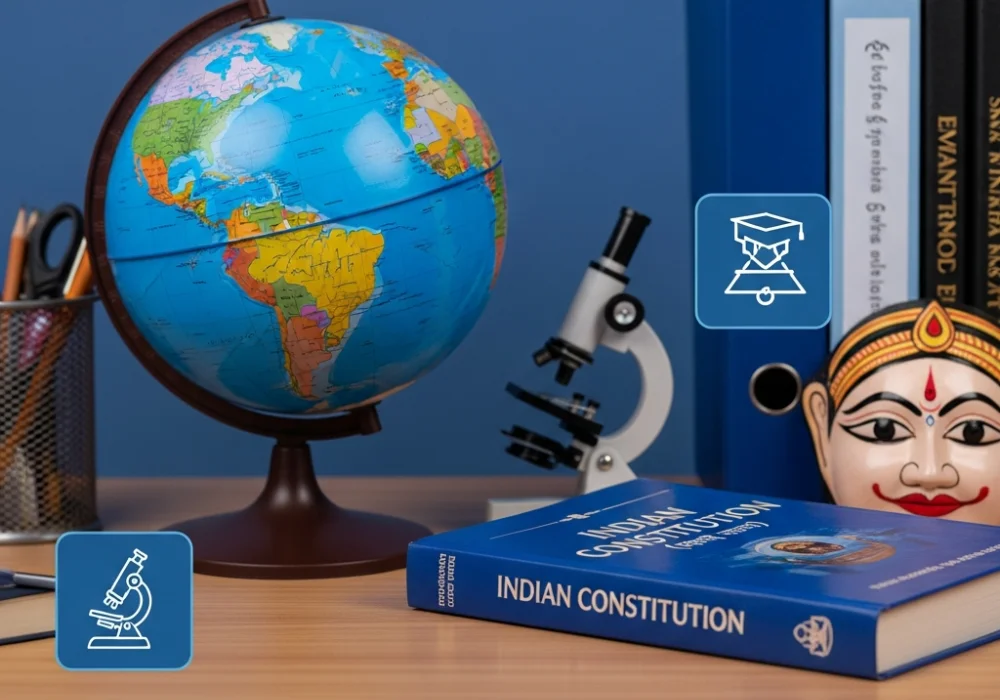
The Strategic Importance of Static GK in Modern Exams
In the landscape of competitive examinations like NID DAT, NIFT GAT, Kerala PSC, and SSC, Static General Knowledge (GK) serves as the bedrock of a candidate’s scoring potential. Unlike current affairs, which fluctuate monthly, Static GK remains constant, providing a predictable yet high-yield section for students. At myentrance.in, we have analyzed the latest pattern of upcoming exams to identify the key pillars of Static GK that frequently differentiate top-rankers from the rest of the applicants.
A mastery of Static GK does more than just help you answer factual questions; it builds context for logical reasoning and comprehension. For design aspirants (NID/NIFT), it informs cultural awareness, while for government job seekers (SSC/PSC), it ensures speed and accuracy in the general awareness paper.
Table of Contents
Indian Geography and Polity: The Core Foundation
For SSC and Kerala PSC candidates, geography and polity often carry the highest weightage. Understanding the physical features of India and the structure of our Constitution is non-negotiable.
Key Geographical Facts:
- Highest Peak in India: Kanchenjunga (8,586 m). Note that K2 (Godwin-Austen) is in POK.
- Longest River: The Ganges (2,525 km).
- Southernmost Point: Indira Point (Great Nicobar Island).
- Largest Saltwater Lake: Chilika Lake (Odisha).
Crucial Polity Figures:
- Fundamental Rights: Part III (Articles 12-35).
- Directive Principles: Part IV (Articles 36-51).
- First President of India: Dr. Rajendra Prasad.
- First Chief Election Commissioner: Sukumar Sen.
💡 Pro-Tip for Polity Revision
Always memorize the ‘Schedules’ of the Indian Constitution using the mnemonic “TEARS OF OLD PM” to quickly recall each schedule’s topic during the exam.
International Organizations and Headquarters
Global governance and financial bodies are frequent topics in the NIFT GAT and SSC exams. Comparing these organizations helps in avoiding confusion between similar-sounding entities.
| Organization | Headquarters | Key Focus Area |
|---|---|---|
| United Nations (UN) | New York, USA | Global Peace and Security |
| UNESCO | Paris, France | Education, Science, Culture |
| World Health Organization (WHO) | Geneva, Switzerland | International Public Health |
| International Monetary Fund (IMF) | Washington D.C., USA | Global Monetary Cooperation |
| SAARC | Kathmandu, Nepal | South Asian Integration |
Art, Culture, and Heritage: Essential for NID/NIFT
For students preparing for the National Institute of Design (NID) and National Institute of Fashion Technology (NIFT), Static GK often revolves around Indian textiles, folk arts, and architectural heritage. This awareness is vital for both the creative and aptitude tests.
- Classical Dances: Bharatanatyam (Tamil Nadu), Kathak (Uttar Pradesh), Kuchipudi (Andhra Pradesh), Mohiniyattam (Kerala).
- Famous Textiles: Patola (Gujarat), Sambalpuri (Odisha), Chanderi (Madhya Pradesh), Kasavu (Kerala).
- UNESCO World Heritage Sites: Ajanta & Ellora Caves, Hampi Monuments, Sun Temple Konark.
💡 Design Student Insight
NID often asks about the ‘Founders’ of modern Indian design or the significance of motifs in traditional art. Ensure you visit the ‘Art and Culture’ section on myentrance.in for specialized mock tests.
General Science and Landmark Discoveries
Science facts are the backbone of the general awareness section for the SSC CGL and Kerala PSC exams. Focus on inventions, biology basics, and chemical names of common compounds.
- Discovery of Penicillin: Alexander Fleming.
- Father of Biology: Aristotle.
- Chemical Name of Baking Soda: Sodium Bicarbonate.
- Unit of Power: Watt.
- Light Year: A unit of distance (the distance light travels in a year).
Mastering Static GK: Effective Strategies for Retention
Static GK is vast, and rote memorization is rarely enough. To ensure long-term retention for your upcoming exams, follow these proven techniques:
- Active Recall: Instead of re-reading notes, test yourself using mock tests from myentrance.in to stimulate brain retrieval.
- Mind Mapping: Connect historical dates with geographical locations and political events to create a mental web of information.
- Flashcards: Use digital or physical flashcards for numbers, dates, and headquarters.
- Visual Learning: Watch documentaries on Indian history or heritage to make facts more memorable.
Frequently Asked Questions
How much time should I spend on Static GK daily?
Ideally, dedicate 45-60 minutes daily to Static GK, alternating between different subjects like History, Geography, and Science.
Is Static GK more important than Current Affairs?
Both are equally important. However, Static GK is ‘fixed’ and can be prepared well in advance, giving you a stable score regardless of current event complexity.
Where can I find mock tests for Static GK?
You can access comprehensive and subject-specific mock tests at myentrance.in to practice for NIFT, NID, and other competitive exams.
Quick Knowledge Check
Test your Static GK knowledge with these three questions!
1. Who is known as the ‘Grand Old Man of India’?
Show Answer
Dadabhai Naoroji.
2. In which city is the headquarters of the International Court of Justice (ICJ) located?
Show Answer
The Hague, Netherlands.
3. Which state in India is the largest producer of Saffron?
Show Answer
Jammu and Kashmir.
Ready to Ace Your Competitive Exams?
Don’t leave your success to chance. Get access to the best mock tests, study materials, and expert guidance tailored for the latest pattern of upcoming exams.
💬 Chat with our Experts on WhatsApp (+91 9526806124)




