
Table of Contents
The Philosophy of a Process-Driven Portfolio
For aspirants of the National Institute of Design (NID), the portfolio is not just a collection of pretty pictures; it is a window into the designer’s mind. The NID jury is significantly more interested in how you think than just what you made. A process-driven portfolio emphasizes the journey—the failures, the pivots, and the incremental improvements that lead to a final solution.
By showcasing your development stages, you demonstrate critical thinking, empathy for the user, and the ability to iterate. This approach aligns perfectly with the latest pattern of NID entrance examinations, where conceptual clarity is prioritized over technical perfection. At myentrance.in, we help students transition from being ‘sketchers’ to ‘problem solvers’ through our specialized mock tests and portfolio guidance.
💡 Click to Reveal: Why NID Values Process
NID looks for ‘trainability.’ If you show only a finished product, the jury doesn’t know if you arrived there by luck or logic. Showing the process proves you have a reliable method for solving design problems.
Key Stages of Design Development
Documenting your design development requires a systematic approach. Every project in your portfolio should ideally cover the following phases:
1. Research and Empathy
Start by showing your understanding of the problem. This could include user interviews, photographs of existing problems in the real world, or mind maps that explore the scope of the challenge. Don’t just state the problem; show how you discovered it.
2. Ideation and Brainstorming
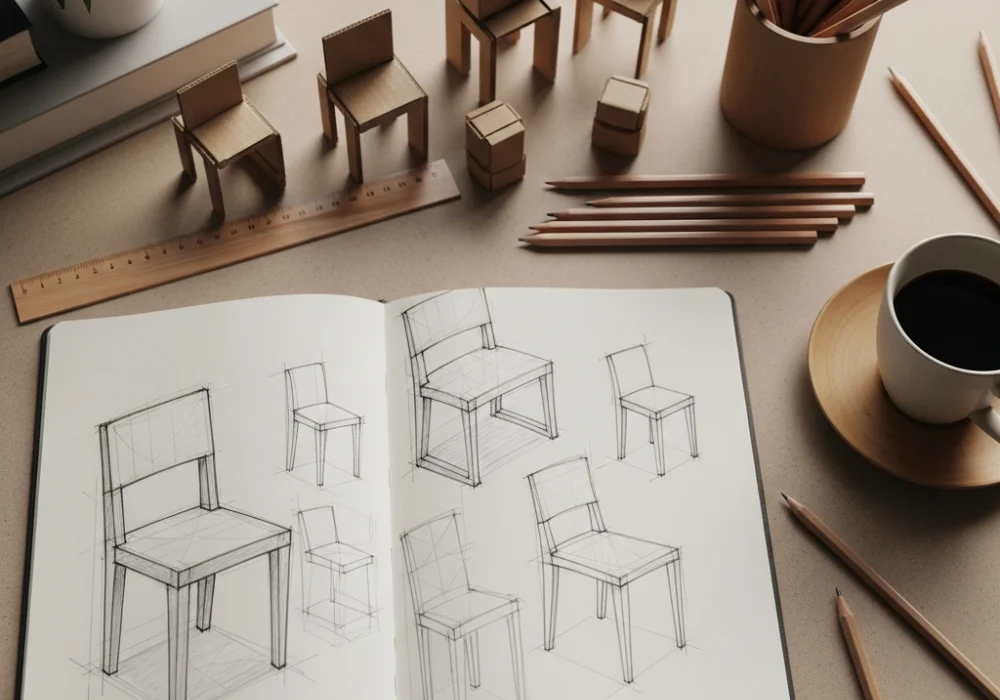
This is where the ‘messy’ part of design happens. Include rough sketches, thumbnail drawings, and lists of ideas—even the bad ones! This proves that you explored multiple avenues before settling on a direction. The jury loves to see ‘divergent thinking’ at this stage.
3. Prototyping and Material Exploration
If you are working on a product or a spatial design, show your low-fidelity models. These could be made of paper, clay, wire, or scrap cardboard. Photographing these stages shows your willingness to experiment with materials and understand form and volume.
4. Iteration and Refinement
Rarely is the first idea the best one. Show how feedback or self-critique led to ‘Version 2’ or ‘Version 3’. Highlighting what changed and why it changed is the hallmark of a mature designer.
- User Feedback: Quotes from potential users after seeing your prototype.
- Technical Sketches: Transitioning from artistic drawings to functional blueprints.
- Material Testing: Why you chose bamboo over plastic, or blue over red.
Process-Driven vs. Product-Driven Portfolios
Understanding the difference between these two approaches is vital for NID aspirants. Use the table below to evaluate your current portfolio draft.
| Feature | Product-Driven Portfolio | Process-Driven Portfolio (Recommended) |
|---|---|---|
| Focus | Aesthetic final renders. | The evolution of an idea. |
| Sketches | Only polished, clean drawings. | Rough scribbles + Refined drawings. |
| Failures | Hidden or ignored. | Documented as learning points. |
| Narrative | “Here is a chair I made.” | “How I solved ergonomic issues for the elderly.” |
Techniques for Effective Documentation
How do you capture the process while you are in the flow of creation? Effective documentation requires a bit of discipline. Here are expert tips from our mentors at myentrance.in:
- Keep a Design Journal: Carry a small notebook everywhere. Capture sudden sparks of inspiration or observations about daily life.
- Photograph Everything: Take high-quality photos of your intermediate models. Even if a model falls apart, the photo remains as evidence of your experiment.
- Scan Your Sketches: Don’t just take phone photos of sketches. Use a high-quality scanner or scanning apps to ensure lines are crisp and colors are accurate.
- Use Annotations: A drawing without a caption is just a picture. Use small, neat annotations to explain why you drew a specific feature.
💡 Pro-Tip: Lighting your Prototypes
When photographing 3D models, use natural daylight or a simple two-light setup to avoid harsh shadows that hide your hard work. Neutral backgrounds (white or grey) work best.
The Narrative Arc: Storytelling Your Work
A great portfolio reads like a story. Each project should have a beginning (the problem), a middle (the struggle and exploration), and an end (the solution and reflection). When presenting to the NID jury, remember that they are reviewing hundreds of portfolios. A compelling story makes your work memorable.
Use the ‘STAR’ method to structure your project descriptions:
- S – Situation: What was the context?
- T – Task: what were you trying to achieve?
- A – Action: What steps did you take? (This is your process!)
- R – Result: What was the outcome and what did you learn?
By using the mock tests and feedback sessions at myentrance.in, students learn how to articulate this narrative clearly and confidently during their studio tests and interviews.
Common Portfolio Pitfalls to Avoid
Avoid these frequent mistakes to ensure your documentation remains professional and impactful:
- Over-crowding: Don’t put 50 sketches on one page. Select the most meaningful ones.
- Lack of Hierarchy: Use font sizes and layout to guide the reader’s eye to the most important parts of the process.
- Neglecting the ‘Why’: Never show a change in design without explaining the rationale behind it.
- Poor Quality Images: Blurry or dark photos can make even brilliant work look amateurish.
Frequently Asked Questions (FAQ)
How many projects should I include in my NID portfolio?
Quality is more important than quantity. Aim for 4-6 diverse, deep-dive projects that show a variety of skills rather than 15 superficial ones.
Should I include digital work or only handmade sketches?
NID appreciates traditional skills, but digital work is welcome if it helps explain the process. A mix is often the best approach to show versatility.
Can I show ‘failed’ projects in my portfolio?
Absolutely! A project that didn’t work but taught you a valuable lesson about materials or user behavior is often more impressive than a ‘perfect’ project with no depth.
Quick Knowledge Check
Test your understanding of process-driven portfolios!
1. What is the most important thing the NID jury looks for in a portfolio?
💡 Click to Reveal Answer
The designer’s thinking process and problem-solving journey (Divergent and Convergent thinking).
2. True or False: You should only show the final, polished version of your prototype.
💡 Click to Reveal Answer
False. Showing low-fidelity, intermediate models is crucial for documenting development stages.
3. What does the ‘S’ in the STAR method of storytelling stand for?
💡 Click to Reveal Answer
Situation: The context or background of the project.
Ready to Ace Your NID Entrance?
Get personalized portfolio reviews and practice with the latest pattern mock tests on myentrance.in. Join thousands of successful aspirants today!
💬 Chat with our Experts on WhatsApp (+91 9526806124)




