
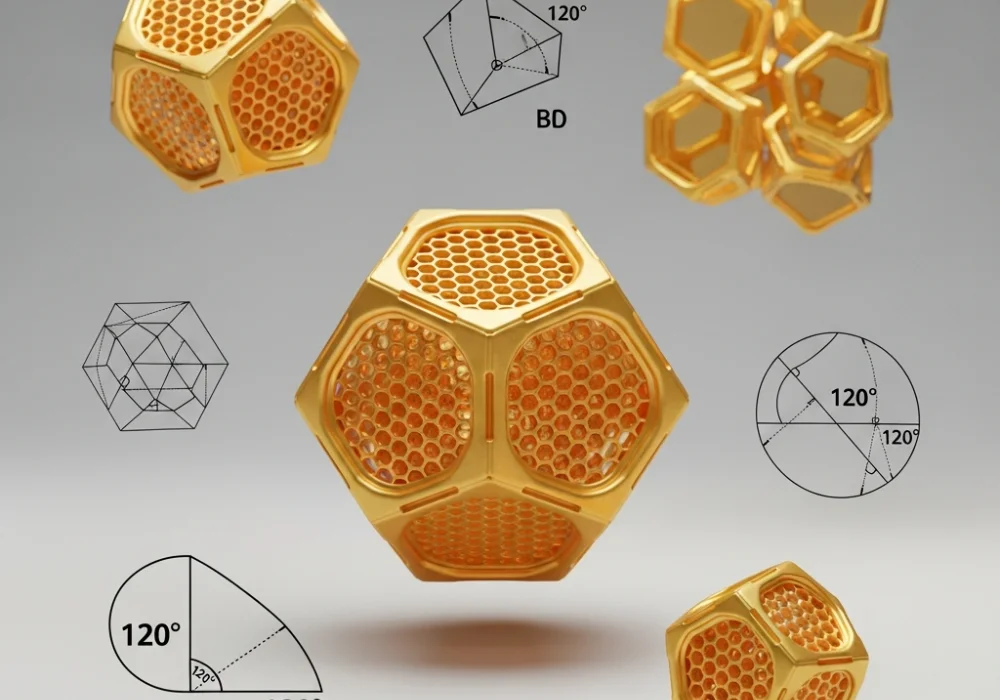
Cracking the Honeycomb: A Masterclass in Hexagonal Spatial Design
In the world of the National Institute of Design (NID) Design Aptitude Test (DAT), geometry isn’t just about math—it is about observation, logic, and structural efficiency. One of the most recurring themes in the Previous Year Questions revolves around the hexagon. From the micro-architecture of a beehive to the macro-structures of futuristic modular housing, the hexagon is nature’s perfect engineer. This article deconstructs the hexagonal tessellation, explains why it dominates spatial design, and provides you with the mental tools to solve complex 3D visualization questions in seconds.
💡 Why do designers love hexagons? Click to Reveal
Hexagons are the most efficient shape for tiling a plane without gaps (tessellation) while minimizing the perimeter for a given area. This means less material and more storage—a concept NID often tests under ‘Material Optimization’.
Question 1: The Geometry of Tiling Efficiency
Problem: You are tasked with designing a flooring system using a single type of regular polygon. Why would a designer choose a regular hexagon over a regular pentagon or a circle for a gapless surface?
The Traditional Method:
Most students start by attempting to draw circles or pentagons. They realize circles leave gaps (interstices). They then try to calculate the internal angles of a pentagon (108 degrees) and realize that 360 is not divisible by 108, meaning pentagons cannot meet at a vertex without overlapping or leaving a gap. This calculation takes 3-5 minutes of precious exam time.
The 30-Second Ninja Shortcut:
Remember the ‘Divisibility of 360’ Rule. For a regular polygon to tessellate, its interior angle must be a factor of 360.
• Triangle: 60° (360/60 = 6)
• Square: 90° (360/90 = 4)
• Hexagon: 120° (360/120 = 3)
Any polygon with more than 6 sides or the ‘awkward’ 5-sided pentagon will fail this rule. The hexagon is the ‘final’ regular polygon that can tile a plane perfectly.
💡 Pro-Tip for NID DAT
When a question asks for ‘Maximum Space Utilization’, always look for the hexagonal option first. It provides the highest area-to-perimeter ratio among the three regular tessellating polygons.
Question 2: 3D Spatial Translation of Honeycombs
Problem: A honeycomb is not just a flat 2D pattern. If you were to cut a cross-section of a 3D honeycomb cell, what shape is the ‘cap’ or the ‘base’ that connects two opposite layers of cells?
The Traditional Method:
Visualizing 3D depth is hard. Students often assume the base is flat (a flat hexagon). However, in nature, honeycombs are back-to-back. Drawing this requires complex 3D perspective skills, which often leads to confusion about how the cells meet in the middle.
The 30-Second Ninja Shortcut:
Use the ‘Rhombic Tip’ logic. Honeycomb cells don’t have flat bottoms; they end in a trihedral pyramid made of three identical rhombi. This is called a Rhombic Dodecahedron geometry. In NID drawings, if you are asked to show the ‘efficiency’ of a 3D honeycomb, draw the base as three tilted diamond shapes meeting at a central point. This demonstrates advanced spatial awareness that examiners crave.
Question 3: Structural Load and Modular Stability
Problem: In modular 3D design, why is a hexagonal grid preferred over a square grid for a vertical load-bearing wall made of lightweight materials?
The Traditional Method:
Analyzing force vectors at 90-degree junctions vs 120-degree junctions. This involves physics principles that might be too technical for a design entrance exam.
The 30-Second Ninja Shortcut:
Think of the ‘Y-Junction’ Principle. In a square grid, lines cross at 90 degrees, creating a ‘plus’ sign. In a hexagonal grid, lines meet at 120 degrees, creating a ‘Y’. The ‘Y’ shape distributes tension into three directions rather than four, preventing the ‘hinge effect’ seen in squares. Hexagons are naturally ‘anti-crush’ structures. This is why cardboard packaging and satellite panels use ‘hex-cores’.
💡 Design Application
If asked to design a ‘disaster relief shelter’ that is lightweight but strong, choose a hexagonal modular system. Mention ‘structural rigidity’ and ‘material economy’ in your explanation.
Question 4: The Truncated Icosahedron Mystery
Problem: A common variation in Previous Year Questions involves the ‘Soccer Ball’ geometry. How many hexagons and pentagons make up this structure, and why?
The Traditional Method:
Attempting to count the faces from a 2D image. This almost always leads to an incorrect count because half the faces are hidden in perspective.
The 30-Second Ninja Shortcut:
Memorize the 20-12 Rule. A truncated icosahedron (the standard soccer ball) always has 20 Hexagons and 12 Pentagons. The pentagons are there to provide the ‘curvature’—without them, the hexagons would just form a flat sheet. If you see a question about ‘Hexagonal Spheres’, remember: Hexagons alone cannot make a sphere; they need pentagons to ‘bend’ the space.
Question 5: Modular Growth and Expansion
Problem: Design a shelving unit that can be expanded in any direction (Horizontal, Vertical, Diagonal) while maintaining a seamless look. Why is the hexagon the best choice?
The Traditional Method:
Drawing various modules and trying to fit them together. This usually results in a messy sketch with uneven gaps.
The 30-Second Ninja Shortcut:
Focus on ‘Radial Symmetry’. A hexagon has 6 axes of symmetry. This means a hexagonal module can be rotated and attached to any of its 6 sides. In modular design, this allows for ‘Non-Linear Growth’. Unlike squares which grow in a grid (X and Y), hexagons grow like a web (360-degree expansion). Use the term ‘Isotropic Growth’ in your answer to impress the NID evaluators.
Cheat Sheet: Hexagonal Geometry Quick Revision
| Property | Value / Concept |
|---|---|
| Internal Angle | 120 Degrees |
| Total Sum of Angles | 720 Degrees |
| Tessellation Ability | Perfect (Zero Gaps) |
| 3D Representative | Hexagonal Prism / Rhombic Dodecahedron |
| Nature’s Use Case | Honeycomb (Storage), Basalt Columns (Cooling) |
| Strength Factor | High Compression Resistance (120° joints) |
Ready to Ace the NID DAT?
Mastering complex spatial patterns is the key to ranking in the top 1%. If you found this deconstruction of Previous Year Questions helpful, imagine what our full mock test series can do for you!
💬 Chat with our Experts on WhatsApp (+91 9526806124)




