
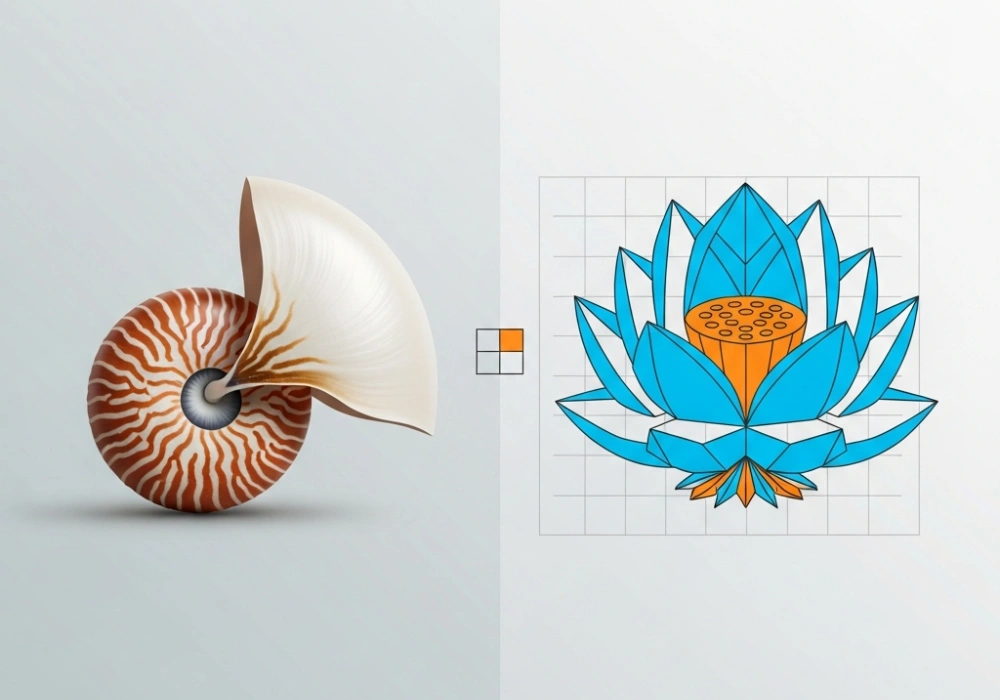
NID DAT Previous Year Questions: Decoding Geometric Abstraction of Organic Forms
The National Institute of Design (NID) Design Aptitude Test (DAT) often challenges students with the concept of ‘Abstraction.’ Specifically, transforming organic, complex nature-born structures like shells and seed pods into minimalist 2D compositions using basic polygons is a hallmark of the exam. This skill tests your observation, analytical thinking, and ability to simplify complexity into visual essence. In this guide, we will break down five key scenarios based on Previous Year Questions to help you master this art.
💡 Why does NID ask this? Click to Reveal
NID assesses your ‘Visual Intelligence.’ Can you see the hidden math in nature? Can you reduce a messy organic shape into a clean, industrial design? This is the foundation of product design, branding, and graphic communication.
Understanding the Core Concepts
Before we jump into the questions, we must define ‘Geometric Abstraction.’ It is the process of stripping away the texture, color variations, and irregular curves of a natural object, leaving behind only the essential geometry (circles, triangles, squares, and hexagons) that defines its structure. This is not just ‘drawing a simple version’—it is an exercise in Semiotics and Gestalt Principles. You are looking for the ‘Primitive Shape’ that acts as the blueprint of the organic form.
Key Principles to Remember: 1. Symmetry: Many seed pods follow radial or bilateral symmetry. 2. Rhythm: Shells often follow a Fibonacci spiral or repetitive scaling. 3. Negative Space: What is left out is just as important as what is drawn.
Question 1: The Nautilus Shell Spiral
The Task: Convert a Nautilus shell into a 2D composition using only triangles and circles. Ensure the sense of growth and movement is retained.
Traditional Method
The average student starts by drawing a spiral line and then tries to fit triangles along that line. This results in a messy, inconsistent composition that lacks structural integrity. They focus on the ‘line’ rather than the ‘volume’.
The 30-Second Ninja Shortcut
Use the ‘Golden Ratio Grid.’ Instead of drawing a spiral, draw a series of squares that decrease in size by roughly 60 percent. Inside each square, place a right-angled triangle. By aligning the hypotenuse of these triangles, the viewer’s eye naturally creates the spiral. This is a ‘Conceptual Abstraction’ rather than a ‘Literal’ one.
💡 Pro-Tip for Shells
Always find the ‘Pivot Point.’ Every shell has a center of rotation. Place your smallest polygon there and scale outwards.
Question 2: The Lotus Seed Pod (The Grid Pattern)
The Task: Abstract a dried lotus seed pod into a minimalist 2D pattern using only hexagons and circles. Focus on the ‘eyes’ of the pod.
Traditional Method
Most students draw a large circle and then haphazardly scatter smaller circles inside it. This fails to capture the mathematical perfection of the pod’s growth pattern.
The 30-Second Ninja Shortcut
Think in ‘Tessellation.’ A lotus pod is essentially a hexagonal grid (like a honeycomb) that has been squeezed into a circular boundary. Draw a light hexagonal grid first. Place a circle at the center of each hexagon. Delete the grid lines. The resulting pattern will look professional, structured, and biologically accurate without being literal.
Question 3: The Star Anise (Radial Symmetry)
The Task: Create a 2D geometric abstraction of a Star Anise seed using only rectangles and squares. Use overlapping to create depth.
Traditional Method
Students often try to draw the eight pods as ‘leaf shapes’ using curves. When told to use rectangles, they get stuck because rectangles have sharp corners that don’t look like seeds.
The 30-Second Ninja Shortcut
Use ‘Rotational Overlap.’ Draw one long, thin rectangle. Rotate it 45 degrees and draw another. Repeat this until you have 4 intersecting rectangles forming an 8-pointed star. Now, place a small square at the intersection of each ‘arm’ and the center. This creates the ‘seed’ within the ‘pod’ using nothing but right angles.
💡 Secret to Radial Abstraction
The number of points (symmetry) is the most important feature. Whether it is 5 (Starfruit) or 8 (Star Anise), maintain that count strictly.
Question 4: The Pea Pod (Linear Rhythm)
The Task: Using only circles and equilateral triangles, represent the rhythm and enclosure of a pea pod.
Traditional Method
Students draw a long curved ‘boat’ shape (the pod) and put circles inside. This is too literal and usually lacks the ‘design’ feel NID examiners look for.
The 30-Second Ninja Shortcut
Use ‘Enclosure and Tangency.’ Draw a row of 3 or 4 circles. Instead of drawing a pod around them, place two large triangles—one above and one below—so their vertices meet or overlap slightly at the ends of the row. The triangles suggest the ‘pointed’ ends of the pod, while the circles represent the peas. The negative space between the triangles becomes the ‘opening’ of the pod.
Question 5: The Pinecone (Layered Complexity)
The Task: Abstract the scales of a pinecone into a 2D composition using only rhombuses (diamonds).
Traditional Method
Trying to draw every scale individually, leading to a cluttered drawing that gets smaller and more chaotic at the top.
The 30-Second Ninja Shortcut
Apply the ‘Scale Shift.’ Start with a large rhombus at the bottom center. Add two smaller rhombuses on either side, slightly higher. Continue this ‘staggered stacking’ (similar to a brick wall pattern but with diamonds). As you move up, decrease the size of the rhombuses proportionally. This creates the ‘upward growth’ and ‘layered’ essence of a pinecone without drawing a single organic curve.
Cheat Sheet: Organic to Geometric Mapping
| Organic Feature | Geometric Equivalent | Design Principle |
|---|---|---|
| Spirals/Shells | Nested Squares/Triangles | Progression |
| Seeds/Eyes | Circles/Hexagons | Repetition |
| Thorns/Spikes | Acute Triangles | Emphasis |
| Stems/Pods | Rectangles/Parallelograms | Structure |
| Petals | Ellipses (from circles) | Symmetry |
Final Expert Advice
When solving Previous Year Questions related to abstraction, always remember: Less is More. The NID examiners are not looking for your ability to render texture; they are looking for your ability to think like a designer. A designer looks at a forest and sees vertical rectangles; they look at a shell and see a mathematical sequence. Practice by taking any object in your room—a remote, a bottle, a leaf—and try to recreate it using only 3 shapes. This ‘Constraint-Based Drawing’ is the fastest way to improve your score.
Stuck on a design problem?
Don’t let your doubts hold you back. Get expert mentorship today!
💬 Chat with our Experts on WhatsApp (+91 9526806124)




