
Introduction: The Crucible of Creativity
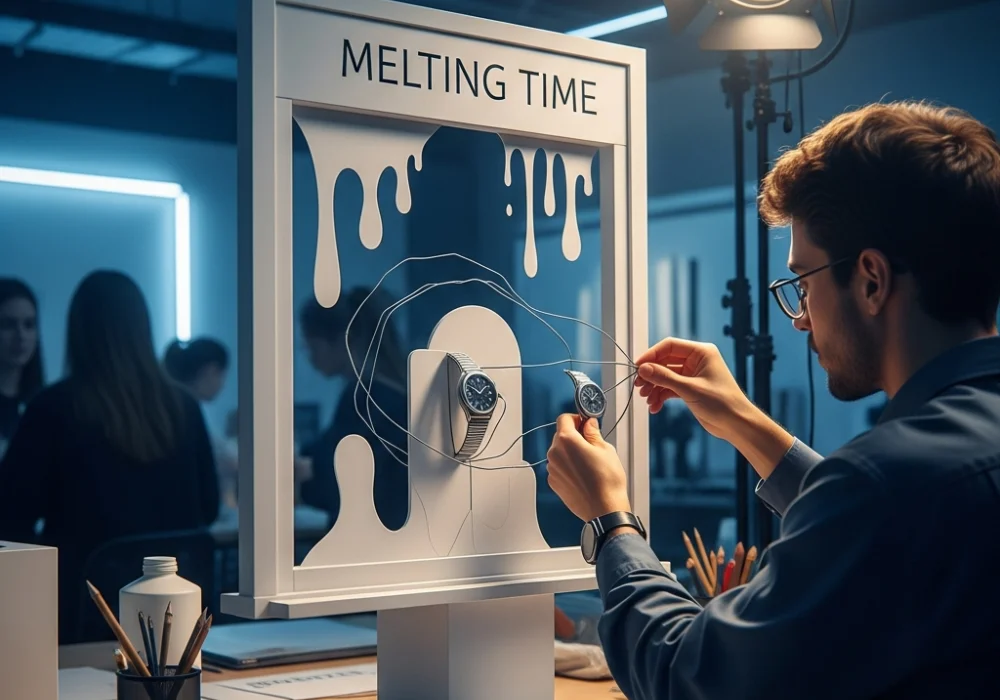
Welcome, future designers. The NIFT Situation Test is the bridge between being an aspirant and becoming a design professional. In this high-pressure environment, you aren’t just building a model; you are narrating a story through materials. The latest challenge we are tackling today is: ‘Develop a creative display window for a high-end watch brand themed around The Meltdown of Time’. This topic demands a fusion of surrealist aesthetics, luxury branding, and impeccable craftsmanship. On www.myentrance.in, we don’t just teach you to make models; we teach you to design solutions.
Understanding the Theme: ‘The Meltdown of Time’
The ‘Meltdown’ theme is a direct nod to Surrealism, specifically Salvador Dalí’s ‘The Persistence of Memory’. However, for a high-end watch brand, you must balance the ‘messiness’ of a meltdown with the ‘precision’ of luxury. High-end branding relies on minimalism, negative space, and a focal point that screams ‘Product is Hero’.
Key Conceptual Vectors:
- Entropy vs. Order: The contrast between a disintegrating clock and a perfectly functioning, rigid luxury watch.
- Fluidity: Using rigid materials like cardboard to simulate liquid or drooping forms.
- Eternal Value: The idea that while time itself might melt away, the brand remains timeless.
💡 Pro-Tip: The ‘Hook’ Factor
Don’t just melt a clock. Think about melting the environment around the watch—perhaps the pedestal itself is liquid, while the watch remains the only solid object in a world of flux.
The Secret Evaluation Criteria: What Examiners Look For
As a panelist, I look past the glue and the paper. I look for a designer’s mind. Here is what we secretly score you on:
- Material Transformation: Can you make a corrugated sheet look like silk? Can you make a plastic straw look like a structural beam?
- Visual Hierarchy: Is the watch (the product) the first thing I see, or is it lost in the decorations?
- Neatness: If I see a single glue drop or an uneven edge, your marks for ‘Technical Skill’ drop. Use the ‘invisible’ joining method.
- Narrative Clarity: Does your model reflect the ‘Meltdown’ theme without you having to explain it orally?
- Economical Use of Material: Do not waste resources. A clean, minimalist model often scores higher than a cluttered one.
Material Handling & Manipulation Guide
In the Situation Test, your materials are your best friends and your worst enemies. Mastering them is half the battle.
1. Cardboard & Ivory Sheets
To create the ‘meltdown’ effect, you need curves. Scoring is the technique where you lightly cut the top layer of the sheet to allow it to bend without breaking. For organic ‘liquid’ shapes, try Kerf cutting (multiple parallel scores).
2. Wire & Threads
Use wire to create the skeleton of a drooping object. If you need to hang the watch ‘in the air’ to show weightlessness, use thin thread. Ensure the tension is perfect so the watch doesn’t sag or look flimsy.
3. OHP Sheets/Transparent Plastics
These are perfect for simulating ‘liquid’ or ‘glass’. You can slightly scratch them to create a frosted look, or layer them to create a sense of depth and distortion, mimicking the refractive index of melting ice.
💡 Material Hack: Texturing
Use the discarded bits of corrugated sheet (the wavy inner part) to create the ‘gears’ of the watch spilling out during the meltdown. It adds a mechanical layer to the organic theme.
Step-by-Step Model Construction Strategy
Follow this 2-hour workflow to ensure you finish with time to spare for your write-up.
Phase 1: Concept & Sketching (10-15 Minutes)
Draw a quick 3D thumbnail. Decide where the watch will sit. I recommend placing it on the ‘Golden Ratio’ point—slightly off-center—to create a dynamic composition.
Phase 2: The Display Box (20 Minutes)
Construct a sturdy 3-walled window display. This acts as your frame. Use dark colors (if available) or clean white to represent a high-end gallery. Ensure the corners are 90 degrees.
Phase 3: The Melting Elements (40 Minutes)
Create 3-4 ‘drip’ elements using scored ivory sheets. These should appear as if they are flowing from the top of the display down to the floor. Intertwine these drips with abstract Roman numerals to represent the ‘disintegration of time’.
Phase 4: Product Placement (30 Minutes)
Create a pedestal that appears to be partially ‘dissolving’. Mount the watch (or a representation of it) on a sturdy, clean-cut wire stand. The watch must remain perfectly horizontal/vertical to contrast with the melting background. This highlights its ‘Timeless’ nature.
Phase 5: Finishing Touches (15 Minutes)
Clean up any stray glue threads. Add a small ‘Brand Plate’ (create a fake luxury logo like ‘Aeterna’) at the bottom right. This adds a level of professional realism.
The Write-Up: Justifying Your Vision
Many students ignore the write-up, but for an examiner, it’s the window into your soul. For ‘The Meltdown of Time’, your write-up should include keywords like ‘Avant-garde’, ‘Ephemeral’, and ‘Structural Integrity’.
“My design explores the dichotomy between the fluidity of time and the permanence of luxury. By using organic, melting forms contrasted against the rigid geometry of the watch, I have created a visual narrative where the product is the only constant in a changing world.”
💡 Check your knowledge: Quiz
Question: Why should you use negative space in a luxury display?
Answer: It allows the product to ‘breathe’ and signifies premium positioning, as it implies the brand doesn’t need to shout to be noticed.
Ready to Ace Your NIFT Situation Test?
Don’t leave your design dreams to chance. Get expert feedback on your models, practice with the latest prompts, and join our community of successful NIFTians.
💬 Chat with our Experts on WhatsApp (+91 9526806124)




