
Unlocking the Secrets of Accessory History for NIFT GAT
Welcome, future designers and fashion moguls! At www.myentrance.in, we understand that the General Ability Test (GAT) for NIFT is not just about logic and math—it is about your depth of knowledge regarding the fashion world’s DNA. One of the most recurring and high-scoring themes involves Iconic Global Fashion Accessories and their Cultural Origins. Understanding why a specific bag changed history or how a piece of jewelry symbolized social status is crucial for cracking the General Knowledge and Case Study sections.
This guide decodes simulated versions of Previous Year Questions, providing you with the historical context and the ‘Ninja Shortcuts’ to identify the right answers in seconds. Let’s dive into the fascinating world of symbolism, craftsmanship, and evolution.
💡 Why do accessories matter in NIFT GAT?
Accessories are often the ‘bridge’ between culture and commerce. NIFT examiners love testing your ability to connect an item (like a scarf) to its origin (like France or India) and its socio-political impact (like the empowerment of women in the 1920s).
Question 1: The Architecture of the Head
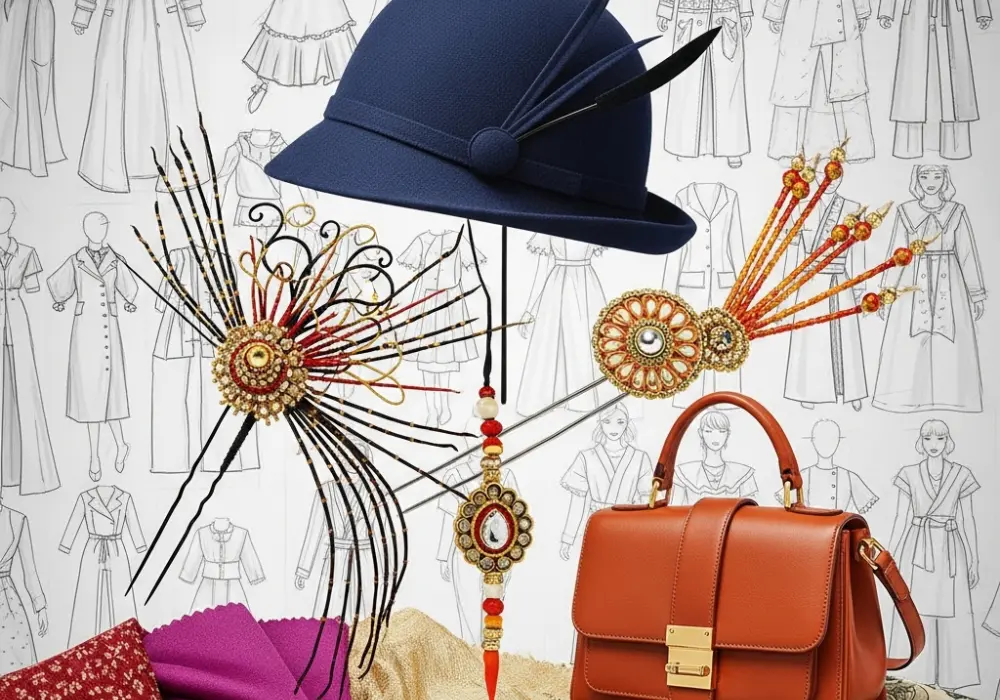
Simulated Question: The ‘Cloche’ hat, a bell-shaped accessory that defined the feminine silhouette in the 1920s, derives its name from which language and what specific meaning?
A) Italian – Meaning ‘Clock’
B) French – Meaning ‘Bell’
C) German – Meaning ‘Crown’
D) Spanish – Meaning ‘Cover’
The Traditional Method:
The student would attempt to recall every hat style from the 20th century, trying to remember the specific etymology of the word. They might spend minutes debating between French and Italian origins because both languages influence fashion terminology.
The 30-Second Ninja Shortcut:
Use Visual Etymology. The Cloche hat looks exactly like a bell. In music, a ‘Glockenspiel’ involves bells (Germanic root), but in fashion high-culture, terminology is almost always French. The word ‘Cloche’ sounds like ‘Clock’, but visually it is a ‘Bell’. Associate ‘Cloche’ with ‘Cloister’ or ‘Enclosure’ – it tightly hugs the head like a bell.
💡 Click to Reveal Answer & Fact
Correct Answer: B) French – Meaning ‘Bell’.
Deep Dive: Invented by Caroline Reboux in 1908, the Cloche hat became the symbol of the ‘Flapper’ era. It mandated a shorter hairstyle (the Bob cut), signaling a massive cultural shift toward women’s liberation and practicality after World War I.
Question 2: The Logic of the ‘It Bag’
Simulated Question: The Hermès Birkin bag, one of the most coveted accessories in history, was famously inspired by an encounter on a flight between the CEO of Hermès and which iconic personality?
A) Audrey Hepburn
B) Grace Kelly
C) Jane Birkin
D) Princess Diana
The Traditional Method:
Memorizing the entire history of the House of Hermès, including the Kelly bag and the Birkin bag, and trying not to confuse the two celebrities involved with the brand.
The 30-Second Ninja Shortcut:
Apply the Eponymous Rule. In 90% of fashion accessory history, the name of the bag is the name of the muse. ‘Kelly’ bag = Grace Kelly. ‘Birkin’ bag = Jane Birkin. ‘Lady Dior’ = Lady Diana. If the question asks about the Birkin, look for ‘Birkin’ in the options!
💡 Click to Reveal Answer & Fact
Correct Answer: C) Jane Birkin.
Deep Dive: In 1984, Jean-Louis Dumas (CEO of Hermès) sat next to Jane Birkin on a flight. She complained that her straw bag wasn’t practical for a young mother. He sketched a spacious, rectangular leather bag on an airplane sick bag—and a legend was born. This highlights the ‘Functionalism’ trend in luxury accessories.
Question 3: Symbolism in Jewelry
Simulated Question: The Cartier ‘Love’ Bracelet is unique because it cannot be worn without a specific tool. What is this tool, and what does it symbolize?
A) A Key – Symbolizing Freedom
B) A Screwdriver – Symbolizing Permanent Commitment
C) A Needle – Symbolizing Domesticity
D) A Hammer – Symbolizing Strength
The Traditional Method:
The student tries to recall the mechanical design of high-end jewelry brands and the marketing campaigns of the 1970s.
The 30-Second Ninja Shortcut:
Think ‘Industrial Romance’. Aldo Cipullo, the designer, wanted to create jewelry that wasn’t just ‘taken off’ at night. What tool is used for semi-permanent fixtures in engineering? A screwdriver. Eliminate ‘Key’ because keys represent opening/closing easily; the Love bracelet is about staying locked in.
💡 Click to Reveal Answer & Fact
Correct Answer: B) A Screwdriver – Symbolizing Permanent Commitment.
Deep Dive: Introduced in 1969, the bracelet is composed of two C-shaped halves screwed together. It was marketed as a ‘modern love handcuff’. Legend has it that Cartier once had a policy that customers couldn’t buy one for themselves—they had to be gifted by a partner.
Question 4: Footwear and Social Status
Simulated Question: In the 17th-century French court of Louis XIV, the ‘Red Heel’ (talon rouge) on shoes was an accessory restricted to whom?
A) Only the Clergy
B) Only the Peasantry to hide mud
C) Only the King and the Aristocracy
D) Only Military Generals
The Traditional Method:
Attempting to remember the specific sumptuary laws of the Baroque period and the history of the red sole (often confused with Christian Louboutin).
The 30-Second Ninja Shortcut:
The ‘Luxury Pigment’ Rule. In history, red dye (cochineal) was incredibly expensive. Anything bright red (like the red heels or the soles) was a sign of wealth because the wearer didn’t have to work in fields. Associate ‘Red’ + ‘Court’ = Exclusivity/Nobility.
💡 Click to Reveal Answer & Fact
Correct Answer: C) Only the King and the Aristocracy.
Deep Dive: King Louis XIV passed an edict that only those granted favor by him could wear red heels. This is a classic example of ‘Symbolic Consumption’ where an accessory functions as a visual passport to high society. This later inspired Louboutin’s iconic red soles.
Question 5: Textile Accessories and Heritage
Simulated Question: The ‘Kanzashi’ is a traditional accessory originating from Japan. What is its primary function and material?
A) A silk waist belt (Obi)
B) A hair ornament made of wood, lacquer, or metal
C) A wooden sandal with a high base
D) A folding fan used for secret communication
The Traditional Method:
Searching through various Japanese terms like Kimono, Obi, Geta, and Tabi to find where Kanzashi fits.
The 30-Second Ninja Shortcut:
Use Phonetic Association. ‘Kanzashi’ sounds like ‘Kan’ (Can) or ‘Pin’. It is a sharp, decorative object. If you look at Geisha culture, the most prominent accessory besides the Kimono is the elaborate hair setup. Eliminate ‘Sandal’ (that’s Geta) and ‘Belt’ (that’s Obi). Kanzashi is the ‘Crown Jewel’ of the hair.
💡 Click to Reveal Answer & Fact
Correct Answer: B) A hair ornament made of wood, lacquer, or metal.
Deep Dive: Kanzashi became popular during the Edo period when hairstyles became more complex. Interestingly, they weren’t just decorative; in some eras, they were designed to be used as defensive weapons by women if attacked!
Master Cheat Sheet: Accessory Symbolism Quick Revision
Review this table 24 hours before your GAT exam to ensure high recall of Previous Year Questions patterns.
| Accessory | Origin / Culture | Key Symbolism |
|---|---|---|
| Bindi | India | Third eye / Spiritual energy |
| Tartan Scarf | Scotland | Clan identity / Lineage |
| Cameo Brooch | Ancient Rome / Victorian | Sentimental portraits / Mourning |
| Espadrilles | Spain (Pyrenees) | Peasant roots / Summer utility |
| Aigrette | Ottoman / French | Egret feathers / Military rank |
| Ascot Tie | England | Formal morning wear / Horse racing |
Ready to Ace the NIFT GAT?
Success in NIFT requires more than just talent; it requires a strategy. Our experts at myentrance.in provide personalized mentorship, exhaustive question banks based on all Previous Year Questions, and real-time mock tests.
Don’t leave your fashion dreams to chance. Get the edge you deserve!
💬 Chat with our Experts on WhatsApp (+91 9526806124)




