
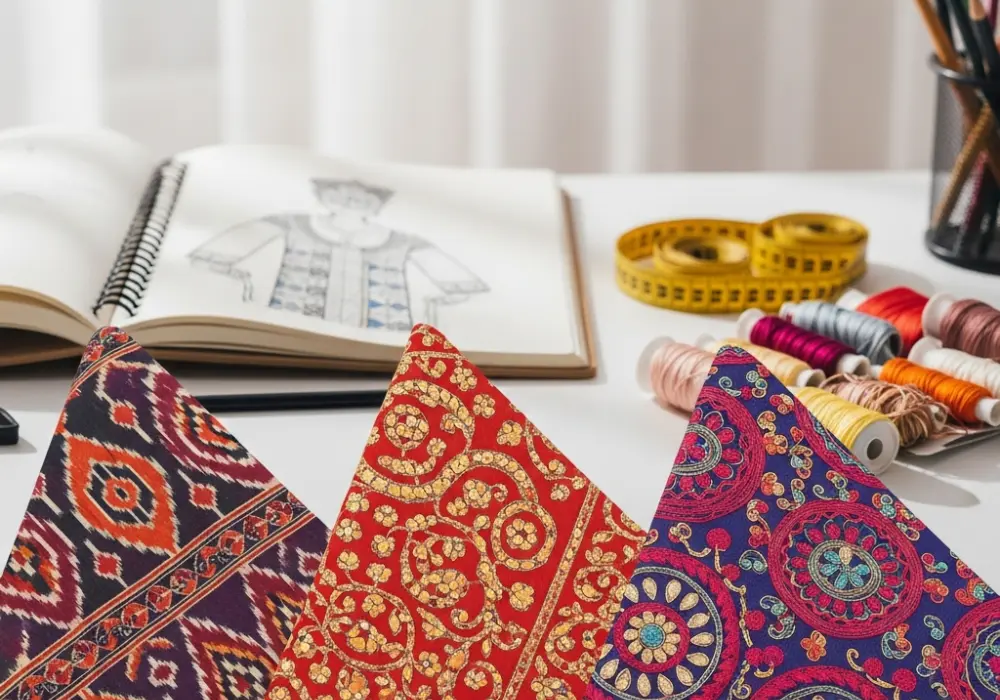
Decoding the Heritage: Indian Handloom Clusters and Geographical Indications (GI) for NIFT GAT
For aspirants aiming for the National Institute of Fashion Technology (NIFT), the General Ability Test (GAT) is a critical hurdle. Within the General Knowledge and Current Affairs section, a recurring and heavyweight theme is the Evolution of Indian Handloom Clusters and the legal protection granted to them via Geographical Indications (GI tags). This topic isn’t just about history; it is about the intersection of culture, economics, and law. Understanding how a cluster like Varanasi or Kanchipuram evolved from a local craft center into a globally recognized brand is essential for any future design professional.
A Geographical Indication (GI) is a sign used on products that have a specific geographical origin and possess qualities or a reputation that are due to that origin. In the context of NIFT GAT, Previous Year Questions often test your ability to link a specific embroidery style, weaving technique, or textile to its state of origin and its unique characteristics. Let us dive deep into the mechanics of these questions and how to solve them in seconds.
Evolution of Clusters: From Local Haats to Global GI Status
Indian handloom clusters have evolved through centuries of royal patronage, colonial challenges, and post-independence revival movements. A ‘cluster’ is essentially a group of artisans living in a close geographical area, sharing resources, techniques, and markets. For example, the Chanderi cluster in Madhya Pradesh evolved through the patronage of the Scindia royal family, while the Jamdani clusters in West Bengal are remnants of Mughal-era finesse.
The introduction of the Geographical Indications of Goods (Registration and Protection) Act, 1999, was a turning point. It allowed these clusters to protect their intellectual property. When you study for NIFT, you must understand that a GI tag doesn’t just protect a ‘design’; it protects the ‘link’ between the product and the land. For instance, ‘Kancheepuram Silk’ is only authentic if it originates from that specific region in Tamil Nadu using traditional methods.
💡 Pro-Tip: The ‘State-Craft’ Connectivity
Always group your study material by state. For example, under Odisha, group Sambalpuri Ikat, Bomkai, and Khandua. This mental mapping is faster than memorizing individual crafts in isolation.
Question 1: The Logic of Luster and Origin
Question: Which of the following handloom products is famous for its ‘Butidar’ motifs and was recently highlighted for its GI status in the state of Uttar Pradesh?
- A) Muga Silk
- B) Banarasi Brocade
- C) Paithani Sari
- D) Baluchari Sari
The Traditional Method:
Students usually try to remember every single sari type in India. They would recall that Muga is from Assam, Paithani is from Maharashtra, and Baluchari is from West Bengal. By elimination, they arrive at Banarasi. This takes about 45-60 seconds of mental scanning.
The 30-Second Ninja Shortcut:
Keyword Association: Connect ‘Butidar’ (floral motifs) + ‘UP’ (Uttar Pradesh) + ‘Brocade’. In the world of textiles, ‘Brocade’ is synonymous with Varanasi (Banaras). Banarasi is the only one in the list from UP. Instant Answer: B.
💡 Click to Reveal Deep Concept
The Banarasi Brocade involves the ‘Zari’ work (gold and silver threads). The ‘Butidar’ pattern specifically refers to small floral sprigs. This GI tag protects the use of specific techniques like ‘Kadwa’ and ‘Fekuan’.
Question 2: Embroidery and Geographical Indicators
Question: The ‘Kasuti’ embroidery, characterized by its intricate geometric patterns done without knots, belongs to which Indian state?
- A) Karnataka
- B) Gujarat
- C) Punjab
- D) Bihar
The Traditional Method:
Memorizing a list of 50 embroideries and their states. A student might confuse ‘Kasuti’ with ‘Kashida’ (Kashmir) or ‘Kantha’ (West Bengal/Bihar) because they all start with ‘K’.
The 30-Second Ninja Shortcut:
The ‘No-Knot’ Rule: Kasuti is the only major Indian embroidery that strictly avoids knots to ensure both sides of the fabric look identical. Associate ‘Kasuti’ with the ‘Chalukya’ temples of Karnataka, as the motifs (Gopura, Chariots) are inspired by them. Instant Answer: A.
💡 Click to Reveal Hidden Quiz Answer
Kasuti uses four main stitches: Gavanti, Murgi, Negi, and Menthi. If you see these terms in a GAT question, mark Karnataka immediately!
Question 3: The Ikat Identity Crisis
Question: Which cluster is renowned for ‘Double Ikat’ weaving, where both warp and weft are tie-dyed before weaving?
- A) Sambalpur (Odisha)
- B) Pochampally (Telangana)
- C) Patan (Gujarat)
- D) Nuapatna (Odisha)
The Traditional Method:
Trying to differentiate between the different types of Ikat. Many students think all Ikat is the same. They might pick Pochampally because it is a very famous cluster.
The 30-Second Ninja Shortcut:
The ‘Double-P’ Logic: While Pochampally is Ikat, the gold standard for ‘Double Ikat’ in India is Patan Patola. In NIFT exams, if the question emphasizes ‘Complexity’ and ‘Double Ikat’ (both warp and weft), the answer is almost always Patan. Instant Answer: C.
💡 Click to Reveal Technique Breakdown
Single Ikat = Either Warp or Weft is dyed. Double Ikat = Both Warp and Weft are dyed. Only Patan (Gujarat) and Pochampally (Telangana) are famous for this, but Patan is the historical ‘master’ cluster.
Question 4: Geographical Indications of the North East
Question: Sualkuchi, often called the ‘Manchester of the East’, is the primary cluster for which GI-protected silk?
- A) Eri Silk
- B) Muga Silk
- C) Tussar Silk
- D) Mulberry Silk
The Traditional Method:
Recalling all North Eastern states and their textile outputs. Confusing the different types of wild silks (Vanya Silks).
The 30-Second Ninja Shortcut:
The ‘Golden’ Connection: Muga silk is the only ‘Golden’ silk in the world and is endemic to Assam. Sualkuchi is the heart of Assam’s weaving industry. Instant Answer: B.
Question 5: Identifying Motifs in Traditional Embroidery
Question: The ‘Bagh’ embroidery, which uses the darning stitch on the wrong side of the cloth to create a carpet-like effect, is a variation of:
- A) Phulkari (Punjab)
- B) Chikankari (UP)
- C) Toda (Tamil Nadu)
- D) Lambadi (Andhra Pradesh)
The Traditional Method:
Students look for the word ‘Garden’ (Bagh means garden) and try to connect it to nature. They might guess any floral embroidery like Chikankari.
The 30-Second Ninja Shortcut:
Technical Match: Phulkari (flower work) and Bagh (garden) are two sides of the same coin from Punjab. While Phulkari has sparse motifs, Bagh covers the entire fabric. Instant Answer: A.
Master Cheat Sheet: Cluster & GI Quick Revision
| State | Handloom Cluster / GI Product | Unique Feature |
|---|---|---|
| Uttar Pradesh | Chikankari, Banarasi | Shadow work, Zari Brocade |
| West Bengal | Jamdani, Baluchari | Muslin weave, Narrative motifs |
| Gujarat | Patan Patola, Tangaliya | Double Ikat, Bead-work look |
| Tamil Nadu | Kanchipuram Silk | Heavy silk, Contrast borders |
| Madhya Pradesh | Chanderi, Maheshwari | Sheer texture, Reversible borders |
| Rajasthan | Kota Doria, Bandhani | ‘Khat’ (square) patterns, Tie-dye |
Ready to Ace the NIFT GAT?
The journey from an aspirant to a NIFTian requires more than just hard work; it requires a strategic approach to the General Ability Test. Understanding the deep roots of Indian craft is your secret weapon. For more in-depth analysis of Previous Year Questions, mock tests, and personalized mentoring, join the MyEntrance community.
Have doubts about a specific cluster or GI tag? We are here to help!
💬 Chat with our Experts on WhatsApp (+91 9526806124)




