
How Can I Master Advanced Sketching for NIFT CAT?
To master advanced sketching for the NIFT Creative Ability Test (CAT), you must transition from basic drawing to conceptual visual storytelling. This involves perfecting three-dimensional perspective, mastering human anatomy with fluid gestures, and applying complex light-and-shade rendering to diverse textures. Successful aspirants focus on innovative composition and speed, ensuring every sketch conveys a unique design solution within the strict time limits of the current exam pattern.
Table of Contents
What is the Importance of Advanced Perspective in NIFT CAT?
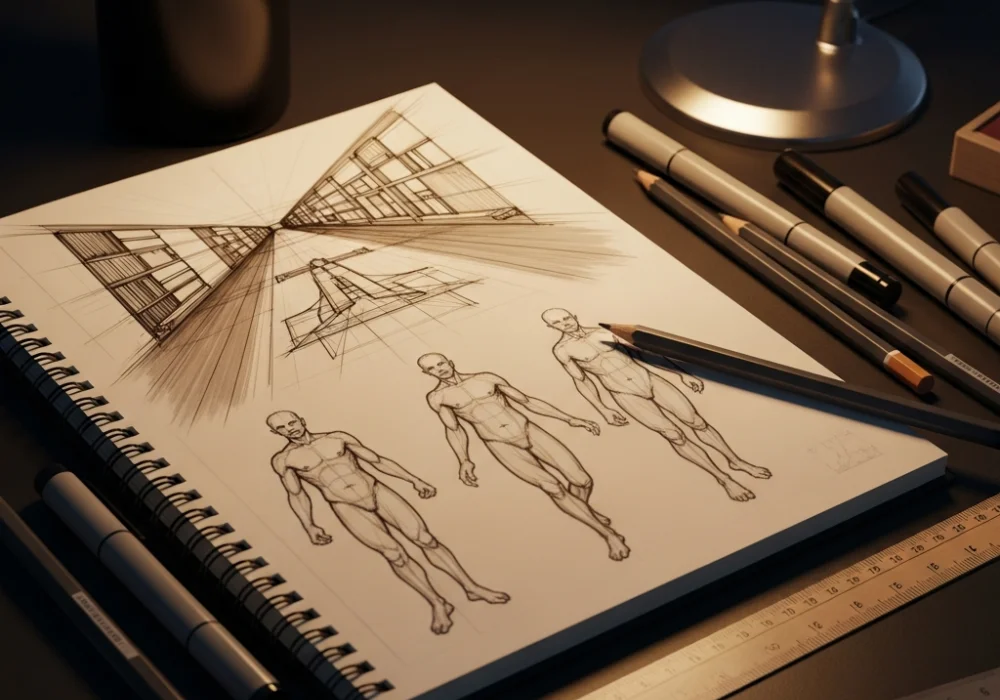
Perspective is the foundation of spatial visualization in design. While basic one-point perspective suffices for simple rooms, NIFT CAT often requires drawing complex urban environments or multi-object scenes. Mastering two-point and three-point perspective allows you to create dynamic angles that grab the evaluator’s attention.
Three-point perspective, specifically the ‘worm’s eye view’ or ‘bird’s eye view’, is essential for showing scale and drama in your illustrations. It helps in depicting tall buildings or vast interior spaces with a sense of depth that flat drawings lack.
💡 Pro-Tip: The Vanishing Point Secret
Always keep your vanishing points far apart on your horizon line. Placing them too close together creates an unnatural ‘fish-eye’ distortion that can make your design look amateurish.
How Do I Draw Realistic Human Figures for Design?
In the latest NIFT pattern, human figures are rarely drawn in static poses. You are expected to show people interacting with products, wearing garments, or moving through spaces. Understanding the 8-head or 10-head proportion rule is vital for fashion and lifestyle illustrations.
Focus on ‘Gesture Drawing’ to capture the essence of movement in under 30 seconds. This technique ensures your figures look alive rather than like stiff mannequins. Pay close attention to the ‘line of action’—an imaginary curved line that follows the spine’s movement.
Mastering hand and feet details is another differentiator. Evaluators look for these small details to judge your technical proficiency and observation skills.
What Are the Best Rendering Techniques for Textures?
Rendering involves using light and shadow to define the form and material of an object. For NIFT CAT, you must be able to distinguish between a shiny metallic surface, a soft silk fabric, and a rough wooden texture using only your pencils or dry media.
Use ‘Value Scales’ to ensure your drawing has a full range of tones from pure white highlights to deep black shadows. Cross-hatching, stippling, and scumbling are advanced techniques that add depth and tactile quality to your sketches.
💡 Click to Learn Texture Rendering
To render transparent glass, focus on sharp, high-contrast highlights and distorted background lines. For soft fur or wool, use short, rhythmic strokes that follow the direction of the material’s growth.
How Does Composition Improve Design Storytelling?
A great sketch is nothing without a strong composition. Use the ‘Rule of Thirds’ to place your main subject off-center, which creates a more balanced and interesting visual flow. This prevents the drawing from looking stagnant.
Storytelling in NIFT CAT involves adding ‘secondary elements’ that support your primary theme. If you are designing a sustainable bag, include background elements like a recycling bin or a nature-inspired setting to reinforce the concept without using words.
Foreground, middle-ground, and background layering are essential. This layering technique adds immense depth and guides the viewer’s eye through the entire narrative of your design solution.
Standard vs. Advanced Sketching Techniques
Understanding the difference between basic sketching and competitive design sketching is crucial for high scores.
| Feature | Standard Sketching | Advanced NIFT CAT Level |
|---|---|---|
| Perspective | Flat, 1-Point | Dynamic 2-Point & 3-Point |
| Figures | Stiff, Frontal Posess | Fluid Gestures & Interaction |
| Shading | Uniform Smudging | Texture-Specific Rendering |
| Ideation | Literal Representation | Conceptual & Metaphorical |
How to Practice Effectively for Upcoming Exams?
Consistency is key to mastering these techniques. Start by sketching every day for at least 60 minutes. Use high-quality mock tests like those provided on myentrance.in to simulate the actual exam environment and time constraints.
Analyze previous year questions to understand the ‘design problems’ typically asked. Practice rapid ideation where you generate three different concepts for the same problem in 10 minutes. This builds your creative muscle and ensures you don’t get ‘artist’s block’ during the CAT.
Reviewing your work with a critical eye or seeking expert feedback is the fastest way to improve. Focus on your weaknesses, whether it is drawing hands or mastering shadows, and dedicate extra time to those areas.
Quick Knowledge Check
Test your understanding of advanced design sketching with these quick questions.
💡 Reveal Answer
Three-point perspective looking down from a high altitude.
💡 Reveal Answer
The primary flow of movement or gesture in a human figure.
💡 Reveal Answer
To create a more dynamic, balanced, and visually engaging layout by avoiding centering the subject.
Frequently Asked Questions (FAQs)
Is it necessary to use color in NIFT CAT?
Yes, most CAT questions require coloring. Mastering dry media like pencil colors or markers is essential for current design trends.
How can I improve my sketching speed?
Practice ‘timed sketches’. Set a timer for 15 minutes and try to complete a full conceptual design. Over time, your hand-eye coordination will improve speed.
Where can I find mock tests for NIFT CAT?
You can access specialized design mock tests and comprehensive study materials on myentrance.in to boost your preparation.
Take the Next Step Towards Your Dream Design College!
Need expert guidance or the latest mock tests for NIFT? Our mentors are ready to help you crack the entrance exam with ease.
💬 Chat with our Experts on WhatsApp (+91 9526806124)




