
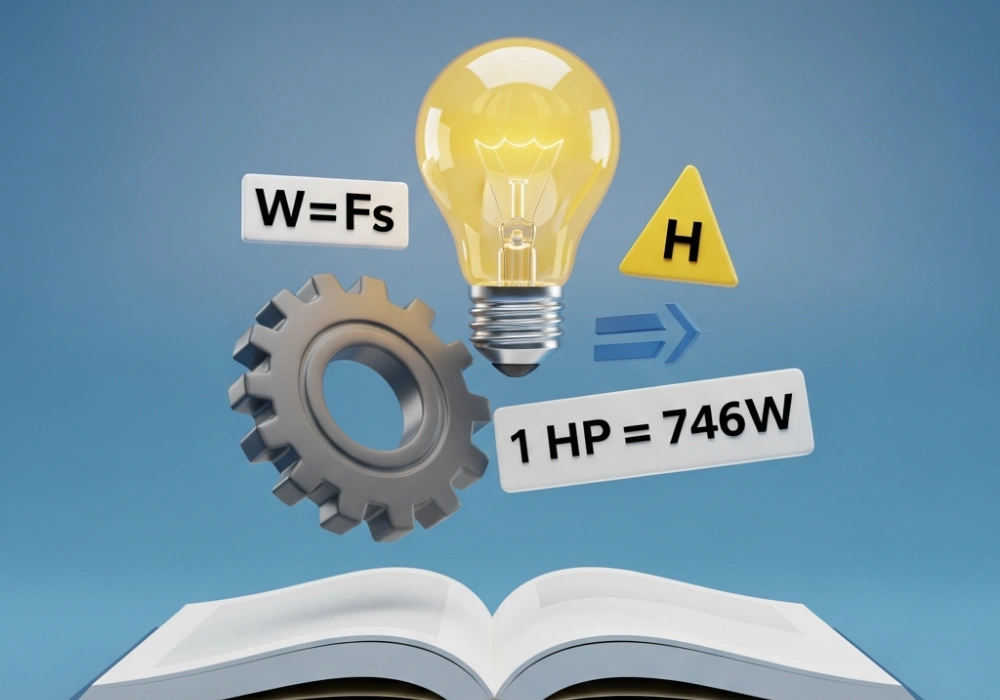
Introduction: The Importance of Work, Power, and Energy
In the competitive landscape of the Kerala Public Service Commission (PSC) examinations, Science and Technology play a pivotal role. Specifically, the principles of Physics concerning Work, Power, and Energy are frequently tested across various levels, from Lower Division Clerk (LDC) to high-level Kerala Administrative Service (KAS) exams. Understanding these concepts is not just about memorizing formulas; it is about grasping how the physical world operates. Whether it is calculating the energy consumed by a household appliance or understanding the force required to move an object, these principles are everywhere. In this comprehensive guide, we will decode the patterns of Previous Year Questions to provide you with the conceptual depth and the competitive edge needed to ace your examination on www.myentrance.in.
Concept 1: The Physics of Work
In everyday language, ‘work’ refers to any physical or mental effort. However, in Physics, work has a very specific definition. Work is done when a force acts upon an object to cause a displacement. The formula for work is given by W = F * s * cos(θ), where F is force, s is displacement, and θ is the angle between the force and displacement vectors.
Scenario-Based Question 1: The Mystery of Zero Work
Question: A coolie carries a heavy suitcase on his head and walks 50 meters on a horizontal platform. What is the work done by the coolie against gravity?
The Traditional Method: Students often see the distance (50m) and the weight of the suitcase and try to multiply them. They might calculate Work = Force (Weight) x Distance. However, gravity acts downwards, and the displacement is horizontal. The angle between the Force and Displacement is 90 degrees. Since cos(90) = 0, the total work done against gravity is zero.
The 30-Second Ninja Shortcut: Always check the direction! If the force is perpendicular to the movement (like carrying something while walking horizontally or a satellite orbiting the earth), the Work Done is ALWAYS Zero. No calculations required!
̑ Click to Reveal Pro-Tip
Remember the SI unit of Work is the Joule (J). One Joule is equal to one Newton-meter (N.m). In the CGS system, the unit is the Erg. 1 Joule = 10^7 Ergs. Kerala PSC loves asking this conversion!
Concept 2: Power and Its Industrial Units
Power is the rate at which work is done. It measures how fast energy is being transferred or transformed. The standard formula is Power = Work / Time. While the SI unit is the Watt (W), in industrial and mechanical contexts, Horsepower (HP) is frequently used.
Scenario-Based Question 2: The Horsepower Conversion
Question: An engine is rated at 2 Horsepower. What is its equivalent power in Watts?
The Traditional Method: A student might try to derive this from basic units, but that is nearly impossible during an exam. The traditional approach in a classroom involves looking up the British vs. Metric horsepower. For Kerala PSC, we strictly follow the standard conversion.
The 30-Second Ninja Shortcut: Memorize the magic number: 746. 1 HP = 746 Watts. For 2 HP, simply double it: 746 * 2 = 1492 Watts. This is a recurring favorite in Previous Year Questions.
̑ Click to Reveal Pro-Tip
Kilowatt-hour (kWh) is NOT a unit of Power. It is a unit of Energy (Commercial unit). PSC often confuses students by putting kWh in the options for Power. Be careful!
Concept 3: Kinetic and Potential Energy
Energy is the capacity to do work. It exists in various forms, but mechanical energy (Kinetic + Potential) is the core of the PSC syllabus. Kinetic Energy (KE) is energy due to motion (1/2 mv^2), and Potential Energy (PE) is energy due to position (mgh).
Scenario-Based Question 3: The Velocity Impact
Question: If the velocity of a moving object is doubled, what happens to its Kinetic Energy?
The Traditional Method: Let initial KE = 1/2 m v^2. If velocity becomes 2v, new KE = 1/2 m (2v)^2 = 1/2 m (4v^2). By comparing, we see the energy is 4 times the original.
The 30-Second Ninja Shortcut: Look at the exponent in the formula (v^2). Kinetic Energy is proportional to the square of velocity. If velocity is tripled, KE becomes 9 times (3 squared). If velocity is doubled, KE becomes 4 times (2 squared).
̑ Click to Reveal Pro-Tip
When a ball is thrown upwards, at the maximum height, its Kinetic Energy is Zero and its Potential Energy is Maximum. Total Energy remains constant due to the Law of Conservation of Energy.
Concept 4: Commercial Units and Electricity
One of the most practical sections of the syllabus involves energy consumption. The Kerala State Electricity Board (KSEB) bills us based on ‘Units’. What exactly is this ‘Unit’?
Scenario-Based Question 4: Decoding the Electric Bill
Question: One unit of electrical energy consumption is equal to how many Joules?
The Traditional Method: 1 Unit = 1 kWh. Convert 1 kilowatt to 1000 Watts and 1 hour to 3600 seconds. Multiply 1000 * 3600 = 3,600,000 Joules.
The 30-Second Ninja Shortcut: Remember the scientific notation: 3.6 x 10^6 Joules. This is a standard value that appears in almost every third science paper in Previous Year Questions.
̑ Click to Reveal Pro-Tip
Energy is a Scalar quantity. Even though it is the product of Force and Displacement, it does not have a direction. This is a common trap in MCQ options.
Concept 5: The Relationship Between Work and Force
Sometimes, work is not just about moving objects but about the resistance faced. Friction is a classic example where work is done against a resistive force.
Scenario-Based Question 5: Work against Friction
Question: When an object is moved over a rough surface, the work done by the force of friction is usually?
The Traditional Method: Analyze the vector of friction. Friction always acts opposite to the direction of motion. The angle between displacement and friction is 180 degrees. cos(180) = -1. Therefore, work done is negative.
The 30-Second Ninja Shortcut: Friction = Resistance = Negative Work. Gravity (when falling) = Support = Positive Work. Gravity (when lifting) = Resistance = Negative Work.
̑ Click to Reveal Pro-Tip
Mass and Weight are different! Work depends on Weight (Force). If a question gives mass in kg, multiply it by 9.8 (or 10) to get Newtons before calculating work.
The Ultimate Cheat Sheet: Quick Revision
| Physical Quantity | Formula | SI Unit | Other Units |
|---|---|---|---|
| Work | F * s * cos(θ) | Joule (J) | Erg, N.m |
| Power | Work / Time | Watt (W) | HP (746W), J/s |
| Kinetic Energy | ½ mv² | Joule (J) | eV (Electron Volt) |
| Potential Energy | mgh | Joule (J) | Calorie (Heat) |
| Commercial Energy | P(kW) * t(h) | kWh | 3.6 x 10^6 J |
Conclusion
The principles of Work, Power, and Energy are fundamental to the Kerala PSC Science syllabus. By analyzing Previous Year Questions, we see a clear pattern: the examiners value conceptual clarity over complex mathematical derivations. Focus on units, conversions, and the conditions under which work becomes zero or energy transforms. Mastering these will guarantee you full marks in the Physics section. Stay consistent, practice regularly on myentrance.in, and keep simplifying your concepts!
Need More Help with Kerala PSC Prep?
Get access to exclusive mock tests, doubt-clearing sessions, and free PDF notes to boost your preparation today!
💬 Chat with our Experts on WhatsApp (+91 9526806124)




