
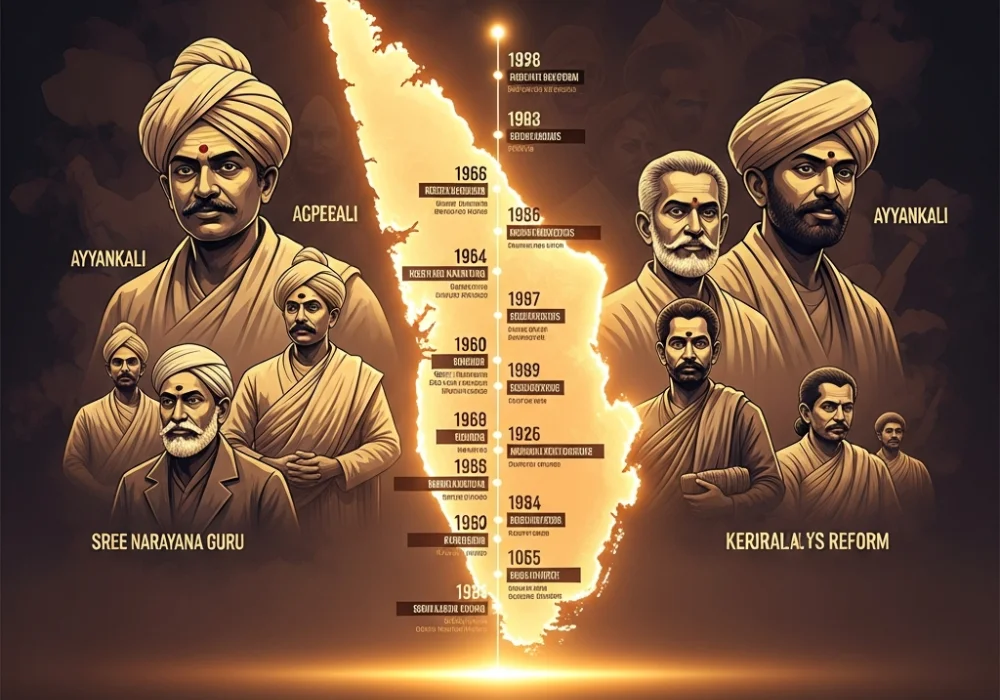
The Dawn of Social Reform: Understanding the Kerala Renaissance
The Renaissance in Kerala stands as a pivotal chapter in the history of South India, marking a transition from a dark age of rigid caste hierarchies to a modern, egalitarian society. For students preparing for Kerala PSC exams, understanding this period is not just a requirement but a necessity, as it forms the core of the ‘Socio-Religious Reform Movements’ segment. During the 19th and early 20th centuries, Kerala was often described by Swami Vivekananda as a ‘lunatic asylum’ due to its extreme practices of untouchability and social stratification. The movement began with individual protests against these injustices and evolved into a massive socio-cultural shift. Leaders like Vaikunda Swamikal, Sree Narayana Guru, and Ayyankali pioneered this change. Their efforts were not merely religious; they were political, social, and educational. They demanded the right to walk on public roads, the right to education for lower castes, and the right to enter temples. The Renaissance was also fueled by organizations like the SNDP, NSS, and Yogakshema Sabha, which worked towards the internal purification of their respective communities. This study guide and interactive timeline will walk you through the most crucial dates and events that defined the Kerala Renaissance. Memorizing these years and the figures associated with them will provide a significant advantage in your upcoming KPSC exams. Let us dive into the chronological flow of these transformative events.
1809
Kundara Proclamation
Issued by Velu Thampi Dalawa, the Prime Minister of Travancore, this was one of the earliest organized calls for resistance against the British East India Company. It is essential for PSC as it set the stage for later political consciousness.
1836
Formation of Samatva Samajam
Vaikunda Swamikal established the Samatva Samajam, often cited as the first organized reform movement in Kerala. He advocated for equality among all castes and initiated the ‘Panthibhojanam’ (inter-dining) tradition.
1859
Channar Revolt (Upper Cloth Revolt)
A historic struggle by Channar (Nadar) women for the right to cover their upper bodies. This resulted in a royal proclamation allowing them to wear upper clothes, marking a victory for human dignity.
1888
Aruvipuram Consecration
Sree Narayana Guru consecrated a Shiva Lingam at Aruvipuram, challenging the Brahmin monopoly over religious rites. He famously declared that he was consecrating an ‘Ezhava Shiva’, not a Brahmin one.
1891
Malayali Memorial
A mass petition signed by 10,028 people, led by G.P. Pillai, was submitted to the Maharaja of Travancore. It demanded a fair share of government jobs for the local population instead of outsiders.
1893
Villuvandi Samaram (Bullock Cart Strike)
Ayyankali rode a bullock cart along the public roads of Venganoor, a privilege restricted to upper castes. This act of defiance was a milestone in the struggle for the right to use public roads.
1903
Formation of SNDP Yogam
Sree Narayana Dharma Paripalana Yogam was formed with Sree Narayana Guru as its President and Kumaran Asan as its General Secretary. It became the institutional backbone of the Renaissance.
1924
Vaikom Satyagraha
The first major organized struggle for temple road access in Kerala. Figures like T.K. Madhavan led the protest, which eventually gained nationwide attention and the support of Mahatma Gandhi.
1931
Guruvayur Satyagraha
Led by K. Kelappan (the Kerala Gandhi), this movement demanded temple entry for all Hindus at the Guruvayur temple. It further intensified the pressure for religious equality.
1936
Temple Entry Proclamation
A historic decree by Sree Chithira Thirunal Balarama Varma, the Maharaja of Travancore, which opened all government-controlled temples to all Hindus, regardless of caste. This is considered the ultimate victory of the Renaissance.
Key Study Tips for Kerala PSC Aspirants
The timeline provided above highlights the relentless struggle for dignity and equality that shaped modern Kerala. From the early spiritual rebellions of Vaikunda Swamikal to the landmark Temple Entry Proclamation of 1936, each event served as a building block for the progressive state we live in today. For Kerala PSC aspirants, these milestones are frequently tested in both Preliminary and Mains examinations. It is crucial to remember the specific journals associated with these leaders—such as ‘Vivekodayam’ by SNDP or ‘Al-Ameen’ by Mohammed Abdur Rahiman—as well as their slogans. Sree Narayana Guru’s ‘One Caste, One Religion, One God for Man’ remains a cornerstone of this era. To master this topic, we recommend that students correlate these historical events with the biographical details of the reformers. Study figures like Sahodaran Ayyappan, who championed the ‘No Religion, No Caste, No God for Man’ slogan, and Pandit Karuppan, known as the ‘Lincoln of Kerala’. Practice identifying the specific locations of revolts and the rulers who were in power during those times. The Kerala Renaissance was not just a historical event; it was the birth of the Malayali identity. By studying these shifts, you gain insight into the social fabric of the state, which is vital for any public service role. Keep this timeline handy for quick revision before your exams.
Boost Your Kerala PSC Preparation!
Get personalized mentorship, free study materials, and access to the latest mock tests designed by experts at MyEntrance.in.
💬 Chat with our Experts on WhatsApp (+91 9526806124)




