
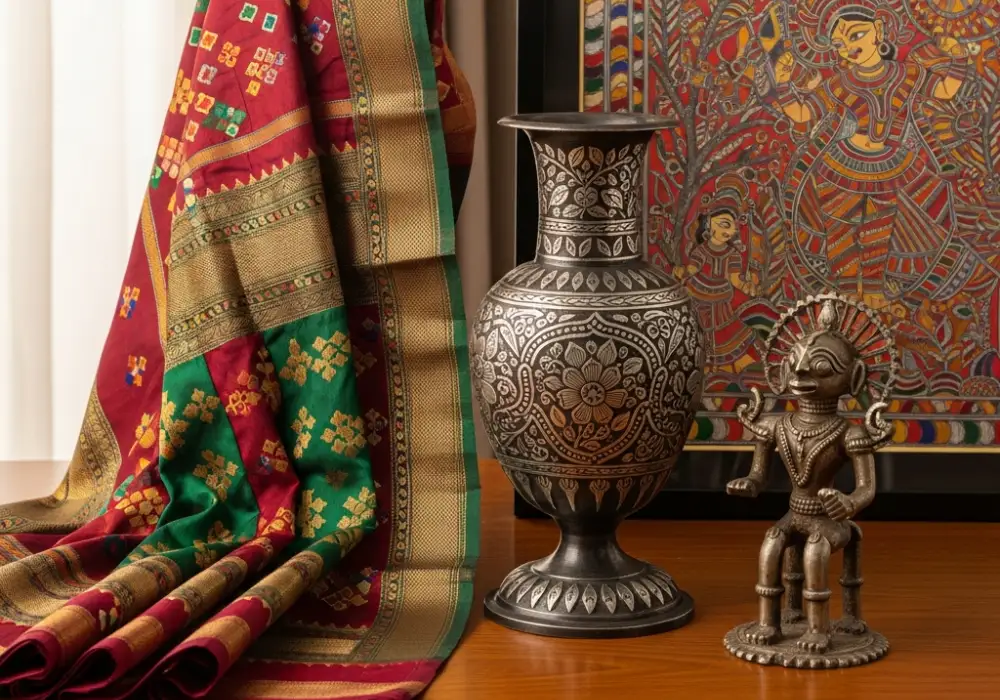
The Soul of Design: Why Indian Crafts Matter for NID
For any student aspiring to crack the National Institute of Design (NID) entrance exam, a profound understanding of Indian crafts is not just optional—it is essential. The NID philosophy is deeply rooted in the marriage of traditional craftsmanship and contemporary design thinking. Indian crafts represent a centuries-old reservoir of sustainable materials, intricate techniques, and cultural narratives. Questions on this topic test your observation skills, your appreciation for regional diversity, and your ability to connect material properties with functional form. In this comprehensive mock test, we explore the length and breadth of India’s artisanal heritage, from the intricate weaves of the North to the metalwork of the South. Mastering this section will not only help you in the GAT (General Ability Test) but also provide a rich visual vocabulary for your Studio Test and portfolio development.
💡 Pro-Tip for NID Aspirants
When studying crafts, always look for the ‘Why’ and ‘How’. Don’t just memorize names; understand the climate of the region, the locally available raw materials, and the social context of the craft. This holistic view is what NID examiners look for.
Section 1: Textile Traditions and Embroidery
Q1. The ‘Patan Patola’ of Gujarat is famous for its ‘Double Ikkat’ technique. What does this term specifically imply?
- A) The fabric is printed on both sides using blocks
- B) Both the warp and the weft threads are tie-dyed before weaving
- C) Two layers of silk are stitched together to form a reversible pattern
- D) The embroidery is done using two different types of golden threads
Q2. Which state is renowned for the ‘Phulkari’ embroidery, characterized by the use of damask stitch on cotton khadi fabric?
- A) Rajasthan
- B) Haryana
- C) Punjab
- D) Himachal Pradesh
Q3. ‘Kalamkari’ art refers to a style of hand-painting or block-printing. Which of the following is a primary characteristic of Srikalahasti Kalamkari?
- A) It uses wooden blocks for intricate geometric patterns
- B) It is performed using a bamboo pen (kalam) for free-hand drawing
- C) It focuses solely on floral motifs inspired by Persian art
- D) It is traditionally done on silk using synthetic dyes
Q4. The ‘Chanderi’ fabric is a blend of which two primary fibers, known for its sheer texture?
- A) Wool and Cotton
- B) Silk and Jute
- C) Silk and Cotton
- D) Linen and Viscose
Section 2: Metal, Stone, and Woodwork
Q5. ‘Bidriware’, a unique metal handicraft from Karnataka, uses an alloy of which two metals as its base?
- A) Copper and Tin
- B) Zinc and Copper
- C) Iron and Nickel
- D) Silver and Gold
Q6. The ‘Dhokra’ craft, practiced by tribal communities in Odisha and West Bengal, utilizes which ancient casting technique?
- A) Sand Casting
- B) Die Casting
- C) Lost Wax Casting (Cire Perdue)
- D) Centrifugal Casting
Q7. Which region is famous for ‘Tarkashi’ work, which involves inlaying fine brass or silver wires into wood?
- A) Saharanpur
- B) Mainpuri
- C) Srinagar
- D) Bastar
Q8. The ‘Nirmal’ paintings and toys, known for their lacquer finish and gold-like glow, originate from which state?
- A) Kerala
- B) Telangana
- C) Tamil Nadu
- D) Karnataka
Section 3: Pottery and Painting Styles
Q9. Jaipur ‘Blue Pottery’ is unique among Indian pottery traditions because:
- A) It is the only pottery fired at extremely high temperatures
- B) It does not use clay as a base material
- C) It uses only vegetable dyes for the blue color
- D) It is always glazed with a mixture of lead and tin
Q10. ‘Madhubani’ or Mithila painting was traditionally created by women in Bihar. What was the original surface for these paintings?
- A) Handmade paper
- B) Silk cloth
- C) Freshly plastered mud walls
- D) Wooden panels
Q11. The ‘Warli’ paintings of Maharashtra primarily use which geometric shapes to represent human figures and nature?
- A) Ovals and Rectangles
- B) Circles, Triangles, and Squares
- C) Hexagons and Pentagons
- D) Only Straight Lines
Q12. ‘Molela’ terracotta is a unique craft of Rajasthan known for:
- A) Miniature figurines of birds and animals
- B) Large hollow pots for water storage
- C) Three-dimensional devotional plaques of local deities
- D) Polished black pottery with silver inlay
Section 4: Puppetry and Regional Crafts
Q13. ‘Tholu Bommalata’ is a traditional shadow puppet theater tradition from which state?
- A) Kerala
- B) Andhra Pradesh
- C) Karnataka
- D) Odisha
Q14. The ‘Sitalpati’ mats, known for their cooling properties and intricate weaving, are primarily made from:
- A) Bamboo splits
- B) Cane stalks
- C) Murta plants (Schumannianthus dichotomus)
- D) Coconut husk fibers
Q15. ‘Ajrakh’ printing is a distinct form of block printing found in Gujarat and Rajasthan. What is its most characteristic color palette?
- A) Bright Pink and Yellow
- B) Indigo Blue and Madder Red
- C) Emerald Green and Black
- D) Pastel Shades of Purple
Q16. Which of these is a famous cane and bamboo craft hub in India?
- A) Jaipur
- B) Majuli
- C) Varanasi
- D) Madurai
Section 5: Intricate Details & Materiality
Q17. In ‘Kasuti’ embroidery of Karnataka, which of the following is true regarding the technique?
- A) It involves heavy use of mirrors and beads
- B) The patterns are stitched without knots so that both sides look identical
- C) It is done exclusively on leather surfaces
- D) It uses thick woollen threads for a 3D effect
Q18. The ‘Kanjeevaram’ sarees are known for ‘Temple Borders’. What does this term refer to?
- A) Sarees only worn in temples
- B) Small triangular motifs along the border resembling temple gopurams
- C) Sarees woven by temple priests
- D) Borders made of solid gold wire
Q19. ‘Pattachitra’ paintings of Odisha are traditionally executed on:
- A) Treated cloth (Patta)
- B) Palm leaves
- C) Both A and B
- D) Neither A nor B
Q20. ‘Chikankari’ from Lucknow is famous for which type of work?
- A) Silver wire inlay on wood
- B) Delicate shadow-work embroidery on muslin
- C) Tie-dye patterns on silk
- D) Metal casting of miniature bells
Answer Key & Detailed Explanations
Check All Answers & Explanations
1. Answer: B (Both the warp and the weft threads are tie-dyed).
Explanation: Patan Patola is the pinnacle of weaving. In ‘Double Ikkat’, both the longitudinal (warp) and transverse (weft) threads are dyed in precise patterns before they ever touch the loom. The weaver must align these dyed points perfectly during the weaving process to create the final design. This is why a single saree can take months or even years to complete and is reversible with identical intensity of color on both sides.
2. Answer: C (Punjab).
Explanation: Phulkari, which literally means ‘flower work’, is the traditional embroidery of Punjab. Historically, it was a domestic art practiced by women. The embroidery is done with a darning stitch on the wrong side of coarse cotton cloth (khadi) using colored silken thread (pat). The stitches are so dense in ‘Bagh’ (a sub-type of Phulkari) that the base cloth is almost invisible.
3. Answer: B (Bamboo pen for free-hand drawing).
Explanation: There are two styles of Kalamkari: Srikalahasti and Machilipatnam. The Srikalahasti style is characterized by the use of a ‘Kalam’ (pen) made of bamboo to draw freehand designs inspired by Hindu mythology. Machilipatnam style, on the other hand, relies more heavily on hand-carved wooden blocks. Srikalahasti is prized for its organic, fluid lines and artistic spontaneity.
4. Answer: C (Silk and Cotton).
Explanation: Chanderi fabric, originating from Madhya Pradesh, is legendary for its light weight and ‘sheer’ quality. This is achieved by weaving high-quality silk and fine cotton together. The silk provides a subtle shimmer, while the cotton ensures breathability and structure. It is often decorated with small ‘Buttis’ (motifs) made of gold or silver zari.
5. Answer: B (Zinc and Copper).
Explanation: Bidriware is a metal handicraft from Bidar, Karnataka. The base is an alloy of zinc (roughly 94%) and copper (roughly 6%). The black color is achieved by dipping the object into a specific soil found only near the Bidar Fort, which contains chemicals that oxidize the zinc. Intricate silver wire is then inlaid into the dark surface, creating a stunning contrast.
6. Answer: C (Lost Wax Casting).
Explanation: Dhokra is one of the oldest known methods of metal casting, dating back to the Indus Valley Civilization (e.g., the Dancing Girl statue). It involves making a clay core, covering it with a layer of wax, detailing the wax, and then covering it with another layer of clay. When heated, the wax melts out (lost), and molten metal is poured into the cavity.
7. Answer: B (Mainpuri).
Explanation: While Saharanpur is famous for wood carving, Mainpuri in Uttar Pradesh is specifically known for ‘Tarkashi’. This involves engraving fine channels into wood (usually Sheesham) and hammering thin brass, copper, or silver wires into these grooves. It creates a very geometric, precise, and shimmering pattern on the dark wood.
8. Answer: B (Telangana).
Explanation: Nirmal art comes from the town of Nirmal in Telangana. It is famous for both paintings and lightweight toys made from ‘Poniki’ wood. The artisans use herbal colors and a specific lacquer technique. A unique feature is the use of ‘gold’ color, which is actually made from a herbal extract that turns golden when fired or treated, giving the craft a royal appearance.
9. Answer: B (It does not use clay as a base material).
Explanation: Jaipur Blue Pottery is distinct because it is ‘low-fire’ and doesn’t use clay. Instead, the ‘dough’ is made from ground quartz stone, glass, soda bicarbonate, Fuller’s earth (Multani Mitti), and gum. This makes it fragile but gives it a unique transparency and prevents it from cracking easily during the glazing process. The blue comes from cobalt oxide.
10. Answer: C (Freshly plastered mud walls).
Explanation: Madhubani painting (Mithila art) originated as wall art done by women to mark births, marriages, and festivals. They would use fingers, twigs, and later brushes to paint on the mud walls of their huts. Today, it has transitioned to paper and cloth for commercial purposes, but the traditional themes of nature and mythology remain the same.
11. Answer: B (Circles, Triangles, and Squares).
Explanation: Warli art is a minimalist tribal art from Maharashtra. It uses a basic graphic vocabulary: a circle represents the sun and moon, a triangle represents mountains and pointed trees, and a square represents a piece of land or a sacred enclosure (chauk). Human and animal bodies are represented by two inverted triangles joined at the tip.
12. Answer: C (Three-dimensional devotional plaques).
Explanation: Molela, a village near Udaipur, is world-famous for its hollow terracotta plaques. These are not flat paintings but 3D relief sculptures of local deities like Devnarayan or scenes from rural life. The plaques are hand-molded on a flat clay base and then fired in an open kiln. They are often brightly painted after firing.
13. Answer: B (Andhra Pradesh).
Explanation: Tholu Bommalata literally translates to ‘the dance of leather puppets’. It is the shadow puppet tradition of Andhra Pradesh. The puppets are large (often human-sized), made from translucent goatskin, and intricately perforated. When held against a backlit white screen, they create beautiful, colorful shadows.
14. Answer: C (Murta plants).
Explanation: Sitalpati mats are made in West Bengal and Assam. The word ‘Sital’ means cool, and ‘Pati’ means mat. They are woven from the green cane of the Murta plant. The stalks are stripped into very fine, thin longitudinal strips. The quality of the mat is judged by its smoothness and the complexity of its weave.
15. Answer: B (Indigo Blue and Madder Red).
Explanation: Ajrakh is a complex 16-step process of block printing and dyeing. It is synonymous with the Khatri community of Kutch (Gujarat). The colors are traditionally restricted to Indigo (blue), Madder (red), Black (iron acetate), and White (the color of the original cloth). The patterns are highly geometric and symmetrical, reflecting Islamic architectural influence.
16. Answer: B (Majuli).
Explanation: Majuli, the largest river island in the world (located in Assam), is a hub for bamboo and cane crafts. In the North East, bamboo is known as ‘green gold’. The artisans of Majuli make everything from sturdy furniture and musical instruments to delicate masks used in ‘Bhaona’ (traditional theater).
17. Answer: B (Stitched without knots).
Explanation: Kasuti is a traditional folk embroidery of Karnataka. It involves four main stitches: Gavanti, Murgi, Negi, and Menthi. A hallmark of high-quality Kasuti (especially Gavanti and Murgi) is that the pattern is identical on both the front and the back because no knots are used. This requires the embroiderer to carefully count the threads of the fabric warp and weft.
18. Answer: B (Small triangular motifs).
Explanation: Kanjeevaram sarees from Tamil Nadu often feature a ‘Temple Border’ or ‘Rekku’. These are series of sharp, triangular patterns that transition the color from the border to the main body of the saree. They are named after the gopurams (towers) of South Indian temples. The weaving technique used to join the border and body is called ‘Kurai’.
19. Answer: C (Both A and B).
Explanation: Pattachitra is the traditional scroll painting of Odisha. While most people associate it with ‘Patta’ (dried and processed cloth strips glued with tamarind seeds), a significant branch of this art is done on ‘Tala Pattachitra’ or palm leaves. In palm leaf painting, the images are etched with a needle and then filled with black ink before being bound together.
20. Answer: B (Delicate shadow-work embroidery on muslin).
Explanation: Chikankari is a delicate and artful floral embroidery style from Lucknow. It involves various stitches, but its most famous is ‘Bakhiya’ or shadow work, where the stitch is done on the reverse side of a semi-transparent fabric (like muslin) so that the opaque pattern is visible as a shadow on the front. It traditionally used white thread on white fabric.
Need More Guidance or Mock Tests?
Preparing for NID requires a strategic approach and expert insights. If you have doubts about any craft technique, need free study materials, or want to enroll in our full-length NID Mock Test series, our mentors are ready to help you!
💬 Chat with our Experts on WhatsApp (+91 9526806124)




