
NIFT GAT Previous Year Questions Decoder: Mastering Traditional Indian Embroidery
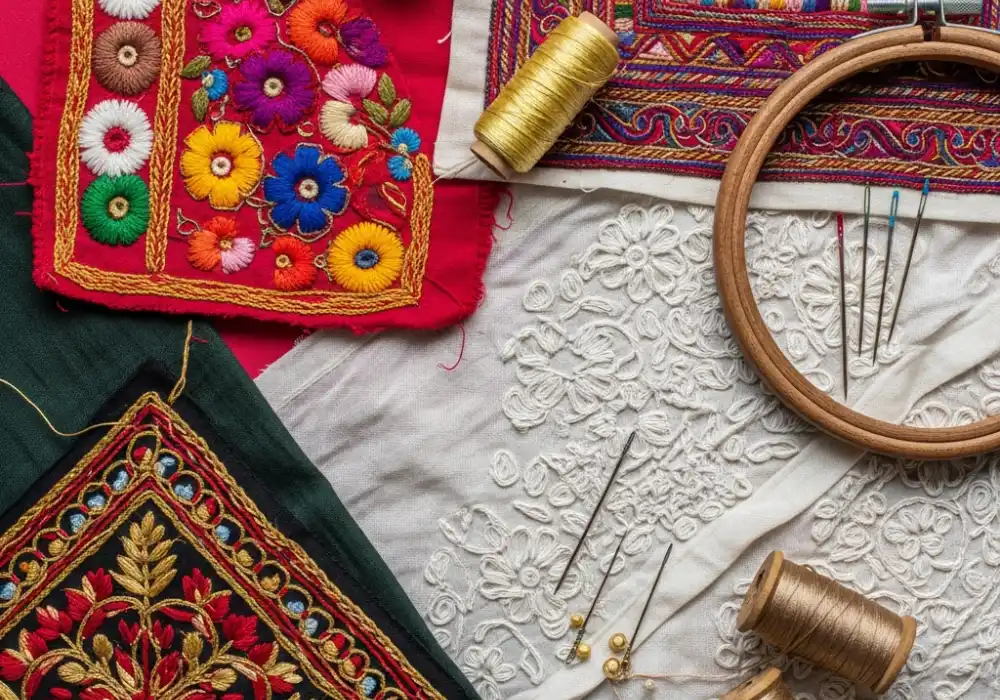
Welcome, future fashion designers and design thinkers! If you are preparing for the NIFT GAT (General Ability Test), you already know that the ‘General Knowledge and Current Affairs’ section is a goldmine for scoring high marks. Among the most recurring topics in this section is Traditional Indian Embroideries. Year after year, NIFT challenges students to identify specific techniques, motifs, and states associated with crafts like Kashida, Phulkari, and Chikankari.
Understanding these crafts isn’t just about memorizing names; it is about recognizing the soul of Indian textiles. In this comprehensive guide, we will decode five highly realistic simulated questions based on trends seen in Previous Year Questions. We will also provide you with ‘Ninja Shortcuts’ to help you solve these questions in under 30 seconds during the high-pressure exam.
The Core of Indian Embroidery: A Quick Overview
Before we dive into the questions, remember that Indian embroidery is usually categorized by its region, the thread used, the base fabric, and the specific stitch. Whether it is the white-on-white elegance of Lucknow or the vibrant geometric patterns of Punjab, every stitch tells a story. NIFT examiners love to test your ability to distinguish between these stories.
Simulated Question 1: The Floral Legacy of the North
Question: An aspirant identifies an embroidery style characterized by the use of silk threads (Pat) on a coarse cotton fabric (Khaddar), typically featuring a ‘Darning Stitch’ to create dense floral patterns that cover the entire base fabric. This embroidery is most likely:
- A) Chikankari
- B) Phulkari
- C) Kantha
- D) Kasuti
The Traditional Method
In a traditional classroom setting, you would study the history of Punjab’s textile industry. You would learn that ‘Phul’ means flower and ‘Kari’ means work. You would research how grandmothers gifted these to their granddaughters. While this provides great context, it takes up too much time during a 120-minute exam where every second counts.
The 30-Second Ninja Shortcut
Keywords: Khaddar + Darning Stitch + Punjab = Phulkari.
Look for the word ‘Bagh’ (meaning garden) in the description. If the embroidery covers the entire fabric so that the base cloth is invisible, it is definitely a ‘Bagh’ Phulkari. If you see ‘Khaddar’ and ‘Silk thread’ mentioned together, eliminate all other options immediately. Chikankari uses Muslin, Kantha uses old rags/saris, and Kasuti uses Ilkal silk.
Simulated Question 2: The Nature-Inspired Stitches of the Valley
Question: Which traditional embroidery technique from Jammu and Kashmir is known for its inspiration from nature, featuring motifs like Chinar leaves, grapes, and butterflies, and is primarily executed using a single thread in a variety of stitches like ‘Zalakdozi’?
- A) Zardozi
- B) Kashida
- C) Phulkari
- D) Toda
The Traditional Method
The standard approach involves studying the Persian influence on Kashmiri crafts and the reign of Sultan Zain-ul-Abidin. You would try to memorize every single motif name, which can be overwhelming given the vastness of the NIFT syllabus.
The 30-Second Ninja Shortcut
Keywords: Nature + Chinar Leaf + Kashmir = Kashida.
Think of ‘Kashida’ as ‘Kashmir’s Signature’. Another massive clue is the ‘Aari’ or hook work. If the question mentions ‘Pointed Hook’ or ‘Crewel work’, it is a direct pointer to the valley. Note: Kashida is rarely done on cotton; it is almost always on wool or silk. If the question mentions ‘Pashmina’, your answer is Kashida.
Simulated Question 3: The Shadow and Light of the Awadh Region
Question: A student is looking at a garment with ‘Shadow Work’ (Bakhiya), where the embroidery is done on the reverse side to create an opaque effect on the front of a sheer fabric. This technique, which often uses 32 different types of stitches, is known as:
- A) Mochi Bharat
- B) Chikankari
- C) Shamilami
- D) Pipli Work
The Traditional Method
You would spend hours learning the 32 types of stitches like Tepchi, Phanda, Keel Kanta, and Murri. While useful for the Situation Test later, for the GAT, you only need to recognize the primary visual identifiers.
The 30-Second Ninja Shortcut
Keywords: Shadow Work + White Thread + Lucknow = Chikankari.
The ultimate giveaway is ‘White on White’ or ‘Whitework’. Although modern Chikankari uses colored threads, NIFT Previous Year Questions often focus on the traditional white-on-white method on Muslin or Georgette. If you see the word ‘Bakhiya’, it is 100% Chikankari.
Simulated Question 4: The Art of Recycling from the East
Question: Identify the embroidery from West Bengal and Odisha that originated from the practice of recycling old saris and dhotis by stitching them together with a simple ‘Running Stitch’ to create quilts and wraps.
- A) Kasuti
- B) Lambadi
- C) Kantha
- D) Kathiawar
The Traditional Method
Traditionally, you would study the socio-economic conditions of rural Bengal and how women expressed their daily lives through thread-work. You would study the ‘Lep Kantha’ and ‘Sujuni Kantha’ variations.
The 30-Second Ninja Shortcut
Keywords: Running Stitch + Recycling + West Bengal = Kantha.
Kantha is the only major embroidery that is defined by its ‘Rippled Effect’. Because the running stitch is so dense, the fabric bunches up slightly. If the question mentions ‘Old Saris’ or ‘Storytelling through stitches’, don’t think twice—mark Kantha.
Simulated Question 5: The Geometric Precision of the Deccan
Question: Which embroidery style from Karnataka is characterized by geometric patterns and the fact that it is done without any knots, ensuring that both sides of the fabric look identical?
- A) Kasuti
- B) Banjara
- C) Chambaru Rumal
- D) Kutch
The Traditional Method
This would involve learning about the Chalukyan period and the temple architecture that inspired the motifs like the Gopuram and Lotus. You would also try to memorize the four main stitches: Ganti, Murgi, Neygi, and Menthi.
The 30-Second Ninja Shortcut
Keywords: No Knots + Geometric + Karnataka = Kasuti.
The ‘No Knot’ rule is the unique selling point of Kasuti. If the question mentions that the ‘Back side is identical to the front’, it is a specific reference to the precision of Karnataka’s Kasuti. Also, Kasuti is always done by counting threads, not by tracing a pattern.
Cheat Sheet: Quick Revision for NIFT GAT
Use this table for a last-minute glance before entering the exam hall. These are the most frequent combinations found in Previous Year Questions.
| Embroidery Name | Origin State | Key Identifier / Motif | Base Fabric |
|---|---|---|---|
| Phulkari | Punjab | Darning Stitch, Bagh, Geometric Flowers | Khaddar (Coarse Cotton) |
| Chikankari | Uttar Pradesh | Shadow Work (Bakhiya), White-on-White | Muslin, Sheer Fabrics |
| Kashida | Jammu & Kashmir | Nature (Chinar, Birds), Aari Work | Wool, Silk |
| Kantha | West Bengal | Running Stitch, Recycling old fabrics | Layered Old Saris |
| Kasuti | Karnataka | No Knots, Geometric, Temple motifs | Ilkal Saris, Cotton |
| Zardozi | UP / Delhi | Metal Threads (Gold/Silver), Royal Look | Velvet, Silk |
| Kutch / Aheer | Gujarat | Mirror Work (Abhla), Vibrant colors | Cotton, Silk |
| Chamba Rumal | Himachal Pradesh | Double Sided (Do-rukha), Painting-like | Fine Muslin |
Expert Tips for Final Preparation
- Visual Identification: NIFT sometimes provides a small black-and-white image. Practice identifying the ‘texture’ of the stitch (e.g., the bumpy texture of Chikankari’s Murri stitch vs. the flat look of Phulkari).
- State Mapping: Always link the craft to the state. NIFT GAT often uses ‘Match the Following’ formats for this topic.
- Terminology: Familiarize yourself with local terms. For example, ‘Pat’ for silk thread in Phulkari or ‘Aari’ for the hook in Kashida.
- Elimination Strategy: If you don’t know the answer, look for the state. If the question mentions ‘South India’ and the options are Phulkari, Chikankari, and Kasuti, you know Kasuti is the only one from the south.
Mastering these details will not only help you in the GK section but will also build a strong foundation for your design career. Traditional textiles are the heart of Indian fashion, and NIFT expects its students to be guardians of this heritage.
Need More Help with NIFT GAT?
Are you struggling with tricky General Knowledge questions or need a structured study plan for the NIFT entrance exam? Don’t worry! Our experts at myentrance.in are here to guide you every step of the way. Whether you need more Previous Year Questions breakdowns, free mock tests, or personalized counseling, we are just a message away.
💬 Chat with our Experts on WhatsApp (+91 9526806124)




